Preliminary Tax in Ireland: Plan Your 2026 Payment
Published October 4th, 2026 | Team Gimbla
Preliminary tax in Ireland is an advance towards your current year’s Income Tax, PRSI and USC. For sole traders preparing their 2026 Pay and File payment, the cash needed can include both a balance for 2025 and an advance for 2026. Start by separating those amounts and checking what you have already paid to Revenue.
October is a useful time to turn the calculation into a payment plan: finish the records, agree the tax basis and identify any funding gap while there is still time to act.
A completed tax calculation tells you what is due. A cash plan tells you whether the money will be available.
Quick answer
The standard Pay and File deadline is 31 October 2026. Under Revenue’s confirmed ROS extension, it moves to 18 November 2026 when you both file the 2025 Form 11 and make the appropriate payments through ROS for the 2025 balance and 2026 preliminary tax. Doing only one part through ROS does not qualify.
This article covers an individual sole trader’s income-tax planning. Companies have separate preliminary Corporation Tax rules.
Key points
- Keep each tax year’s liability and payments in separate lines of your workpaper.
- Use the relevant tax liability when choosing a payment basis; turnover and bank balance are not substitutes.
- Check that money described as “tax saved” is still available after other committed payments.
- Keep filing acknowledgements and payment evidence together so both actions can be verified.
How much preliminary tax should you pay?
Revenue’s preliminary tax guidance sets out three bases. Your payment must reach at least the lowest applicable amount.
| Basis for 2026 | Amount | What to establish |
|---|---|---|
| Current year | 90% of the tax due for 2026 | A reliable estimate of the full year’s liability, including the remaining months. |
| Previous year | 100% of the tax due for 2025 | The relevant final liability, rather than just the balance left to pay. |
| Pre-preceding year | 105% of the tax due for 2024 | This option requires payment by direct debit and a non-nil liability for that earlier year. |
The previous-year basis gives you a known starting figure. The current-year basis may be useful when income has fallen, but it requires a defensible forecast. A slow month alone does not establish the annual tax outcome.
Ask your adviser to account for other income, tax credits, reliefs and tax already deducted when identifying the relevant liability. The profit and loss statement supports that calculation; its bottom line is not your personal tax bill.
Separate the liability from the balancing payment
A common mistake is to copy last year’s remaining payment into this year’s preliminary-tax line. The remaining payment may already have been reduced by an earlier advance.
Keep a short reconciliation for each year: final liability, payments and credits already applied, then the balance outstanding. Compare your records with Revenue’s payment history. A transfer between your own accounts is money reserved, not tax paid.
Simple example
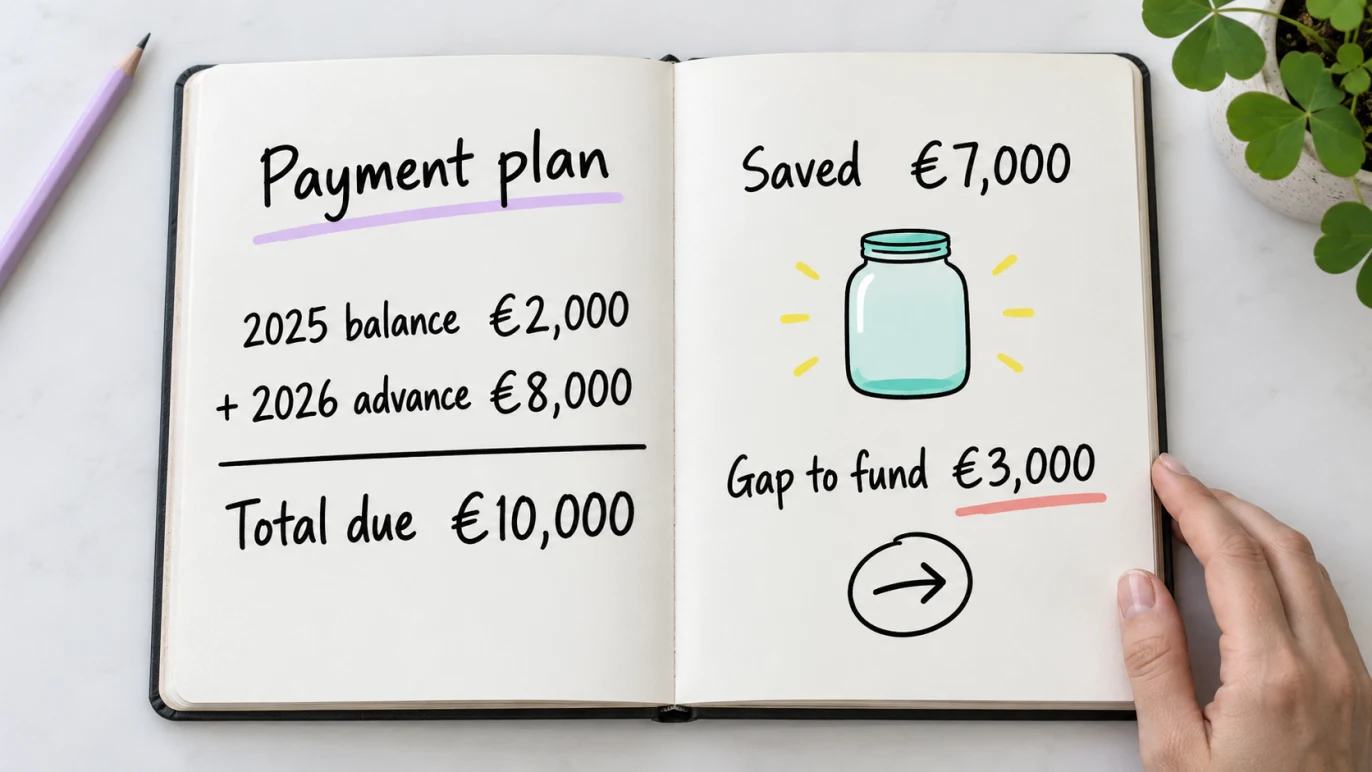
Niamh is an Irish sole-trader designer. Her final 2025 self-assessed liability is €8,000, after the relevant credits and tax deductions. She paid €6,000 preliminary tax for that year on time, using her 2024 liability as the basis, and met her earlier obligations. Her 2025 balance is therefore €2,000.
For 2026, she chooses the previous-year basis and has made no advance payments yet. Her preliminary tax is €8,000. Assume there are no other credits, offsets, interest or surcharges to include.
| Payment component | Amount |
|---|---|
Balance for 2025: €8,000 less €6,000 already paid | €2,000 |
| Preliminary tax for 2026 | €8,000 |
| Total payment to fund | €10,000 |
With €7,000 saved and available for this payment, Niamh has a €3,000 funding gap. She puts that gap into her weekly cash plan and checks which customer receipts will arrive before payment is needed. Using last year’s basis does not cap her final 2026 bill; higher profits could leave a further balance when that return is prepared.
Prepare records your accountant can follow
Give your adviser a pack that separates completed-year figures from current-year estimates:
- Accounts supporting the 2025 return: reconciled sales, expenses, bank balances and relevant year-end adjustments.
- Current trading information: 2026 accounts to date, expected work, costs and material changes for the rest of the year.
- Tax payment history: receipts and allocations showing which year each payment belongs to.
- Personal tax information: other income and evidence for relevant reliefs or credits, with questions clearly flagged.
Revenue requires business records that support the figures in a return; original documents generally need to be kept for six years. Keep the underlying invoices and receipts as well as the summary reports. Mark estimates clearly so they are not mistaken for completed transactions.
Build the cash plan from your Gimbla records
In Gimbla, complete bank reconciliation before relying on the available cash figure. Review unpaid customer invoices and supplier bills, then export the relevant profit and loss and balance sheet reports for your accountant.
Keep the owner’s personal tax payments distinct from ordinary trading costs. For a sole trader, discuss the appropriate drawings or capital account with your accountant; the equity explanation shows how owner withdrawals affect the books. A payment from the business bank account does not automatically become a deductible expense.
Use a 12-week cash budget to place the tax outflow beside wages, supplier payments, VAT and essential overheads. If you transfer money to a separate reserve account, avoid counting both that transfer and the eventual tax payment as two external outflows in a combined cash forecast.
These bookkeeping records support tax preparation. Complete the Form 11 and payment through ROS, yourself or with your adviser.
Put the plan into action this week
- Agree who will finalise the return and who will authorise payment.
- Confirm ROS access and the bank or card details you intend to use.
- Reconcile previous payments, choose the preliminary-tax basis and record the assumptions.
- Put the required cash outflow into the forecast and assign an action to any shortfall.
- After submission, retain both acknowledgements and check the bank transaction against Revenue’s records.
Once this payment is funded, review a regular reserve for the next cycle. Base it on an updated forecast and adviser input rather than applying an arbitrary percentage to every sale.
Frequently asked questions
Do I have to pay preliminary tax in my first year?
A payment may not be required if you use the previous-year basis and the relevant liability was nil. Confirm your position, particularly if you already had self-assessed income. Any unpaid first-year tax still needs funding when the return falls due.
What happens if I do not pay enough preliminary tax?
Revenue may charge interest where preliminary tax is insufficient or late. Filing the return late can also trigger a separate surcharge. If cash is short, contact your tax adviser or Revenue promptly rather than lowering the payment without a valid calculation.
How do I pay preliminary tax on ROS?
Revenue lists a ROS Debit Instruction from a bank account, or a debit or credit card, as payment options. Check the tax year and payment allocation, retain the acknowledgement, and confirm the payment clears. Completing a return alone does not complete the payment.