- Overview
- Quick answer
- Key points
- What changed in 2026
- eInvoicing is not the same as emailing a PDF
- What small suppliers should prepare
- Simple example
- What can still slow payment down
- How this affects cash-flow planning
- How Gimbla fits the workflow
- Checklist before sending a government eInvoice
- Frequently asked questions
- In short
New Zealand eInvoicing Prompt Payment: What Small Businesses Should Check
Published May 23rd, 2026 | Team Gimbla
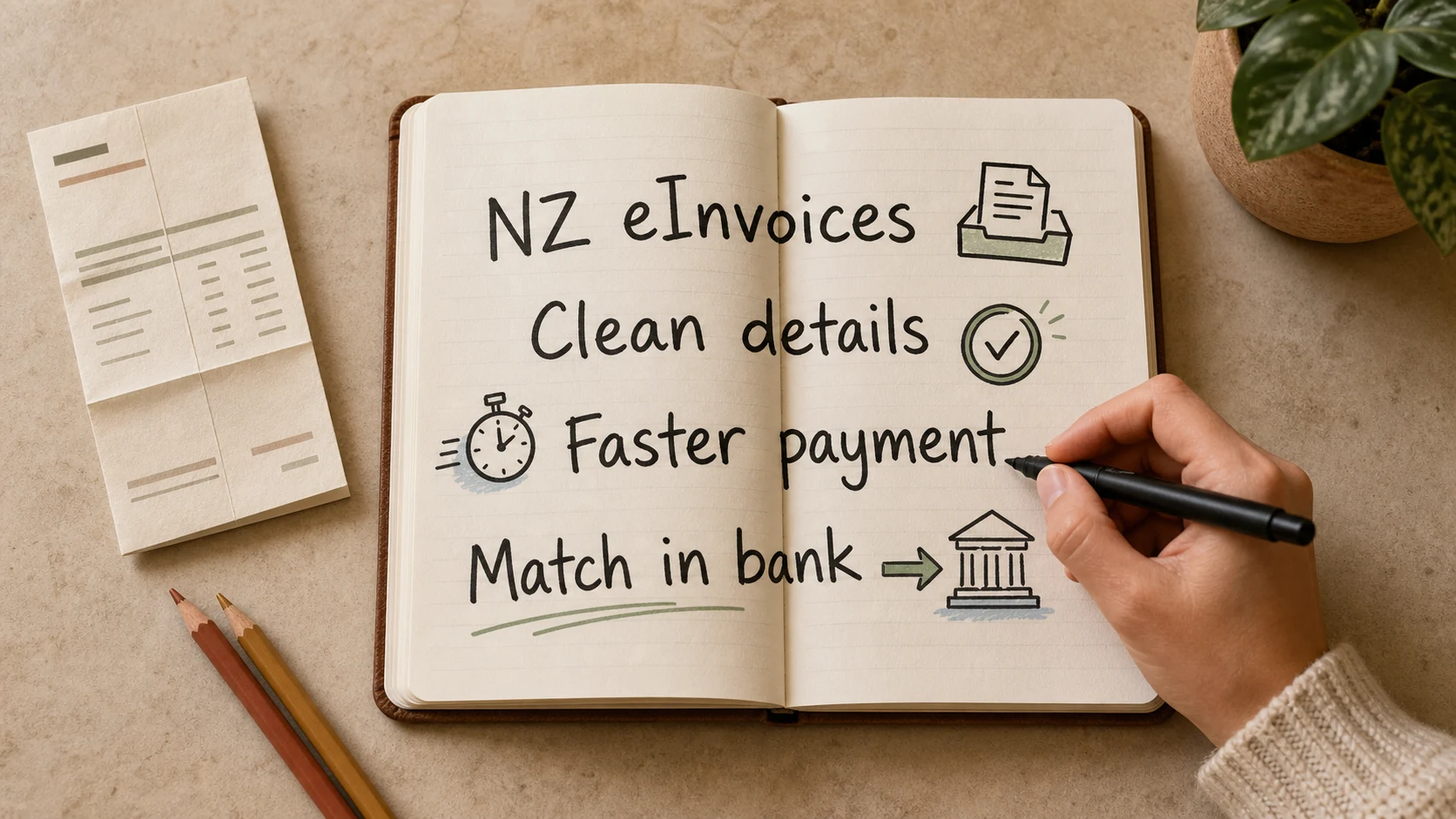
New Zealand’s eInvoicing and prompt-payment rules create a practical opportunity for small suppliers that invoice government agencies. From January 2026, mandated agencies are expected to pay 95% of eligible eInvoices within five business days, while other domestic trade invoices are expected to be paid within 10 business days. That does not mean every invoice is automatically paid in five days. It means a clean eInvoice workflow can give a supplier a faster, more traceable path through government accounts payable.
For a small business, the work is mostly ordinary bookkeeping discipline: correct buyer details, clear line items, the right GST treatment, purchase order or contact details where required, and a reconciliation process that can confirm when the payment lands.
eInvoicing helps payment speed only when the invoice data is clean enough to move through the buyer’s system without avoidable queries.
Quick answer
The Ministry of Business, Innovation and Employment says New Zealand’s government eInvoicing and prompt-payment rules took effect in January 2026. Under those rules, mandated agencies must send and receive eInvoices and pay 95% of them within five business days, while paying other domestic trade invoices within 10 days.
The official MBIE announcement frames the change as a cash-flow and efficiency measure for businesses, especially small businesses. The eInvoicing programme’s payment-times guidance explains that the payment-time clock starts when an invoice is entered into a finance system, so suppliers still need to send invoices that can be received, matched and approved cleanly.
This is a New Zealand government procurement and payment workflow. Do not treat it as the same thing as Singapore GST InvoiceNow, Ireland VAT Modernisation, Australian Peppol eInvoicing or ordinary PDF invoicing.
Key points
- The five-business-day target applies to eligible eInvoices handled by mandated New Zealand government agencies.
- eInvoicing is structured data sent through the Peppol network, not just an emailed PDF.
- Faster payment still depends on clean invoice data, buyer details, purchase order information and approval workflow.
- Small suppliers should check their NZBN, software setup and invoice fields before assuming eInvoicing will shorten cash-flow delays.
- The bookkeeping benefit is better traceability from invoice sent to payment received and bank reconciliation.
What changed in 2026
New Zealand has linked government eInvoicing capability with faster payment expectations. MBIE says mandated agencies must send and receive eInvoices, pay 95% of them within five business days and pay other domestic trade invoices within 10 days.
The practical signal for small suppliers is clear: if you invoice government customers, eInvoicing may help reduce payment friction when your customer is ready to receive eInvoices and your invoice data is complete.
| Area | What it means | What a small supplier should check |
|---|---|---|
| eInvoice capability | The invoice is sent as structured data through the Peppol network | Your software, access point or provider can send eInvoices correctly |
| Prompt-payment target | Mandated agencies are expected to pay most eligible eInvoices within five business days | The customer is a covered agency and the invoice is valid for processing |
| Domestic trade invoice scope | Other domestic trade invoices have a 10-business-day target | The invoice type is in scope and not delayed by missing details |
| Reporting | Agencies report payment times to MBIE | Suppliers should keep their own sent, accepted and paid records too |
The rule is not a substitute for invoice quality. A wrong purchase order, missing contact, unclear line item or disputed amount can still slow payment.
eInvoicing is not the same as emailing a PDF
Emailing a PDF invoice is electronic, but it is not eInvoicing in the Peppol sense. A PDF may still need someone to open it, read it, key details into a finance system, check the supplier and route it for approval.
An eInvoice sends structured invoice data between the supplier’s and buyer’s systems. That can reduce manual handling, but only if the data is useful. Supplier identity, buyer identity, invoice number, GST details, line items, references and payment details still need to be accurate.
If you are new to the term, start with the eInvoicing glossary. For the everyday accounting record underneath it, see invoice, tax invoice and the create an invoice guide.
What small suppliers should prepare
Before sending eInvoices to a government customer, check the details that usually cause payment delay:
- Confirm the buyer can receive eInvoices and ask what details they require.
- Check your New Zealand Business Number and Peppol setup with your software or eInvoicing provider.
- Use the correct legal or trading name for the buyer.
- Include purchase order, contract, project, cost centre or contact details if the buyer needs them.
- Keep line descriptions specific enough for approval.
- Check GST treatment before sending the invoice.
- Attach or retain supporting evidence where the customer or contract requires it.
- Reconcile the bank payment when it arrives and match it to the invoice.
The aim is not to make invoicing complicated. It is to remove the small errors that stop a buyer’s accounts payable team from approving the invoice quickly.
Simple example
A Wellington design studio sends a $2,400 GST-inclusive eInvoice to a government agency for a completed brochure project.
The studio checks three things before sending:
| Check | Clean version |
|---|---|
| Buyer details | Correct agency name, eInvoicing recipient and contact |
| Approval details | Purchase order and project reference included |
| Accounting details | GST amount, line description and bank account are correct |
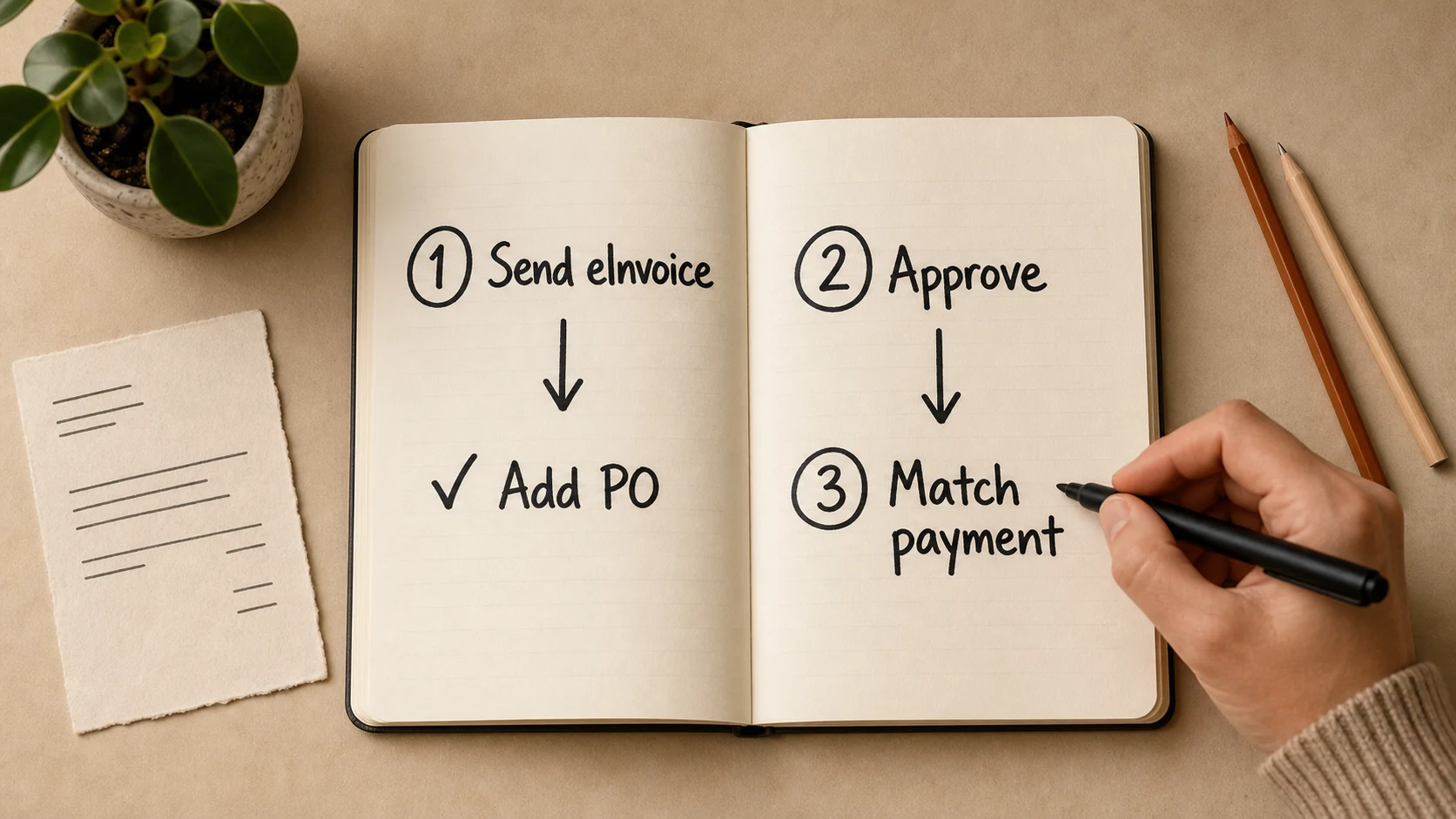
The eInvoice reaches the agency’s finance system as structured data rather than a PDF attachment. Because the purchase order and project contact are clear, the invoice can move to approval without a basic query. When payment arrives, the studio matches it to the invoice during bank reconciliation and marks the invoice paid.
What can still slow payment down
eInvoicing improves the data path, but it does not remove every approval issue. Payment can still slow down if:
- the buyer cannot match the invoice to a purchase order, contract or approved work
- the invoice is sent to the wrong recipient
- the supplier details do not match the buyer’s records
- the GST treatment or invoice total is unclear
- supporting evidence is missing
- the invoice is disputed
- the buyer’s internal approval owner is not clear
Those are bookkeeping and workflow issues, not just software issues. A small supplier should treat eInvoicing as part of the quote-to-cash process: quote, approve, deliver, invoice, follow up, receive payment and reconcile.
How this affects cash-flow planning
The useful cash-flow change is not just “payment might be faster”. It is better certainty around the invoice path.
When invoices are sent as structured data and payment-time expectations are visible, a business can track:
- which customers accept eInvoices
- when each invoice was sent
- whether the invoice has the details needed for approval
- expected payment timing
- whether the payment arrived and matched the invoice
- which customer or invoice type still causes delays
That gives a small business better evidence for follow-up and cash-flow forecasting. It also helps separate genuine late payment from internal invoicing issues that can be fixed.
For broader cash-flow habits, read Mastering Your Cash Flow and Accounts Receivable.
How Gimbla fits the workflow
Gimbla’s New Zealand accounting tools help with the everyday record trail around invoices: customers, invoice details, GST-friendly records, bank reconciliation, reports and cash-flow review. If you use a separate eInvoicing provider or access point, the accounting job is still to keep the invoice, payment and bank record aligned.
Helpful starting points include:
- New Zealand accounting software
- Free invoice generator
- Create an invoice
- Bank reconciliations
- GST, VAT and sales tax
The practical test is simple: after payment arrives, can you trace the invoice from customer request to invoice record, payment, bank reconciliation and report? If yes, eInvoicing becomes part of a cleaner accounting workflow rather than another disconnected tool.
Checklist before sending a government eInvoice
Use this quick check before relying on prompt-payment timing:
- Confirm the government customer accepts eInvoices for the work.
- Check your eInvoicing setup with your software or provider.
- Confirm the buyer’s required invoice details before sending.
- Add purchase order, contract, project or contact references where required.
- Review GST, invoice total and line descriptions.
- Keep evidence that the work was delivered or approved.
- Track when the invoice was sent and when payment arrives.
- Reconcile the bank receipt to the invoice.
- Review any delayed invoice and record the reason.
Frequently asked questions
Do New Zealand government agencies have to pay eInvoices within five business days?
Mandated agencies are expected to pay 95% of eligible eInvoices within five business days from 1 January 2026. Suppliers should still check customer requirements and make sure the invoice can be processed without missing information.
Is eInvoicing the same as emailing a PDF invoice?
No. eInvoicing sends structured invoice data between systems through the Peppol network. A PDF invoice may still be useful as supporting evidence, but it is not the same as a structured eInvoice.
Do all New Zealand businesses have to use eInvoicing?
The prompt-payment rules discussed here apply to mandated government agencies. A small business should decide whether eInvoicing is useful based on its customers, software setup and payment workflow.
What should a small supplier check before sending an eInvoice?
Check the buyer details, NZBN or Peppol setup, purchase order or contact details, GST treatment, invoice lines, attachments and bank reconciliation workflow.
In short
New Zealand’s eInvoicing prompt-payment rules are a cash-flow opportunity for small suppliers, but the speed comes from clean records as much as from the technology. If the eInvoice reaches the right buyer with the right details, it has a better chance of moving through approval quickly and landing cleanly in the bank reconciliation.