Ireland VAT Modernisation: What eInvoicing Means for Small Businesses
Published May 23rd, 2026 | Team Gimbla
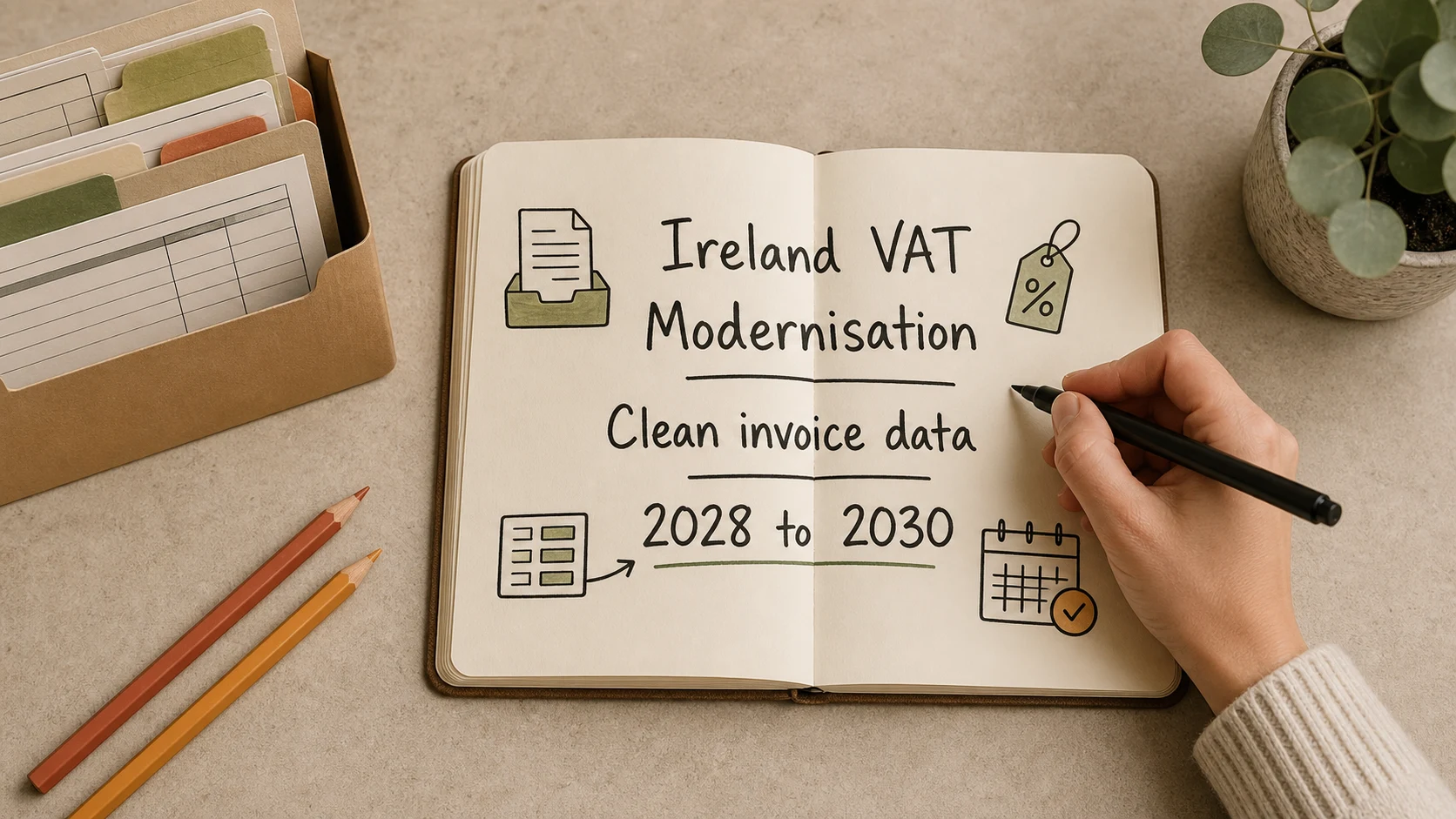
Ireland’s VAT Modernisation programme is the move toward structured eInvoicing and digital VAT reporting. For most Irish small businesses, it is not an emergency switch to flip today. The first domestic phase starts on 1 November 2028 for VAT-registered large corporates, but the direction is clear: VAT records, invoice data and software workflows need to become cleaner and more structured.
The practical move for a small business is to prepare early without pretending the detailed rules are final for every business. Check which phase may affect you, keep supplier and customer records tidy, and make sure invoices, credit notes, VAT codes and bank reconciliation can support a more digital reporting workflow.
VAT Modernisation is not just a tax deadline. It is a data-quality test for invoices, VAT codes, supplier records and the systems that hold them.
Quick answer
Ireland VAT Modernisation is Revenue’s phased move to eInvoicing and digital reporting of VAT transaction data. Revenue says the programme aligns Ireland with the EU’s VAT in the Digital Age framework and aims to reduce errors, manual work and fraud while helping businesses report the correct VAT at the correct time. The Council of the EU’s VAT in the Digital Age overview explains the broader EU package behind the cross-border timeline.
Revenue’s VAT Modernisation timeline says Phase 1 begins in November 2028 for VAT-registered large corporates, Phase 2 begins in November 2029 for VAT-registered businesses engaged in cross-border EU B2B trade under zero-rate VAT arrangements, and Phase 3 starts in July 2030 for EU ViDA cross-border B2B requirements.
Key points
- Ireland-specific VAT Modernisation is different from Singapore GST InvoiceNow, Australian Peppol eInvoicing and ordinary PDF invoicing.
- The first Irish sending obligation is aimed at VAT-registered large corporates from 1 November 2028.
- Revenue says all businesses must be able to receive and process eInvoices from suppliers who are mandated to issue them.
- An eInvoice is structured data, not just a PDF attachment.
- Small businesses should use the lead time to clean customer records, supplier records, VAT numbers, VAT codes, invoice numbers, credit notes and audit trails.
Ireland VAT Modernisation timeline
The dates matter, but so does the scope. Do not assume every Irish small business has the same obligation on the same day.
| Date | What Revenue says happens | Small business takeaway |
|---|---|---|
| 1 November 2028 | Phase 1 starts for VAT-registered large corporates issuing domestic B2B eInvoices and reporting a subset of eInvoice data to Revenue | Smaller businesses may still need to receive structured eInvoices from mandated suppliers |
| November 2029 | Phase 2 extends the domestic obligation to VAT-registered businesses engaged in cross-border EU B2B trade under zero-rate VAT arrangements | Irish exporters and EU-facing service businesses should watch this closely |
| July 2030 | EU ViDA requirements become mandatory for cross-border EU B2B transactions across member states | Businesses trading across the EU will need systems that can handle the standardised eInvoice and reporting workflow |
Revenue’s Phase One guidance also says an eInvoice must be issued, transmitted and received in a structured electronic format that allows automated processing, and must comply with the European Standard EN 16931. It explicitly excludes unstructured formats such as PDF or scanned paper.
What changes for small businesses?
If you are not a large corporate, the immediate obligation may not be to send eInvoices in 2028. The earlier pressure is likely to come from supply chains, customers, software providers and EU-facing trade.
For example, a small business might:
- receive structured eInvoices from a larger supplier
- sell to a large Irish business that wants cleaner invoice data before its own deadline
- trade with EU business customers and need to watch the 2029 and 2030 phases
- move away from PDF-only invoice workflows because structured data becomes the normal expectation
- need better evidence around VAT numbers, invoice details and tax treatment
That makes VAT Modernisation a bookkeeping-readiness project. It is about the reliability of the records before the formal filing or reporting step.
eInvoicing is not the same as emailing a PDF
This is the place many businesses get tripped up. Emailing a PDF may be electronic, but it is not necessarily eInvoicing for VAT Modernisation.
| Item | What it usually means | Why it matters |
|---|---|---|
| PDF invoice | A readable document attached to an email | Useful for people, but often still needs manual entry or scanning |
| Structured eInvoice | Invoice data sent in a standard electronic format | Easier for software to receive, validate and process |
| Digital VAT reporting | VAT transaction data reported to the tax authority | Makes tax reporting closer to the transaction workflow |
| Peppol | A network used in many eInvoicing settings | Relevant to public procurement and many eInvoicing systems, but not the whole VAT Modernisation story |
Ireland already has a public-procurement eInvoicing context. The Office of Government Procurement’s Suppliers and eInvoicing guidance says Ireland chose PEPPOL for transmitting public-procurement eInvoices and also says there is no requirement on suppliers in Ireland to send eInvoices to Irish public bodies under that public-sector model. That is separate from the newer VAT Modernisation roadmap, so keep the two concepts distinct.
Simple example
Imagine a small Irish ecommerce wholesaler that sells to retailers in Ireland and occasionally to VAT-registered customers in other EU countries. It is not a large corporate, so Phase 1 may not make it a sender on 1 November 2028.
The owner still reviews the invoice workflow in 2026 because later phases could affect EU B2B trade, and because larger suppliers may start sending structured eInvoices first.
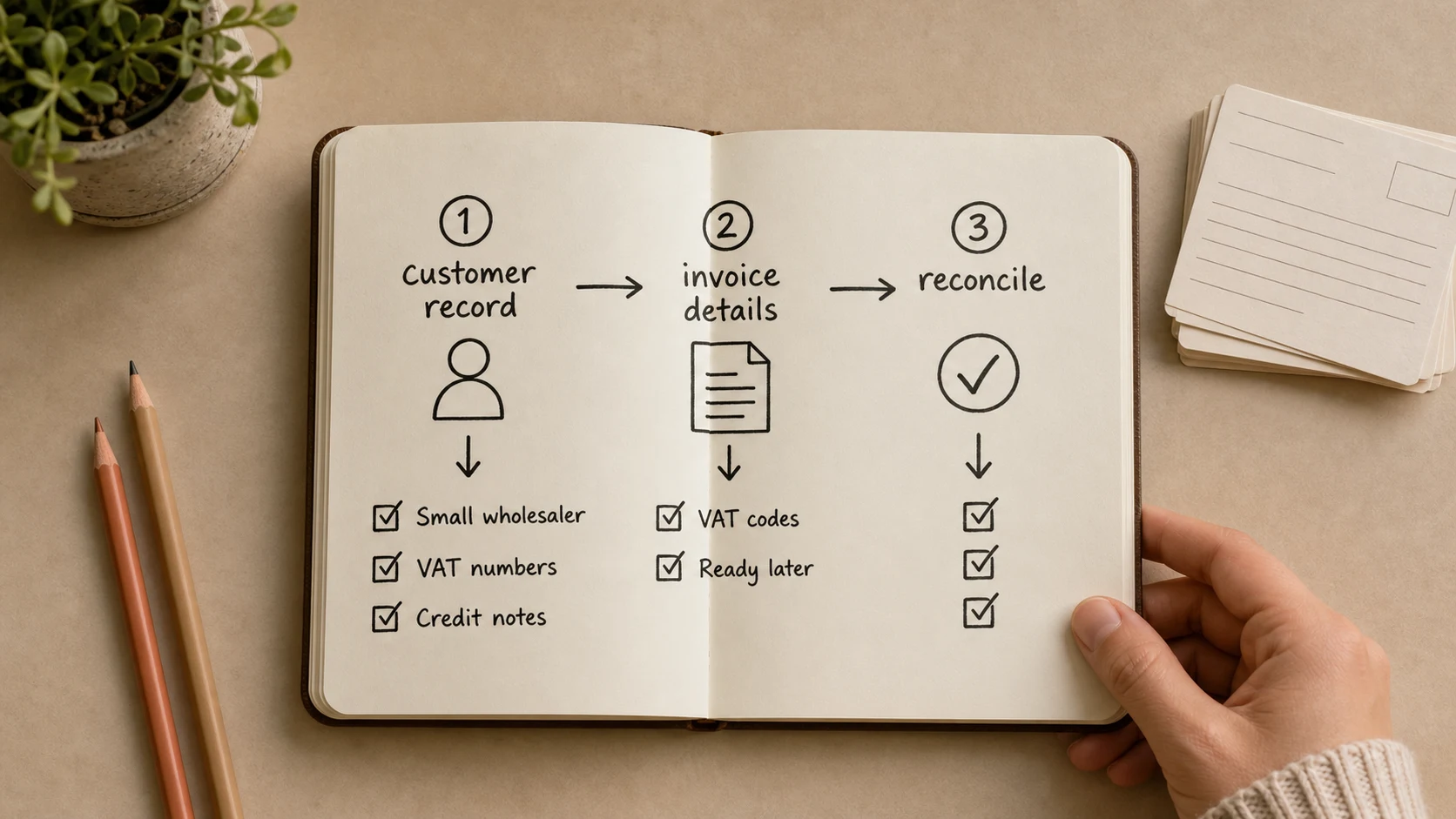
They find four weak spots:
- Customer VAT numbers are stored in notes instead of the customer record.
- Some EU customer details are incomplete.
- Credit notes are not always linked to the original invoice.
- VAT codes are reviewed only at return time.
The business does not need to solve every future technical requirement today. It does need to make invoice data cleaner now, so a future eInvoicing or digital reporting workflow has something reliable to use.
What to prepare before the deadlines
Start with the parts of your records that will be hardest to clean in a rush.
Customer and supplier records
Check names, addresses, VAT numbers, countries, contact details and payment terms. If details live in email threads or spreadsheets, move the important fields into the accounting workflow.
The VAT number guide explains how VAT numbers fit into invoices, supplier records and EU checks.
Invoice and credit note controls
Review invoice numbering, line descriptions, VAT treatment, due dates, credit notes and cancelled invoices. If adjustments are disconnected from the original invoice, structured reporting will be harder to trust.
Use invoice, tax invoice and credit note as the plain-English starting points.
VAT code review
VAT Modernisation will not make the tax treatment magically correct. The business still needs appropriate VAT codes, review controls and adviser input for unusual transactions, exports, reverse charge cases, exemptions or mixed supplies.
For broader tax setup concepts, see VAT - Value Added Tax, eInvoicing and the GST, VAT and sales tax guide.
Bank reconciliation and audit trail
Digital invoice data still has to agree with payments, receipts, bills and adjustments. Reconcile bank accounts regularly and keep an audit trail for changes.
Gimbla’s bank reconciliation guide is a useful practical checkpoint.
How Gimbla fits into the workflow
Gimbla’s free accounting software for Ireland page is written for Irish small businesses that need invoicing, expense tracking, VAT-friendly records and clear reports.
The useful habit is not waiting for a mandate. It is keeping the everyday workflow tidy:
- create invoices with clear customer, VAT and line-item details
- store VAT numbers in customer and supplier records
- record bills and credit notes close to the original transaction
- reconcile bank activity so invoice status is reliable
- review VAT reports before filing or accountant handover
- keep a clear audit trail for edits, approvals and adjustments
The create an invoice guide covers the everyday invoice workflow that sits underneath any later eInvoicing setup.
What to ask your accountant or software provider
Before the Irish rules reach your business, ask:
- which phase is most likely to affect this business?
- do we trade with EU business customers under zero-rate VAT arrangements?
- can we receive structured eInvoices from suppliers?
- where are customer and supplier VAT numbers stored?
- are credit notes and invoice adjustments linked clearly?
- does the software roadmap include Ireland VAT Modernisation support?
- what records should we keep when a VAT number or invoice detail changes?
Revenue says it will continue to engage with businesses, software providers and other stakeholders, and will publish further guidance and technical specifications. That means your plan should be practical, but not frozen too early.
FAQs
Does Ireland VAT Modernisation apply to small businesses now?
Not as an immediate sending mandate for most small businesses. The first Irish phase starts on 1 November 2028 for VAT-registered large corporates. Smaller businesses should still watch the receiving requirement, customer or supplier pressure, and the 2029 and 2030 phases for EU-facing trade.
Is an eInvoice just a PDF invoice?
No. Revenue describes an eInvoice as structured electronic invoice data that allows automated processing. A PDF or scanned paper invoice may be electronic in a loose sense, but it is not the same as a structured eInvoice for VAT Modernisation.
What should an Irish small business prepare first?
Start with invoice data quality. Review customer and supplier records, VAT numbers, VAT codes, invoice numbering, credit notes, bank reconciliation and audit trails before worrying about advanced technical settings.
In short
Ireland VAT Modernisation is a future compliance shift, but the preparation starts with ordinary bookkeeping discipline. Clean invoice data, accurate VAT records, linked credit notes and reconciled payments will make the move to structured eInvoicing much easier when the relevant phase reaches your business.