GST on Gift Cards: Recording Sales and Redemptions
Published | Team Gimbla
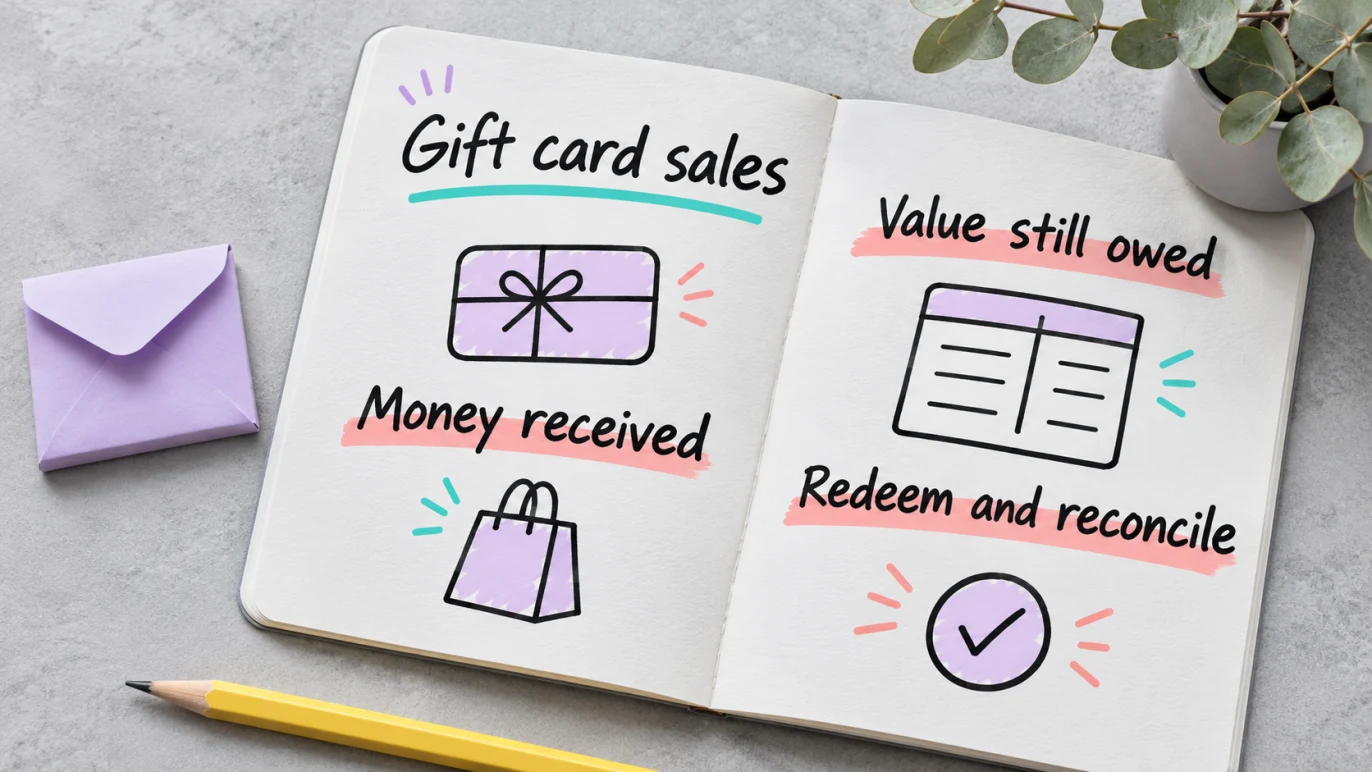
For GST-registered Australian businesses selling their own gift cards, GST generally arises when a qualifying face-value voucher is redeemed for taxable goods or services. Receiving the money also does not automatically mean you have earned revenue: under accrual accounting, the amount usually starts as a liability until you deliver what the customer buys.
Before launching November or Christmas promotions, agree how the card sale, later purchase and remaining balance will reach the books. This article covers businesses issuing their own vouchers, with a straightforward example sold at face value.
Follow each card from money received to value redeemed, then reconcile what the business still owes.
Quick answer
A paid voucher with a stated monetary value and a reasonable choice of goods or services can qualify for Division 100 treatment. When sold for no more than that value, its issue is not a taxable supply. When the customer uses it, assess GST on the actual goods or services provided.
The ATO’s voucher ruling, GSTR 2003/5, explains the conditions and exceptions. A voucher for one specified treatment, meal or other supply needs a separate assessment, even if it displays a price.
Key points
- Separate cash collected from revenue earned and GST payable.
- Keep a card register that records issues, partial redemptions and outstanding value.
- Review discounts, bonus offers and third-party arrangements before reusing standard coding.
- Investigate unused balances before releasing them to income.
Identify the voucher before choosing a tax code
The wording of the offer matters more than the name printed on the card. A $110 credit redeemable across a shop’s range differs from a certificate promising one particular service.
| Arrangement | What to establish | Bookkeeping consequence |
|---|---|---|
| Paid card redeemable up to a stated dollar value | Whether the terms meet the face-value voucher conditions | Keep issue receipts separate from the later supply and tax calculation |
| Voucher for one specified service | The actual entitlement and ordinary GST timing | Do not assume GST waits until the appointment or delivery |
| Discounted card, bonus value or free promotional voucher | What was paid, what value can be redeemed and the promotion terms | Retain both values and obtain treatment specific to the offer |
| Third-party card accepted by your business | Who issues it, who supplies the goods and how settlement works | Reconcile provider settlements and fees using that arrangement |
No GST on issue does not automatically make a card a GST-free sale. A generic zero-rate code can put the receipt into the wrong BAS category. Confirm the reporting treatment with your registered tax or BAS agent before setting up transaction templates.
Cash received and revenue earned are different
Under accrual accounting, an advance payment for goods or services generally creates a liability: the business still owes the customer something. It becomes revenue as that obligation is fulfilled. This is the practical idea behind deferred revenue.
AASB 15, paragraphs B44–B47, sets out the treatment of customer prepayments and unexercised rights for entities applying the standard. Your accountant should determine the policy appropriate to your financial statements, including any recognition of amounts customers are not expected to redeem, known as breakage.
Keep that accounting policy separate from GST and income-tax decisions. A bank receipt, a revenue entry and a BAS amount can describe different stages of the same transaction.
Simple example
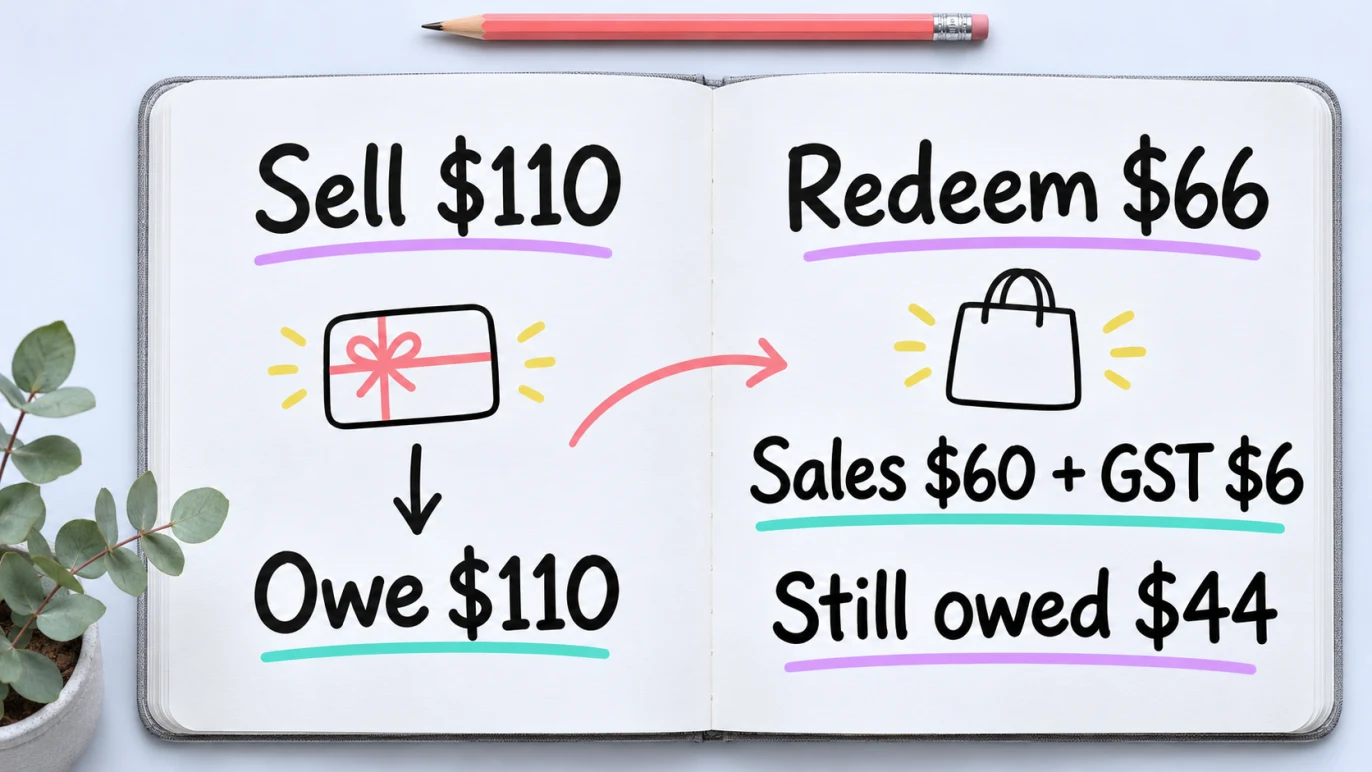
Assume a GST-registered Australian retailer sells a qualifying $110 gift card for $110 in November. It prepares accrual accounts and records the full amount as a gift-card liability. There are no fees, discounts, bonus offers, refunds or breakage adjustments.
On issue, the bookkeeping is a $110 debit to bank and a $110 credit to the gift-card liability. There is no sales revenue or GST from issuing this qualifying card.
In December, the customer uses $66 of the card to take home goods wholly taxable at 10%. The retailer reduces the liability by $66 and recognises $60 sales revenue plus $6 GST. No further money enters the bank for this purchase.
The remaining $44 stays in the card register and liability account. When the rest is redeemed, the next sale reduces that balance. Recording both the original $110 receipt and the later $66 purchase as ordinary sales would overstate revenue.
Reconcile the card register as well as the bank
A bank statement confirms money received. It cannot tell you which cards remain usable or how much customers have spent.
Keep each card’s unique reference, issue date, cash received, face value, terms, redemption dates, transaction references and remaining value. Record refunds and approved adjustments separately, with an explanation and supporting evidence.
For the straightforward at-face-value arrangement above, use this monthly bridge:
Opening liability + new cards issued − value redeemed − refunds − approved releases = closing liability.
Compare that result with the register’s outstanding balance and the general ledger. Investigate differences such as a redemption imported twice, an omitted refund or a card sale mixed into ordinary till revenue. Discounted schemes and estimated breakage need their own reconciliation rather than this simple face-value bridge.
Where a payment processor deposits a net payout, retain the gross issue receipts and fee breakdown too. Otherwise a fee can look like missing card value.
Review expiry and unused balances before releasing income
Consumer terms determine how long customers can use the card. The ACCC’s gift-card guidance says most cards purchased on or after 1 November 2019 must remain redeemable for at least three years, with expiry information displayed. Exceptions include certain discounted, promotional, reloadable and reward arrangements; check the exact conditions before relying on an exception.
An old issue date alone is not enough evidence to clear a balance. Review lawful expiry, the terms given to the customer, any extensions and your accounting policy.
There is also a GST consequence. For a paid qualifying voucher that remains partly or wholly unredeemed, writing the redemption reserve back to current income triggers an increasing adjustment under section 100-15. The adjustment is one-eleventh of the unredeemed stated monetary value. The ATO ruling also addresses businesses that do not maintain redemption reserves. Have your adviser determine the entry and BAS period before posting a release.
Bring the records into Gimbla
Use a separate gift-card liability account in your chart of accounts, with the account classification and tax treatment agreed with your accountant. Retain the detailed card register in your issuing or point-of-sale system and compare its totals with the ledger.
Match the original receipts through bank reconciliation. For redemptions, agree a sales or journal workflow that reduces the liability and records the goods supplied and their tax once. A card redemption uses money collected earlier, so creating another bank receipt would invent a cash movement.
Review the liability balance alongside the Tax Transactions report. If journals carry the sales tax, confirm their tax codes, sales-adjustment direction and reporting basis with your adviser. Gimbla’s GST reporting guide explains the tax-report review and clearing workflow.
Before the next promotion:
- Save the offer terms and confirm the voucher classification.
- Test one issue and one partial redemption through the register, ledger and tax report.
- Assign someone to reconcile outstanding cards each month.
- Keep expiry reviews and unusual adjustments for accountant approval.
Frequently asked questions
Are gift cards GST-free in Australia?
A qualifying face-value voucher is not a taxable supply when issued under Division 100. That is different from classifying it as a GST-free sale. GST on redemption depends on the goods or services supplied.
Is selling a gift card immediately revenue?
Under accrual accounting, money received for future goods or services generally starts as a liability. Revenue is recognised as the business fulfils its promise. GST and income-tax treatment need separate consideration.
Can unused gift-card balances be moved straight to profit?
Review the customer terms, lawful expiry, accounting policy and GST adjustment first. Writing an unredeemed qualifying voucher reserve back to income can trigger a GST increasing adjustment.