- Overview
- Quick answer
- Key points
- Separate the costs before choosing tax codes
- The minor benefits exemption needs more than a low price
- Gifts need their own classification
- Simple example
- Keep an event record alongside the invoices
- Record festive spending in Gimbla
- Before confirming the booking
- Frequently asked questions
Christmas Party Tax Deductions: Meals, Gifts and Guests
Published | Team Gimbla
For Australian businesses, Christmas party tax deductions depend on who attends, where the event is held and how entertainment is valued. A staff party can be exempt from fringe benefits tax (FBT) yet produce no income-tax deduction or GST credit. Separate meals, gifts and guest types before recording the costs.
As you book this year’s celebrations, give the bookkeeper more than the venue receipt. A short attendance list, itemised costs and a record of who received gifts can prevent a lengthy reconstruction at BAS or FBT review time.
An FBT exemption answers one tax question; deductions and GST credits need their own review.
Quick answer
For a commercial employer using the actual-cost method, Christmas party entertainment is generally income-tax deductible only to the extent it is subject to FBT. Exempt party costs generally carry no deduction or GST credit. Client entertainment is generally outside FBT but remains non-deductible, with no GST credit. Non-entertainment staff gifts can have a different outcome.
The ATO’s entertainment-related fringe benefits guidance explains the classifications and common scenarios. The examples here use actual costs for a commercial employer. The 50:50 split method, 12-week register method, salary-packaged benefits and tax-exempt employers need separate treatment with your adviser.
Key points
- Record employees, their partners or other associates, and clients separately.
- Keep party food and drink separate from gifts and other activities.
- Review FBT, income-tax deductibility and GST credit eligibility as three decisions.
- Retain the evidence for an exemption, even when no FBT is payable.
Separate the costs before choosing tax codes
A restaurant bill may cover several kinds of guest. A single payment can also include meals, gifts and other benefits. The payment total alone cannot establish the tax treatment.
| Keep separate | Record | Why it matters |
|---|---|---|
| Current employees | Names, meal cost, location and date | Food and drink consumed on business premises on a working day may qualify for the property exemption |
| Partners and other associates | Who attended and the benefit provided to each person | The workplace exemption for current employees does not extend automatically to their guests |
| Clients | Client attendees and their share of entertainment | Their costs need to be identified separately from employee benefits |
| Gifts | Item, recipient, value and any GST charged | A gift’s classification and exemption assessment can differ from the meal |
For off-site meals, review the employee and associate benefits for FBT unless an exemption applies. If you need to allocate a shared bill, retain the actual costs where available or a reasonable per-head calculation, with the guest count supporting it.
The minor benefits exemption needs more than a low price
A minor benefit must have a value strictly less than $300, including GST where applicable. That threshold is only the first test. The exemption also requires it to be unreasonable to treat the benefit as a fringe benefit, considering the statutory criteria.
Your review should consider frequency, the value of identical or similar benefits, associated benefits and the circumstances in which the benefit was provided. Repeated hospitality throughout the year can change the assessment of an otherwise modest function.
The ATO’s minor benefits ruling, TR 2007/12 explains that Christmas gifts and the party are assessed separately for the threshold. Associated benefits still matter when considering the other criteria. Keeping two separate records helps establish the facts; it does not create an exemption by itself.
Confirm the employer’s valuation method before using that approach. The minor benefits exemption does not reduce meal entertainment valued under the 50:50 split method.
Gifts need their own classification
A non-entertainment staff gift can generally qualify for an ordinary business deduction even where it is exempt from FBT. A gift that provides entertainment, such as theatre tickets, follows the entertainment rules instead.
Assess any input tax credit separately. The purchase must include GST and meet the normal eligibility and evidence requirements. A hamper can contain items with different GST treatment, so do not automatically divide its total by eleven.
Keep the gift receipt and recipient list together. Record what was supplied, rather than using a description such as “Christmas expenses” that gives the reviewer little to work with.
Simple example
A GST-registered Australian company holds an annual restaurant party for four employees, two partners and two clients. The meal costs $220 per person, including GST. Each employee also receives a separate non-entertainment gift costing $110, including $10 GST.
Assume the company uses the actual-cost method, the benefits are outside salary packaging, and its adviser has confirmed that the employee and partner meals and the staff gifts satisfy all minor benefits exemption criteria. Assume the gifts meet ordinary business-deduction and GST-credit requirements, with valid tax invoices held.
The cash costs are:
| Spending | Amount |
|---|---|
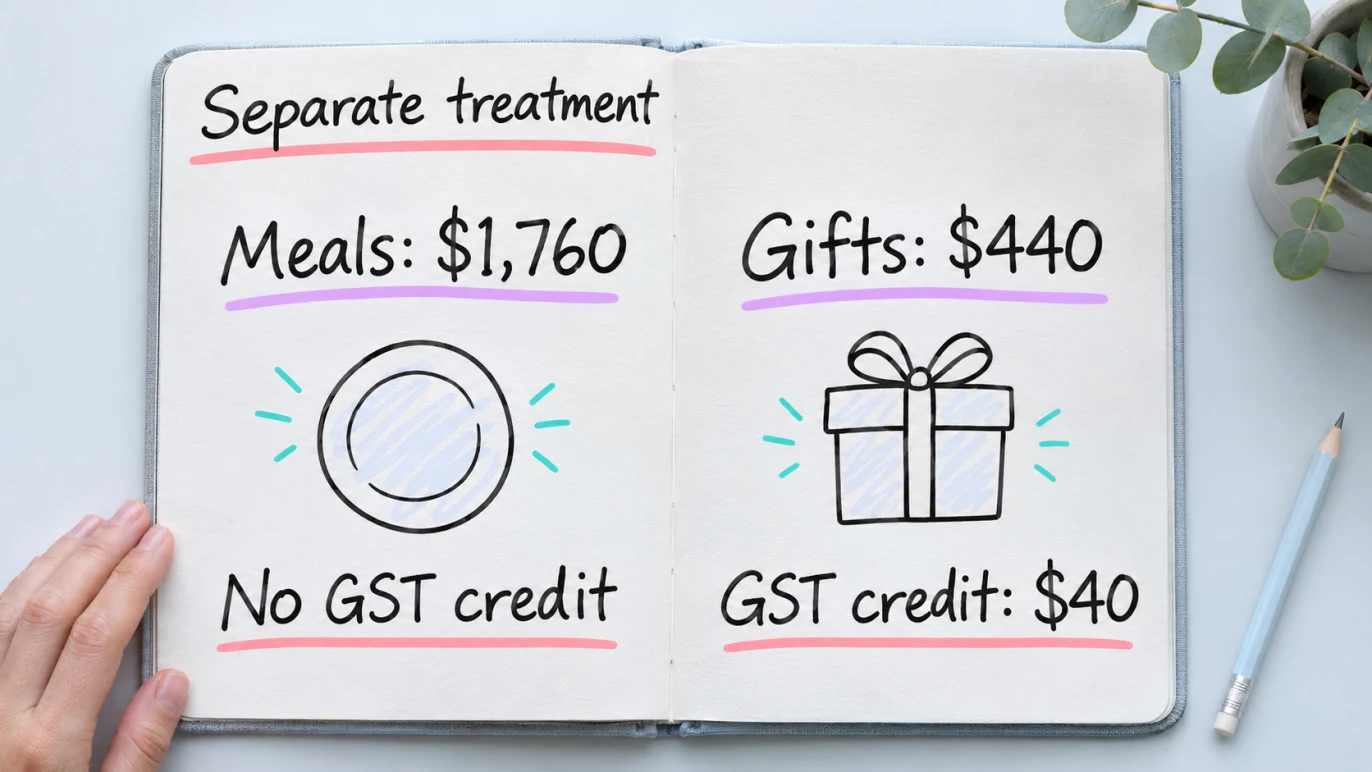
| Eight meals at $220 | $1,760 |
| Four gifts at $110 | $440 |
| Total cash paid | $2,200 |
The employee and partner meals are exempt from FBT on the stated assumptions; the client meals are outside FBT. None of the $1,760 meal cost produces an income-tax deduction or GST credit in this example.
The $440 of gifts is also exempt from FBT, but qualifies for a $40 GST credit and a $400 income-tax deduction. That deduction reduces taxable income; the tax saving depends on the company’s tax position.
Each employee received a meal and gift worth $330 in total. Assessing those separate benefits, while considering their association and the other exemption criteria, is why a single combined “cost per employee” figure is insufficient.
Keep an event record alongside the invoices
Prepare a short record containing:
- the event date, location and whether it was a working day
- attendees grouped as employees, associates and clients
- the food, drink, gifts and other benefits provided
- actual costs or the basis of any allocation
- the employer’s valuation method and exemption assessment
- supplier invoices, payment evidence and the gift recipient list.
The receipt establishes what the supplier charged. The event record explains how the business used the purchase. Both help the adviser assess FBT and document the resulting treatment.
Keep recreational activities, travel and accommodation identifiable if they are included in the booking. They may need their own assessment rather than inheriting the meal’s result.
Record festive spending in Gimbla
Use separate bill lines or accounts for costs that need different treatment. Your chart of accounts might distinguish staff entertainment, client entertainment and non-entertainment gifts, with the final structure agreed with your accountant.
If you use a bill scanner, review the proposed GST coding before posting. A scanner can read a supplier’s tax amount, but it cannot establish credit eligibility from the receipt alone. The GST invoice checks help with source-document evidence; the event facts determine the entertainment assessment.
Attach the invoices to the relevant records and retain the event schedule with the supporting workpapers. Match payments through bank reconciliation, then give the adviser a breakdown of the costs and tax treatment for BAS, income-tax and FBT review.
An expense can remain in the financial accounts even when it is not deductible for income tax. Keep that distinction visible in the year-end workpapers rather than deleting a genuine business cost to make the tax result fit.
Before confirming the booking
Ask the venue for itemised prices, confirm who is invited and decide how gifts will be recorded. Check the employer’s entertainment valuation method with the adviser before relying on an exemption estimate.
After the event, update the attendance list to reflect who actually came. Reconcile the invoices and payments, record the reason for each tax decision and pass any unresolved classifications to the adviser before claiming credits.
Frequently asked questions
Is a staff Christmas party tax deductible?
For a commercial employer using the actual-cost method, party entertainment is generally deductible only to the extent it is subject to FBT. An exempt staff party generally produces no income-tax deduction or GST credit. Other valuation methods need their own calculation.
Is the $300 FBT exemption automatic?
No. The minor-benefit value must be strictly less than $300, including GST where applicable, and the other statutory criteria must be satisfied. Frequency, similar and associated benefits, and the circumstances of provision matter.
Are Christmas gifts to staff tax deductible?
Non-entertainment staff gifts can generally qualify for an ordinary business deduction even when exempt from FBT. Entertainment gifts follow different rules. Any GST credit also depends on GST being charged and the normal credit requirements being met.