Cash vs Accrual GST: Which BAS Includes Part-Paid Invoices?
Published October 4th, 2026 | Team Gimbla
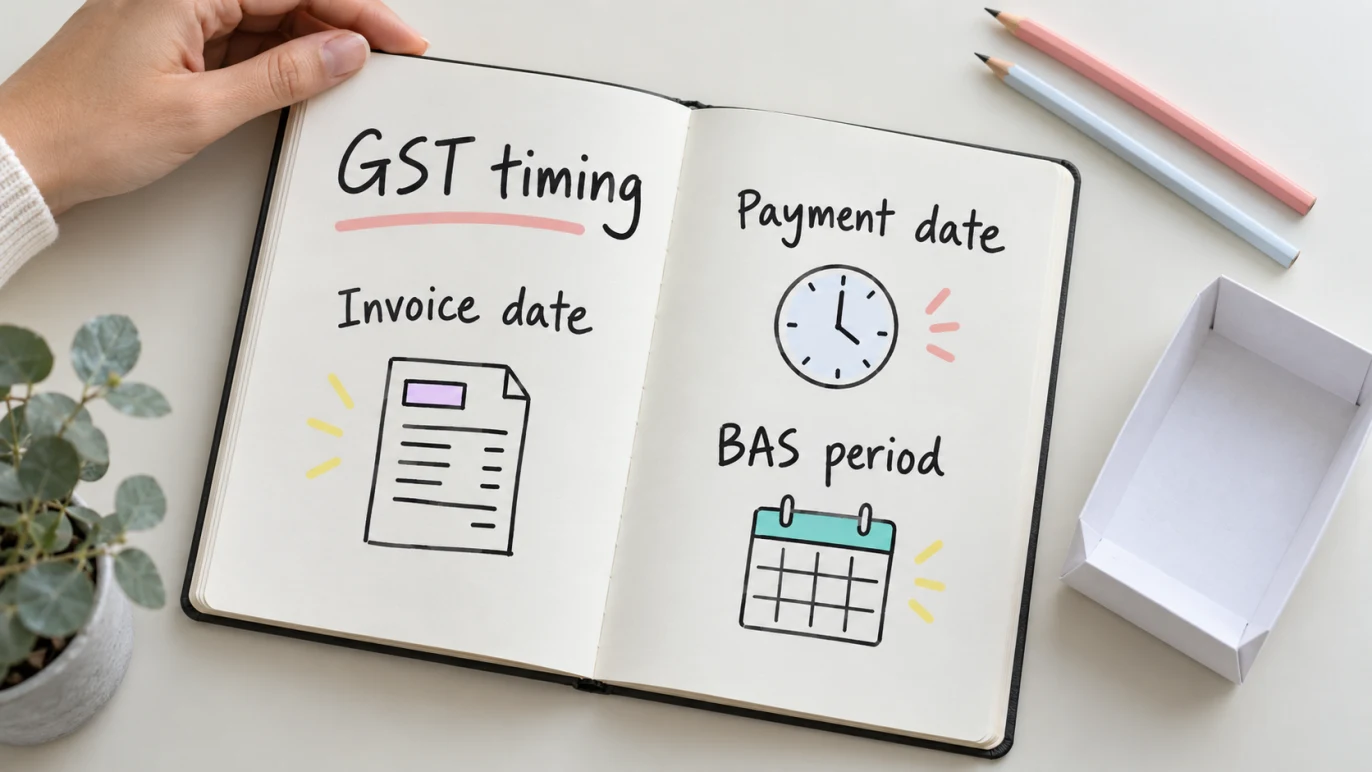
For Australian businesses, cash vs accrual GST determines which BAS includes a sale or purchase. Cash-basis GST follows payments; non-cash GST, often called accrual GST, can fall due before a customer pays the full invoice. A payment due date does not decide the reporting period.
With the September quarter finished, check invoices and bills that cross into October. Keep the original document date, each payment and the unpaid balance together, then confirm the GST method used for your BAS.
Trace each part-payment from the original invoice to the BAS period it belongs to.
Quick answer
Under the ordinary rules, cash-basis businesses report GST only to the extent payment is received and claim eligible purchase credits only to the extent payment is made. Non-cash businesses attribute the full GST on a sale to the earlier period in which an invoice is issued or any payment is received. The equivalent purchase rule uses the earlier of invoice issue or payment, subject to credit eligibility and tax-invoice requirements.
The ATO’s guidance on choosing a GST accounting method explains both methods. The comparison below concerns ordinary taxable transactions; special arrangements need separate review.
Key points
- Apply the business’s GST method consistently to sales and purchases.
- Allocate each part-payment to the correct invoice or bill.
- Keep unpaid balances visible even when they are excluded from cash-basis GST.
- Check purchase evidence before claiming an input tax credit.
- Review method changes with your adviser before altering reporting settings.
What happens at the quarter boundary?
An invoice issued near the end of a quarter may be paid in the next one. These are the consequences for a normal transaction where the invoice is issued before payment.
| Transaction at quarter-end | Cash GST | Non-cash GST |
|---|---|---|
| Customer invoice remains wholly unpaid | No GST on that sale in the quarter | Full GST in the invoice quarter |
| Customer pays only part of the invoice | GST attributable to the paid portion | Full GST; later collection does not report it again |
| Eligible supplier bill remains wholly unpaid | No credit on that purchase in the quarter | Full eligible credit, with the required tax invoice held at lodgement |
| Business pays only part of an eligible bill | Credit attributable to the paid portion, with required evidence | Full eligible credit; later payment does not claim it again |
A receipt before invoice issue also matters under the non-cash rules. Do not use invoice dates as the only filter when reviewing advance payments.
GST timing is separate from profit reporting
Accrual basis accounting recognises income when earned and expenses when incurred. A GST reporting method answers a different question: which tax period receives the GST amount?
A business can maintain accrual management accounts while reporting GST on a cash basis. Its profit and loss may therefore include a completed sale whose unpaid portion has not yet entered the BAS. Income-tax accounting also needs its own assessment.
This is why a difference between the GST report and the ledger is a starting point for reconciliation. Prepare a short bridge showing unpaid sales, unpaid purchases and relevant adjustments before assuming an entry is wrong.
Simple example
Assume a GST-registered Australian design business reports quarterly and has used the same method throughout. Both transactions below are wholly subject to 10% GST. The purchase is entirely for creditable business use, and the business holds a valid supplier tax invoice when lodging. There are no security deposits, progressive supplies or other adjustments.
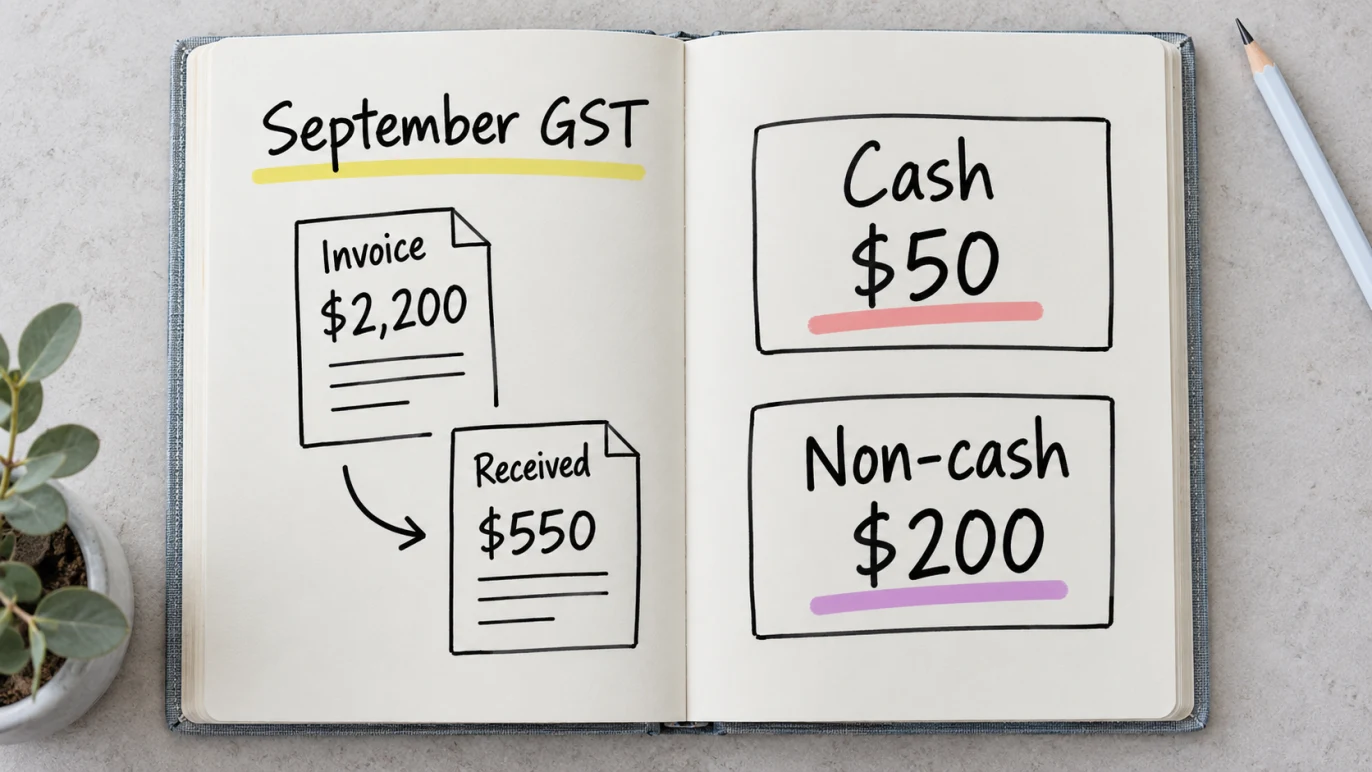
The business issues a $2,200 invoice, including $200 GST, on 25 September. It receives $550 on 28 September and the remaining $1,650 on 2 October.
It also receives a $1,100 supplier bill, including $100 GST, issued on 20 September. It pays $220 on 29 September and the remaining $880 on 3 October.
For the July–September BAS, the two methods produce these amounts:
| These two transactions only | Cash GST | Non-cash GST |
|---|---|---|
| GST on the sale | $50 | $200 |
| Less eligible purchase credit | $20 | $100 |
| Net GST contribution for the quarter | $30 | $100 |
The cash calculation is $550 ÷ 11 for sales GST, less $220 ÷ 11 for the purchase credit. In the October–December quarter, the remaining payments contribute $150 sales GST less $80 credit: $70 net GST. Under non-cash accounting, those later payments add no further GST for these transactions.
Across both quarters, each method produces $100 net GST. The difference is timing. These figures are contributions from two transactions, rather than a complete BAS calculation. Dividing by 11 works here because every amount is wholly taxable at 10%; mixed or GST-free invoices need their actual tax breakdown.
What to review before relying on the figures
Purchase eligibility and evidence. Timing alone does not create a credit. Check business use, whether GST was charged and whether the purchase supports a credit. The ATO’s GST credit guidance explains the conditions. A valid tax invoice is generally required for purchases costing more than $82.50 including GST when you lodge, rather than necessarily at quarter-end. Review missing evidence before including a claim.
Payment allocations. A bank receipt labelled with a customer’s name may still be unallocated or spread across several invoices. A supplier payment may cover multiple bills. Trace each allocation instead of dividing the entire bank transaction by 11.
Special arrangements. Genuine security deposits, progressive or periodic contracts, hire purchase and imports can have different rules. Ask your accountant to review the arrangement before applying the ordinary example. A payment labelled “deposit” does not settle its GST treatment.
Overdue balances and changes. An unpaid invoice is not automatically a bad debt. Use the separate bad debts and GST review if collection becomes doubtful. If the GST method changed, outstanding transactions need transition treatment so amounts are neither omitted nor counted twice.
Bring the review into your Gimbla workflow
Start with the original sales invoices and supplier bills. When recording a customer receipt, enter the actual date and amount received. Gimbla’s invoice payment guide shows how to edit the amount for a part-payment while leaving the remaining balance open.
Complete bank reconciliation, then compare the invoice payment history, supplier allocations and GST workpaper. Reconciliation helps confirm the money movement; the GST method determines how that movement feeds the tax period.
Run the Tax Transactions report for the relevant period and confirm its reporting basis with your bookkeeper or agent. Retain a schedule of unpaid and part-paid items to explain any difference from the ledger. The GST reporting and clearing-account guide covers reviewing tax totals and recording the subsequent payment or refund.
Before handing over the BAS figures:
- Confirm the GST method and period being reviewed.
- Resolve unmatched receipts and supplier payments.
- Review invoice issue dates and money received or paid around the boundary.
- Identify missing tax invoices and transactions needing separate advice.
- Save the reports, allocation details and reconciliation with the final workpaper.
Frequently asked questions
Who can account for GST on a cash basis?
Australian businesses with aggregated turnover below $10 million can generally choose cash accounting for GST. Other eligibility routes and ATO permissions exist, so confirm your circumstances before changing methods.
Can I use accrual accounts and cash-basis GST?
Yes. Accrual management accounts and cash-basis GST can coexist. Confirm the GST method separately from the basis used for your profit and loss and income-tax reporting.
Can I change from cash to accrual GST for the next BAS?
A change needs an effective tax period and transition treatment for outstanding invoices and bills. Ask your registered tax or BAS agent to plan it before changing software settings, so amounts are not reported twice or omitted.
For this quarter’s review, choose one part-paid customer invoice and one part-paid supplier bill. Trace each from the document to payment allocation and GST workpaper. That small review will reveal whether the method, dates and evidence are working together before you rely on the wider totals.