- Overview
- Quick answer
- Key points
- Start with the reason the invoice is unpaid
- GST relief is different from a tax deduction
- Simple example
- Keep a review record for each balance
- Avoid treating every write-off as a credit note
- Bring the review into your Gimbla workflow
- Frequently asked questions
- Before you close the quarter
Bad Debts and GST: Handling Unpaid Invoices in Australia
Published September 20th, 2026 | Team Gimbla
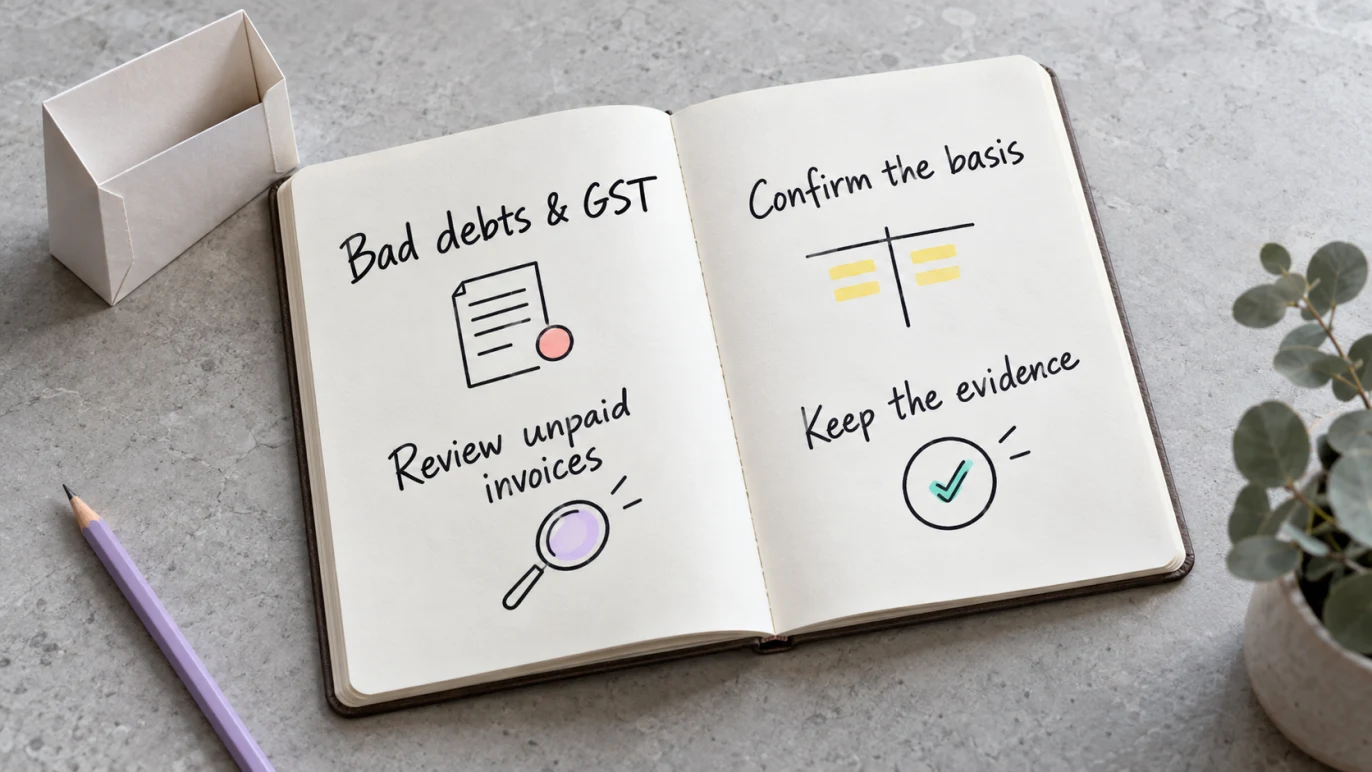
An unpaid invoice can affect GST as well as cash flow. For Australian businesses reporting GST on a non-cash basis, bad-debt rules can reduce GST previously attributed on a sale. A late payment alone does not establish that a debt is bad, and an income-tax deduction has its own conditions.
With the September 2026 quarter nearing its end, review old customer balances before preparing your next BAS. Start with the invoice, payment history and GST accounting basis. This is a useful quarter-end routine under existing rules, not a new September tax change.
Give each old invoice a documented next step: collect, correct, investigate or write off.
Quick answer
Under the ATO’s GST ruling on bad debts, a non-cash GST business has a decreasing adjustment where a taxable sale has been attributed, payment remains outstanding, and the debt is written off as bad or has been overdue for 12 months or more. For a wholly taxable sale, the adjustment is one-eleventh of the qualifying unpaid amount.
Attribute the adjustment to the period of write-off, or the period when you become aware that the overdue test is met. The latter can apply without an accounting write-off. Check whether relief has already been recorded so the same balance is not adjusted twice.
Key points
- Reconcile receipts before deciding how much a customer still owes.
- Separate collection problems from invoice errors and agreed price reductions.
- Keep GST, accounting entries and income-tax treatment distinct in your review.
- Preserve enough detail for another person to trace the decision back to the original sale.
Start with the reason the invoice is unpaid
An accounts receivable ageing report is a starting point, not a write-off instruction. Add a short explanation beside each material overdue balance.
| What you find | Practical next step |
|---|---|
| The customer paid, but the receipt is unmatched | Match the bank receipt and update the customer balance. |
| The invoice contains an error or an agreed price reduction | Resolve the sale correction and its GST treatment. |
| The customer is late but payment remains realistic | Follow up and record the expected payment date. |
| Evidence indicates the balance is uncollectible | Document the write-off decision and obtain the appropriate accounting and tax review. |
For example, a customer who has promised to pay next week needs a follow-up date. A liquidator’s advice that no distribution is expected gives you different evidence to assess. Avoid clearing both invoices simply because they appear in the same ageing bucket.
GST relief is different from a tax deduction
For ordinary trade debts, an income-tax deduction generally requires the debt to have been included in assessable income and written off as bad during the relevant income year. An allowance for doubtful debts is not the same as that specific write-off. The ATO’s guidance on unrecoverable income explains the distinction between cash and accrual income accounting.
Keep two separate questions in your workpapers: how does the business account for GST, and how does it recognise income for income tax? A cash-basis GST setting does not, by itself, answer the income-tax question. The cash vs accrual GST example shows how unpaid and part-paid invoices enter different BAS periods. Companies, trusts and unusual debt arrangements can have additional conditions, so ask your tax adviser to confirm deductibility.
The bad debt glossary explains the broader accounting concept, including the difference between an estimated loss allowance and removing a specific receivable.
Simple example
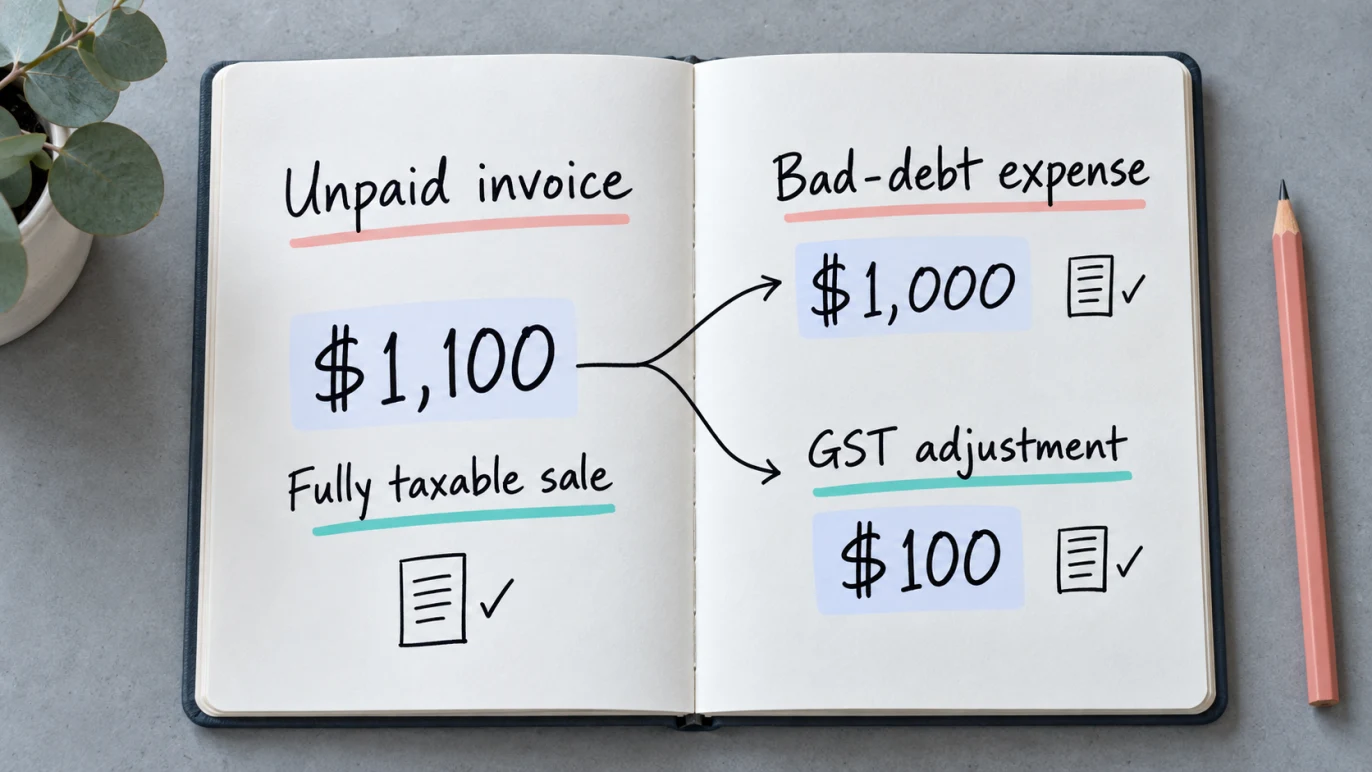
Assume an Australian design business issued a $1,100 invoice for a service fully subject to 10% GST. It uses non-cash GST accounting, already attributed the $100 GST, and has received no payment. In September, it documents that the debt is bad and writes it off. No loss allowance or earlier GST adjustment has been recorded.
The GST adjustment is $1,100 ÷ 11 = $100. The remaining $1,000 is the bad-debt expense in this simplified accounting example.
| Write-off component | Amount |
|---|---|
| Bad-debt expense | $1,000 |
| Decrease in GST payable | $100 |
| Receivable removed | $1,100 |
Conceptually, debit bad-debt expense $1,000, debit GST payable $100 and credit accounts receivable $1,100. Your software may require a specific transaction workflow to update both the customer balance and BAS report. If an allowance already exists, the expense entry changes. This example does not establish eligibility for an income-tax deduction.
Keep a review record for each balance
Use a short workpaper with these fields:
- Invoice reference and due date: identify the original sale and its payment terms.
- Remaining amount: reconcile part-payments, credits and unmatched deposits.
- Collection evidence: retain reminders, customer replies and relevant insolvency correspondence.
- Decision and approval: record what was decided, by whom and when.
- Reporting trail: note the entry reference, GST adjustment period and any separate tax-review question.
Do not backdate a decision to fit a preferred reporting period. Where a balance includes non-taxable items, part-payments or a previous adjustment, have the calculation reviewed rather than applying the example mechanically.
Avoid treating every write-off as a credit note
A credit note normally documents a correction or reduction in the customer’s charge. An uncollectible valid invoice presents a different accounting issue. Software may use similar screens for different transaction types, but the reason, account coding and tax outcome still matter.
Before entering anything, write down the result you need: which customer balance should change, which expense or allowance account should be used, and what should appear in the GST report. That makes it easier to spot an entry that clears the invoice but produces the wrong reporting result.
Bring the review into your Gimbla workflow
In Gimbla, begin with customer invoices and recorded payments. Complete bank reconciliation so an unallocated receipt is not mistaken for a loss. Use the invoice reminder workflow for balances still being pursued.
For an approved write-off, agree the posting method with your accountant or bookkeeper. After posting, compare three records: the individual customer balance, the receivables control account and the GST report. A journal that changes the general ledger without clearing the invoice can leave those records inconsistent.
Keep a before-and-after copy of the relevant reports with the workpaper. Then update the expected receipts in your cash budget, so an amount removed from receivables is not still funding next month’s planned payments.
Frequently asked questions
Do I have to wait a year before writing off a bad debt?
No. A genuinely bad debt can be written off earlier when the facts support that decision. Keep a written record of the amount, reason and date. The separate GST overdue-debt rule does not set a minimum waiting period for a genuine write-off.
Can a cash-basis business claim GST back on an unpaid invoice?
For a business that consistently accounts for GST on a cash basis, no GST has been attributed on the unpaid amount, so there is no bad-debt GST adjustment to claim. A change of accounting basis can require separate advice.
What happens if the customer pays after the write-off?
Record the recovery against the original debt trail. If you previously made a decreasing GST adjustment, an increasing adjustment applies to the recovered taxable amount. Ask your accountant to check the income-tax treatment too.
Before you close the quarter
Choose the oldest material unpaid balances and give each one an owner and a next action. Resolve unmatched receipts first, send recoverable debts back into collection, and prepare the evidence for balances needing a write-off review. Finish by checking that the customer ledger, GST report and cash forecast tell the same story.