- Overview
- Quick answer
- Key points
- What Changes, and Who Sets the Rules?
- Find the Invoices That Can Cross the Deadline
- Ask Your Provider About Existing Links
- Update Messages Without Losing the Record
- Simple example
- Can a Service Fee Replace the Surcharge?
- Reconcile the First October Settlements
- Frequently Asked Questions
Credit Card Surcharge Ban in Australia: Unpaid Invoices
Published September 9th, 2026 | Team Gimbla
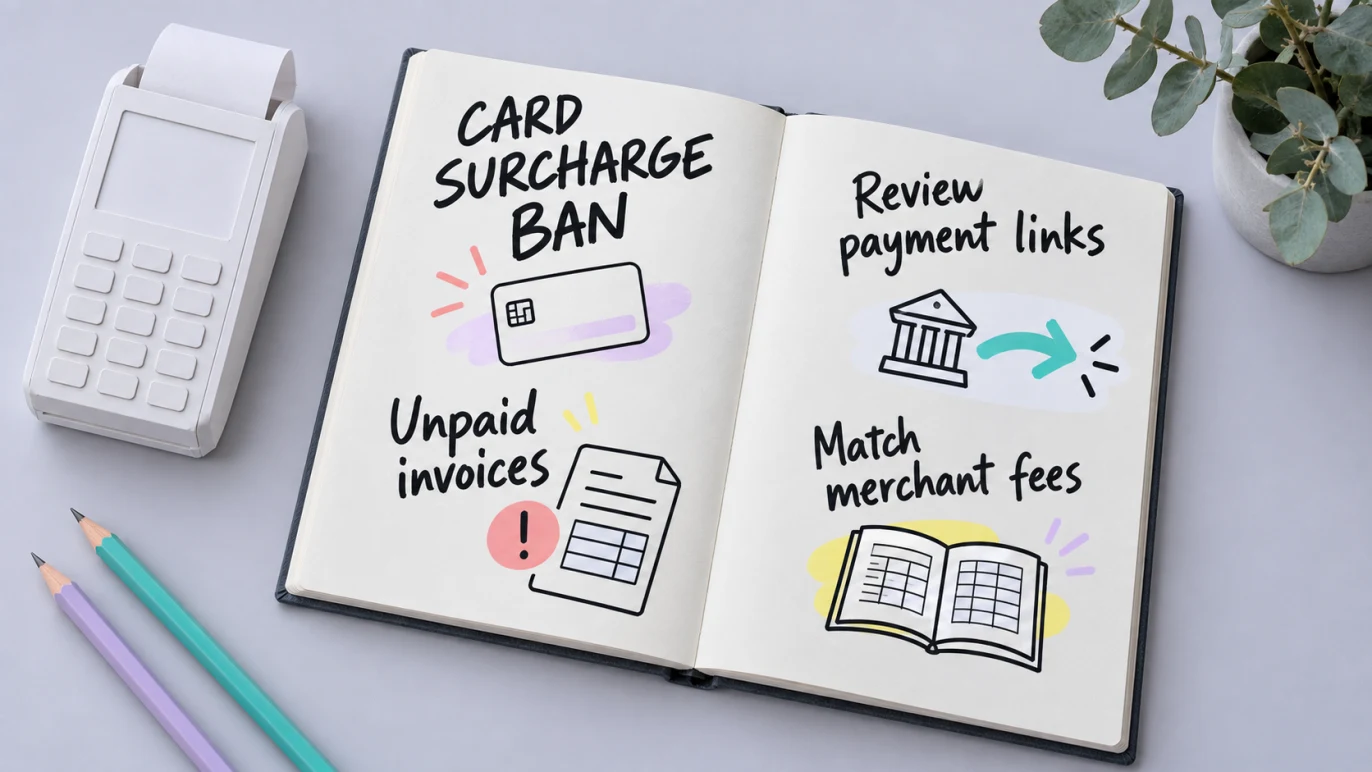
Australia’s credit card surcharge ban starts on 1 October 2026, and businesses with unpaid invoices should prepare now. The announced changes cover eftpos, Visa, Mastercard and American Express, including relevant debit and prepaid payments. Business.gov.au’s August update confirms the date and scope. Review outstanding invoices, saved payment links and automated reminders so customers paying in October see the correct amount.
An invoice sent in September can still be sitting in a customer’s inbox when the rules change. That makes the payment journey just as important as the template used for new invoices.
Check what an existing customer will actually pay in October, then reconcile the full payment separately from the provider’s processing fee.
Quick answer
An earlier invoice date does not guarantee that a later card payment can carry a surcharge. The RBA’s surcharge-removal FAQs specifically address this situation: for payments made on or after 1 October, surcharging may no longer be available even where the invoice was issued earlier. Ask your provider how its changes affect existing payment links and scheduled collections.
For broader pricing and terminal preparation, read the card surcharge changes overview. This guide focuses on invoices that remain unpaid, the customer messages attached to them and the first merchant settlements after the change.
Key points
- Review overdue invoices as well as invoices whose due dates fall in October.
- Test old payment links and recurring collection settings, not only newly created invoices.
- Keep any correction to an issued invoice traceable through your normal accounting process.
- A processing fee deducted by your provider is a business cost; it does not mean the customer underpaid.
What Changes, and Who Sets the Rules?
The ACCC’s current guidance explains that the no-surcharge requirements operate through card-network rules and merchant contracts. Networks and payment providers enforce those requirements, while consumer-law obligations about pricing and misleading claims continue.
Business.gov.au also makes clear that card processing and other payment-related costs will continue. Removing a customer surcharge does not mean the payment provider stops charging your business.
Do not assume that an invoice addressed to another business creates an exception. The RBA says business-to-business payments are not generally exempt; any exception would need support in network rules or law. Special arrangements, including taxi payments regulated by states and territories, need their own checks with the relevant provider or regulator.
Find the Invoices That Can Cross the Deadline
Start with your accounts receivable list. Filter for unpaid and partially paid invoices, then identify which customers can pay through a card link. Include older overdue invoices: their due date may have passed, but their payment can still arrive after the change.
For each collection channel, record who owns the setting, what changes are required and how you will confirm the result. A simple working list might look like this:
| Payment path | What to inspect | Evidence to save |
|---|---|---|
| September invoice paid in October | Card link, invoice footer and checkout total | Provider confirmation and a preview of the updated payment page |
| Overdue reminder | Old surcharge wording and reused links | A reviewed reminder template and its destination |
| Recurring collection | Saved fee rule and scheduled payment date | Confirmation of how existing schedules will change |
| Deposit followed by a balance payment | Remaining amount due and the later card collection | Separate records for the deposit and final payment |
Keep a copy of the settings before changing them. That gives the bookkeeper a reference if a payment collected around the transition needs investigation.
Ask Your Provider About Existing Links
The Australian Small Business and Family Enterprise Ombudsman recommends checking invoicing and online payment systems, contacting providers, updating customer information and testing the changes on 1 October.
Make the provider conversation specific:
- Will existing invoice links stop adding surcharges automatically, or must we replace them?
- Which recurring payments and third-party integrations need separate changes?
- How are delayed captures, refunds and payments around the cut-off handled?
- What will the first October settlement report show, and will our merchant pricing change?
These are questions to resolve, not assumptions about how every provider works. Keep the written response with your transition notes. If one provider updates a terminal, that does not establish what a separate invoice-payment gateway will do.
Update Messages Without Losing the Record
Remove stale surcharge statements from payment terms and invoice reminders. Check the PDF, email and checkout together: editing one does not necessarily change the others.
If an issued invoice already includes a separate surcharge amount, ask your accountant how to correct it and whether an adjustment document is needed. Preserve the original record and the reason for the change. Avoid silently changing an agreed price or deleting a transaction to make the balance disappear.
A customer message can be short and specific: identify the invoice, confirm the amount now payable and provide the reviewed payment method. Do not send a blanket message saying every invoice total has changed if only the optional card-payment add-on has been removed.
Check deposits and credits before confirming the remaining amount due. A surcharge update should not accidentally restore money the customer has already paid.
Simple example
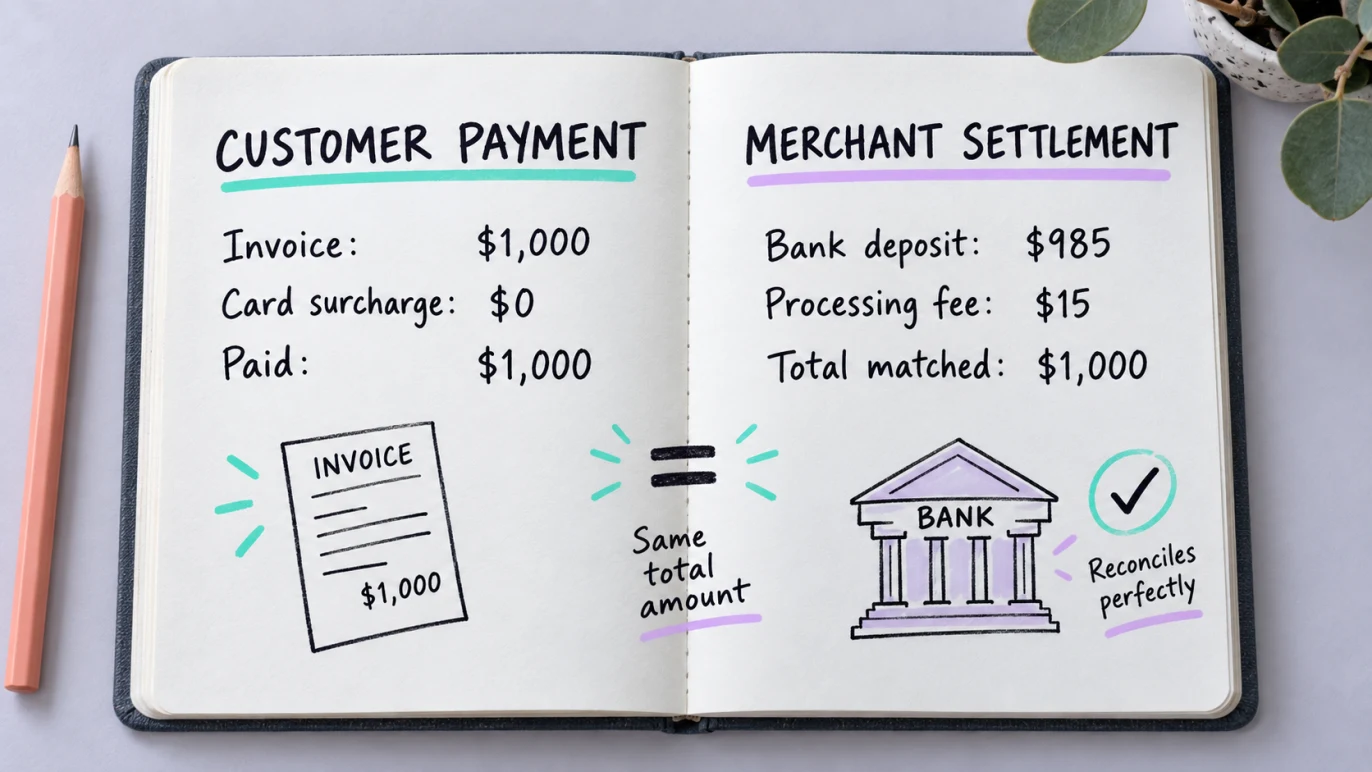
Assume a business issued a $1,000 invoice on 24 September 2026. Its old payment link would have added a card surcharge, but the invoice itself contains no surcharge line. The customer pays by card on 5 October, after the business has confirmed that surcharging is disabled for that payment.
The customer pays $1,000. For this illustration, the provider deducts a $15 processing fee and deposits $985 into the business bank account. Assume there are no refunds, reserves or other settlement adjustments.
The payment reconciliation is $985 bank deposit + $15 processing fee = $1,000 customer payment. Record the invoice as fully paid using the provider’s payment evidence, and account for the fee separately. Do not leave $15 outstanding or send the customer an overdue reminder for it.
The $15 is an illustrative fee, not a quoted provider rate or a forecast of October pricing. This example shows payment matching only; use the invoice and provider documents to determine the correct GST coding with your accountant or BAS agent.
Can a Service Fee Replace the Surcharge?
The ACCC warns against avoiding the rules by describing a card payment surcharge as another fee. A charge that exists because the customer pays by card needs scrutiny regardless of its label.
Genuine non-card-related charges, such as delivery or booking fees, are a separate matter and remain subject to pricing rules. The change also does not abolish properly disclosed hospitality weekend or public holiday surcharges. Do not use those categories as a substitute name for the removed card charge.
Reconcile the First October Settlements
When using Gimbla, keep the invoice, customer payment and merchant statement connected through clear references. The guides to mark an invoice as paid and bank reconciliations cover the core accounting tasks. Agree the clearing-account or fee-entry approach with your bookkeeper where a provider combines multiple payments into one deposit.
For the first settlements after the change, compare:
- the total customers paid against the payment-provider transaction report
- fees and adjustments against the provider’s supporting documents
- net settlements against the bank deposits
- remaining invoice balances against genuine unpaid customer amounts.
Assign someone to investigate differences before reminder emails go out. Review actual merchant costs after the transition rather than budgeting on an assumed fee reduction.
Frequently Asked Questions
When does Australia’s credit card surcharge ban start?
The announced no-surcharge rules start on 1 October 2026 for eftpos, Visa, Mastercard and American Express. The changes cover debit and prepaid payments on the relevant networks as well as credit cards.
Can a September invoice still have a card surcharge if paid in October?
Do not assume the invoice date preserves the surcharge. The RBA says surcharging may no longer be available for card payments made on or after 1 October 2026, even if the invoice was issued earlier. Check the applicable rules with your payment provider.
Are business-to-business card payments exempt?
There is no general business-to-business exemption. The RBA says an exemption would need to come from the relevant card network’s rules or from law or regulation. Confirm any claimed exception with your provider.
Can I rename a card surcharge as a service fee?
Renaming a card payment surcharge does not make it a different charge. The ACCC warns that describing a card surcharge as another fee to avoid the rules may be misleading. Genuine non-card-related fees have their own pricing requirements.