Invoice Total Amount Due: How to Add Line Items, GST and Payments
Published May 24th, 2026 | Team Gimbla
The total amount due on an invoice is the amount the customer still needs to pay. It starts with the line items, then adjusts for GST, discounts, deposits, credits and any payments already received. For a small business, the invoice total should be easy to check before it is sent and easy to match when the money arrives.
This guide focuses on the maths behind the invoice total. For Australian GST compliance, pair it with the GST invoice checklist, because tax invoices have extra rules that depend on whether the business is registered for GST and what has been supplied.
A good invoice total should answer one question without mental maths: what does the customer still owe today?
Quick Answer
Add the invoice line amounts first. That gives you the subtotal. Then apply GST where the prices are GST-exclusive, subtract any discount or credit note, subtract any deposit or payment already received, and show the remaining amount as the total amount due.
The ATO tax invoice guidance says tax invoices need enough information to identify the seller, ABN, issue date, what was sold, price, GST amount where relevant, and the extent to which each sale is taxable. Business.gov.au’s invoicing guide also explains that an invoice should tell customers how much they owe, when to pay, and how they can pay.
Key Points
- The subtotal is the sum of the invoice line items before GST, discounts, credits or payments are applied.
- If line prices are GST-exclusive, GST is usually added after the subtotal for taxable sales.
- If line prices are GST-inclusive, do not add another 10%; identify the GST component already inside the total.
- Deposits, credits and previous payments reduce the amount still due, but they should not hide the original sale value.
- The invoice should make the final payable amount obvious to the customer and useful for accounts receivable.
What Makes Up An Invoice Total
Most invoice totals are built from a small set of parts. Keep each part visible so the customer and the bookkeeper can check the calculation quickly.
| Invoice Part | What It Means | Typical Treatment |
|---|---|---|
| Line items | Goods or services sold, usually with quantity | Add each line to create the subtotal |
| Subtotal | Total before GST, discounts, credits or payments | Use as the base for GST-exclusive calculations |
| GST | Tax on taxable sales where the business is registered for GST | Add to GST-exclusive taxable sales or disclose inside GST-inclusive prices |
| Discounts or credits | Agreed reductions, returns or corrections | Subtract before showing the amount still due |
| Deposits or payments | Money already received for the invoice | Subtract from the balance still payable |
| Total amount due | What the customer still needs to pay | Show clearly near payment terms and due date |
This is not just presentation. A clear total helps later when you reconcile the bank payment, follow up overdue invoices, check GST, and explain the sale to an accountant.
Use The Right GST Basis
The first question is whether your invoice prices are GST-exclusive or GST-inclusive.
| Pricing Basis | What The Customer Sees | How To Check GST |
|---|---|---|
| GST-exclusive lines | Line prices before GST, then GST added later | Add GST to taxable lines, then calculate total |
| GST-inclusive lines | Line prices already include GST | GST is inside the total, usually one-eleventh of the GST-inclusive taxable price |
| No GST charged | Invoice does not include GST | Do not label it as a tax invoice if the business is not registered for GST |
| Mixed supplies | Taxable and non-taxable lines appear together | Separate taxable treatment so GST is not applied to every line by mistake |
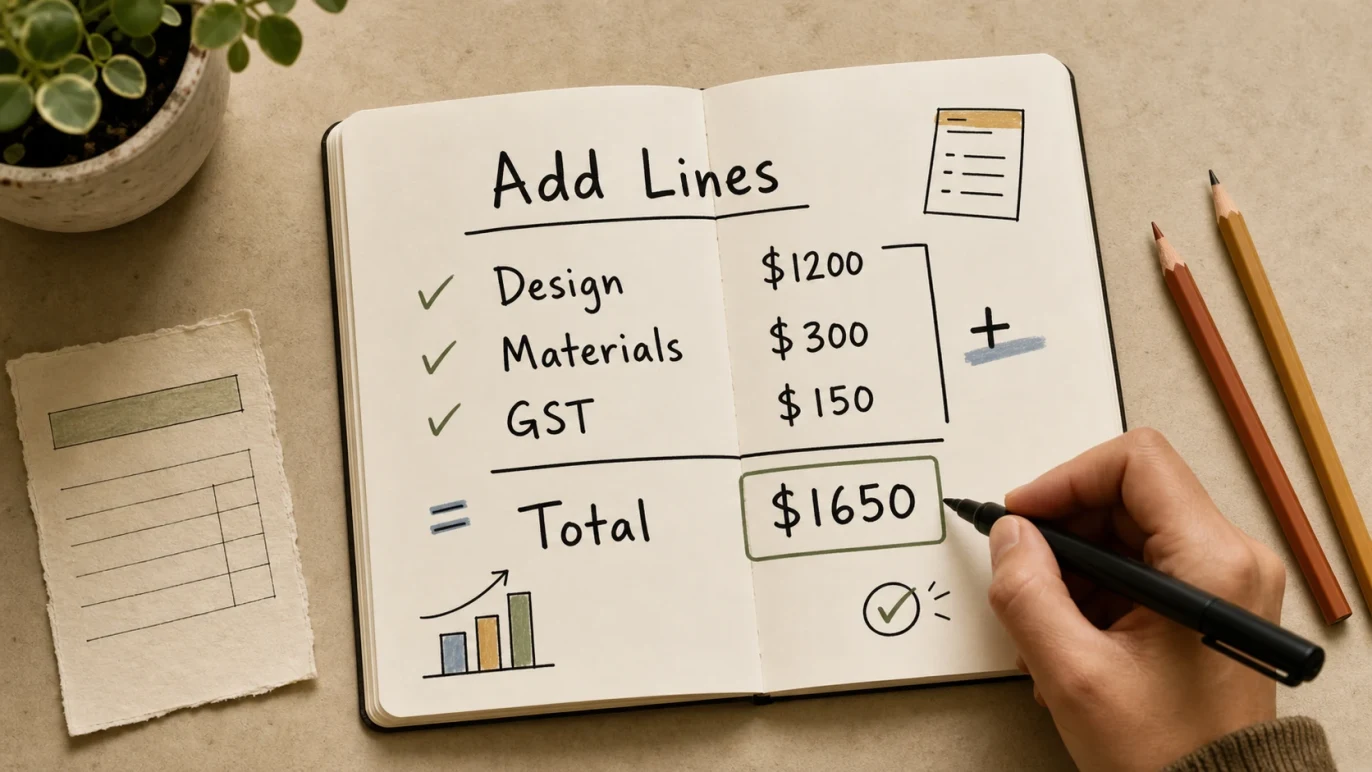
For example, if a GST-registered business lists GST-exclusive line items of $1,200 and $300, the subtotal is $1,500. GST at 10% on those taxable lines is $150, so the total before payments is $1,650.
If the same $1,650 was already GST-inclusive, you would not add another $165. You would identify the GST component inside the total. For simple fully taxable GST-inclusive pricing, the GST component is one-eleventh of the GST-inclusive price.
Simple example
A small design studio sends a GST-exclusive invoice for website update work. The invoice has two taxable lines: design work for $1,200 and materials for $300. The studio adds those two lines to get the subtotal, adds $150 GST, and shows $1,650 as the total amount due.
| Invoice Line | Calculation | Amount | |
|---|---|---|---|
| Design work | Line item | $1,200 | |
| Materials | Line item | $300 | |
| Subtotal | $1,200 + $300 | $1,500 | |
| GST on taxable sales | 10% of subtotal | $150 | |
| Total amount due | $1,650 | ||
The important part is the order. The subtotal explains the sale value before GST. The GST line explains the tax added. The total amount due tells the customer what to pay.
Add Discounts, Credits And Deposits Carefully
Some invoices are not as simple as two lines plus GST. A customer may have paid a deposit, returned part of an order, received a discount, or already made a part payment.
Use a separate adjustment section rather than changing the original sale lines until the invoice no longer explains what happened.
| Situation | Better Invoice Habit | Why It Helps |
|---|---|---|
| Upfront deposit | Show the full sale, then subtract deposit paid | Customer sees the job value and remaining balance |
| Discount | Show discount as its own line or adjustment | Makes the agreed reduction visible |
| Credit note | Link the credit note to the invoice | Keeps credit note and GST records clearer |
| Part payment | Show amount paid and remaining balance | Helps customer pay only what is still owing |
| Rounding | Keep rounding small and visible | Avoids confusion when bank payments differ by cents |
Here is a simple balance example after a deposit:
| Balance Step | Treatment | Amount | |
|---|---|---|---|
| Total invoice value | Starting balance | $1,650 | |
| Deposit already paid | Subtract payment received | -$300 | |
| Amount still due | $1,350 | ||
This keeps the invoice readable. The customer can see the original total and the amount still payable, and your accounts receivable record has a cleaner trail.
Check Tax Invoice Details Before Sending
For Australian businesses registered for GST, the invoice maths needs to sit inside a compliant tax invoice. The ATO says the information required depends on the sale amount, sale type and who issues the invoice. For sales of $1,000 or more, the buyer’s identity or ABN is also required.
Use this quick review before sending:
| Check | Why It Matters |
|---|---|
| Seller name and ABN | Identifies the business issuing the invoice |
| Invoice date and number | Helps the customer and bookkeeper track it |
| Customer details | Reduces payment and approval delays |
| Item description and quantity | Explains what was supplied |
| GST treatment | Shows taxable, GST-free or non-taxable handling |
| Total amount payable | Tells the customer what to pay |
| Due date and payment method | Supports cash flow and follow-up |
If your business is not registered for GST, do not call the document a tax invoice and do not add GST to the total. If you are unsure whether the business should be registered, check the ATO or speak with a registered tax or BAS agent.
Where The Total Connects In Gimbla
In Gimbla, the invoice total sits in the wider customer payment workflow:
- Create or select the customer.
- Add invoice line items with quantity, price and tax treatment.
- Review subtotal, GST and amount due.
- Send the invoice with clear payment terms.
- Match the payment during bank reconciliation.
- Review unpaid balances in accounts receivable.
The create an invoice guide shows where line items, tax and totals fit in the Gimbla invoice workflow. If you only need a quick customer-facing invoice before setting up the full books, the free invoice generator can help with a simple invoice format.
If a sale begins as a quote, the same maths should carry through. The quote approval guide explains how clear itemised pricing and total price wording can reduce approval delays before the invoice is created.
Common Mistakes
Adding GST Twice
If prices are already GST-inclusive, do not add another 10% to the total. Instead, show that the total includes GST or disclose the GST component where required.
Hiding The Amount Still Due
A customer should not have to subtract a deposit from a total by themselves. If money has already been paid, show the original invoice value, the payment received, and the remaining balance.
Mixing Taxable And Non-Taxable Lines
Mixed invoices need careful line treatment. Do not apply GST to every line automatically if some lines are GST-free or outside GST.
Using Vague Line Items
Line items such as “services” make the total harder to trust. Use descriptions that match the quote, purchase order, job, timesheet or delivery record.
Pre-Send Checklist
Before sending the invoice, check:
| Question | Yes |
|---|---|
| Do the line items add to the subtotal? | |
| Is GST handled on the correct basis? | |
| Are discounts, deposits and credits visible? | |
| Is the total amount due easy to find? | |
| Are payment terms and due date clear? | |
| Does the invoice match the quote or agreement? | |
| Can the bank payment be matched later? |
This check is quick, but it prevents common clean-up work. When the invoice total is clear, the customer knows what to pay, the bookkeeper knows what to reconcile, and the business has a stronger record for GST and cash flow.
FAQs
What Does Total Amount Due Mean On An Invoice?
Total amount due means the amount the customer still needs to pay. It may be the same as the invoice total, or it may be lower if a deposit, credit or part payment has already been applied.
Is GST Added Before Or After The Subtotal?
If prices are GST-exclusive, GST is added after the subtotal for taxable sales. If prices are GST-inclusive, the GST component is already inside the price and should not be added again.
Should A Deposit Reduce The Invoice Total Or The Amount Due?
A deposit usually reduces the amount still due. The invoice can still show the full sale value, then subtract the deposit so the customer understands both the total job value and the remaining balance.
Does Every Australian Invoice Need To Show GST?
No. GST details apply when the business is registered for GST and is issuing a tax invoice for taxable sales. A non-GST-registered business should issue a regular invoice and should not charge GST.