- Overview
- Quick Answer
- Key Points
- What Is Changing From 1 October 2026?
- What Still Applies Before October 2026?
- What Small Businesses Should Do Now
- How To Think About Pricing After Surcharges End
- Update Invoices And Payment Terms
- Keep The Bookkeeping Clean
- A Practical October 2026 Checklist
- Frequently Asked Questions
- In Short
Card Surcharge Changes in Australia: What Small Businesses Should Do Before October 2026
Published May 22nd, 2026 | Updated September 9th, 2026 | Team Gimbla
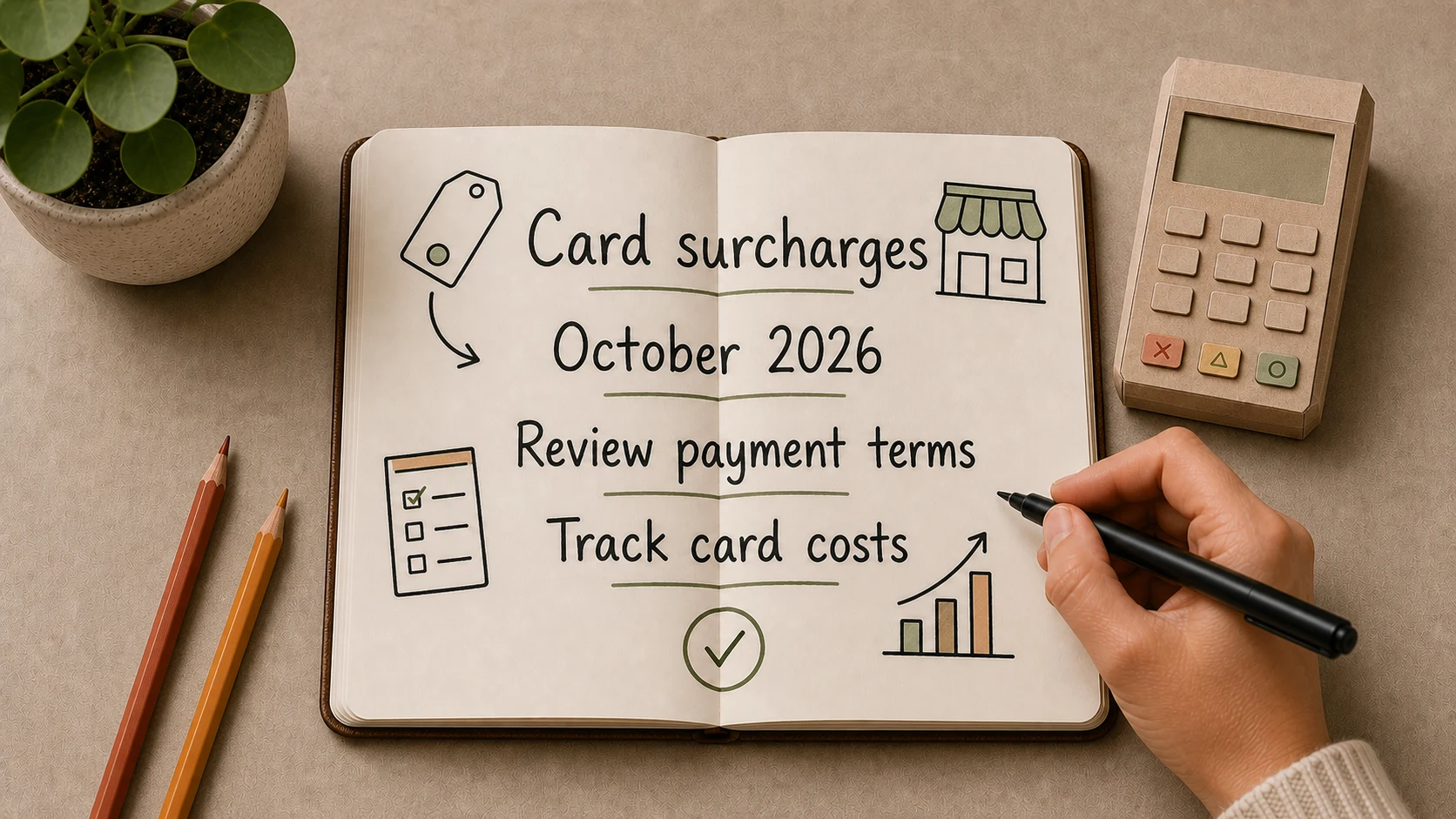
Australia’s card surcharge rules change on 1 October 2026. The RBA’s current FAQs confirm that eftpos, Mastercard, Visa and American Express have decided to introduce no-surcharge rules. Relevant debit and prepaid payments are included as well as credit cards. Payment costs will still exist, so businesses need to review how they recover and record them.
For invoices that may be paid after the change, the unpaid-invoice surcharge guide explains how to review old payment links and reconcile merchant settlements.
This is not just a checkout problem. It affects pricing, invoice wording, payment terms, accounting records, bank reconciliation and the way you explain payment costs to customers.
Card surcharges are moving from a customer-facing add-on to an internal business cost that needs to be priced, reviewed and reconciled like any other operating cost.
Quick Answer
From 1 October 2026, eftpos, Mastercard, Visa and American Express are introducing no-surcharge rules. Businesses must still follow current surcharging laws until the changes take effect. Check the applicable network rules and provider instructions for your payment arrangements.
For now, a small business that charges card surcharges should keep them no higher than the actual cost of accepting that payment type, disclose them clearly and avoid misleading customers about the final price. Before October 2026, review your merchant fees, invoice wording, checkout settings, price displays and accounting treatment so card costs do not become messy after the rule change.
Key Points
- The October 2026 change covers eftpos, Mastercard, Visa and American Express, including relevant debit and prepaid payments as well as credit cards.
- Card payment costs will not disappear; businesses need to decide whether to absorb them, adjust prices or offer discounts for lower-cost methods.
- Until the change takes effect, existing excessive surcharge rules still apply.
- Invoice and website wording should be reviewed before October 2026 so customers are not shown outdated surcharge messages.
- Accounting records should separate sales, card fees, merchant deposits and reconciliation differences clearly.
What Is Changing From 1 October 2026?
The RBA’s March 2026 card payments review concluded that surcharging on debit and credit cards should end from 1 October 2026. It also says maximum interchange fees for debit and consumer credit card payments will be lowered, and payment cost transparency will improve so businesses can compare providers more easily.
The ACCC’s card surcharge guidance explains the transition in practical terms: eftpos, Mastercard and Visa can ban businesses from applying card payment surcharges from 1 October 2026, and businesses must still comply with existing laws until then.
That difference matters. The change is not a reason to stop checking today’s surcharges. It is a reason to prepare before old pricing, invoice and checkout settings become stale.
What Still Applies Before October 2026?
Until the new arrangements take effect, Australian businesses that surcharge need to follow the current excessive surcharge rules.
The ACCC says a card surcharge must not be more than what it costs the business to process that payment type. It also explains that if a business charges the same surcharge across card types, the surcharge must not be higher than the lowest cost among those card types.
For a small business, the practical controls are:
- Check the merchant statement, not a rough guess.
- Separate debit, credit and other payment costs where your provider reports them.
- Make sure any flat fee does not overcharge small transactions.
- Show surcharges clearly before the customer pays.
- Keep evidence of how the surcharge was calculated.
If a customer has no way to pay without a surcharge, the ACCC says the minimum surcharge payable generally needs to be included in the displayed price. That is easy to miss in online checkout flows, booking systems and card-only venues.
What Small Businesses Should Do Now
Use September as a clean-up window. The worst approach is waiting until the week before 1 October 2026 and then trying to untangle checkout settings, invoice templates and merchant fees in a rush.
| Area to review | What to check | Why it matters |
|---|---|---|
| Merchant statements | Card fees, provider fees, terminal fees and settlement timing | Shows the cost that may need to be absorbed or priced differently |
| Checkout settings | Card surcharge rules, payment method labels and gateway defaults | Prevents outdated surcharges from appearing after the change |
| Invoice templates | Payment instructions, card fee wording and accepted methods | Keeps invoices clear and avoids stale surcharge text |
| Website pricing | Displayed prices, booking fees, card-only flows and add-ons | Helps customers see the real amount before they pay |
| Accounting records | Merchant fees, net deposits, gross sales and refunds | Keeps bank reconciliation and reports clean |
| Customer communication | Quotes, terms, emails and payment reminders | Reduces confusion when surcharge wording changes |
This review is also a chance to shop around. The RBA says new transparency measures should help businesses compare payment costs. If your card fees are high, do not simply bake them into prices without first checking whether a better payment plan, bank, acquirer or gateway is available.
How To Think About Pricing After Surcharges End
When surcharging ends, the cost of accepting card payments becomes more like rent, software, insurance or bank fees. It is still a business cost, but it may no longer appear as a separate card surcharge to the customer.
Small businesses have a few options:
- Absorb the cost if card fees are small and margins can handle it.
- Adjust prices modestly if card costs are material and most customers pay by card.
- Offer discounts for lower-cost payment methods, where appropriate and clearly explained.
- Review providers if current merchant fees are higher than comparable options.
- Change payment workflows if one channel creates unnecessary processing costs.
Do not make the decision from one transaction fee alone. Look at the whole pattern: average sale value, card mix, refund rates, online versus in-person payments, settlement timing, chargebacks and monthly terminal or gateway costs.
Update Invoices And Payment Terms
Payment terms should tell customers how and when to pay. Business.gov.au’s payment terms guidance says payment terms should explain accepted payment methods, when payment is expected, whether credit is offered and how overdue payments are collected.
Before October 2026, review:
- invoice footer wording that says “card surcharges apply”
- quote templates that mention payment fees
- website checkout notes
- booking pages and online forms
- payment reminder emails
- customer contracts or terms of trade
- point-of-sale signage
If your business invoices customers in Gimbla, keep the payment instructions simple: accepted methods, due date, bank details or payment link, and any terms that still apply. If your current process depends on a card surcharge line, plan what will replace it before the rule changes.
Keep The Bookkeeping Clean
Card surcharge changes can make reports messy if the accounting setup is unclear.
For example, card sales may settle into the bank account after merchant fees have been deducted. If the business records only the net deposit, sales may be understated. If it records gross sales but ignores merchant fees, bank reconciliation may not match.
The cleaner approach is usually:
- Record the customer sale or invoice at the gross amount charged.
- Record merchant or payment processing fees separately as an expense.
- Match card deposits during bank reconciliation.
- Review refunds, chargebacks and partial payments separately.
- Check GST treatment with your accountant or BAS agent if payment fee handling is unclear.
Gimbla can help keep invoices, receipts, payments and bank reconciliation in the same workflow. The related guides to create an invoice, mark an invoice as paid and manage invoice reminders are useful starting points.
A Practical October 2026 Checklist
Use this checklist before the new surcharge settings start.
- Download recent merchant statements and identify card payment costs.
- Ask your provider what changes they will make before 1 October 2026.
- Remove or rewrite outdated card surcharge wording from invoice templates.
- Check checkout, booking, ecommerce and payment-link settings.
- Review displayed prices where card payment is the normal or only payment method.
- Decide whether prices, discounts or payment options need to change.
- Update bookkeeping categories for merchant fees and payment processing costs.
- Train staff who quote, invoice, collect payment or answer customer questions.
- Reconcile card deposits after the change to catch unexpected fee treatment.
Keep the checklist practical. The aim is not to overcomplicate payments. It is to avoid a stale surcharge setting creating customer confusion or messy books.
Frequently Asked Questions
When Do Card Surcharge Changes Start In Australia?
The announced no-surcharge rules start on 1 October 2026 for eftpos, Mastercard, Visa and American Express. Relevant debit and prepaid payments are included as well as credit cards. Some other payment-cost transparency changes are scheduled later, including parts that take effect from 1 April 2027.
Can Businesses Still Surcharge Before 1 October 2026?
Yes, but the existing rules still apply. A surcharge must not be more than the business’s cost of accepting that payment type, and pricing must not mislead customers about the final amount payable.
Does This Mean Card Payments Are Free For Businesses?
No. Businesses may still pay merchant fees, gateway fees, terminal fees or other payment processing costs. The key change is that card surcharges on the affected networks are being removed, so those costs need to be managed inside pricing and accounting.
Should I Increase Prices Now?
Not automatically. First review your actual payment costs, margins, customer payment mix and provider options. Some businesses may absorb the cost, some may adjust prices, and some may offer discounts for lower-cost payment methods.
In Short
The card surcharge change is a pricing and bookkeeping transition, not just a payment terminal update. Before 1 October 2026, check your current surcharge compliance, review merchant costs, update payment terms, remove stale invoice wording and make sure card fees are recorded cleanly in the books.
If you do that early, the rule change becomes a tidy admin project instead of a last-minute checkout surprise.