- Overview
- Quick answer
- Key points
- Budget vs forecast: the practical difference
- Why a small business needs both
- Budget, actual and forecast work as a cycle
- Profit forecast is not the same as a cash flow forecast
- Simple example
- What to do when the forecast moves away from budget
- Common budgeting and forecasting mistakes
- How Gimbla fits the workflow
- A monthly budgeting and forecasting routine
- Frequently asked questions
- In short
Budget vs Forecast: How Small Businesses Use Both
Published August 15th, 2026 | Team Gimbla
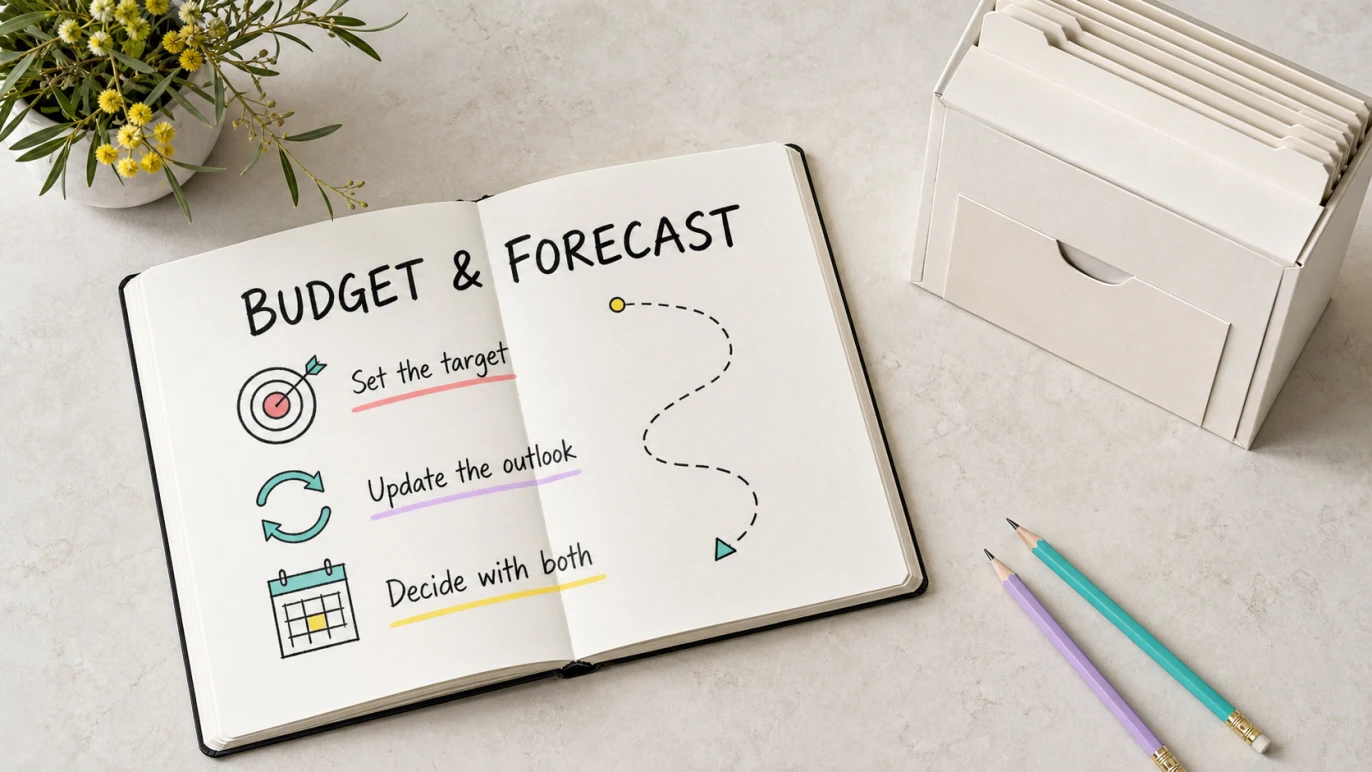
A budget sets the financial result your small business wants to achieve. A forecast updates what is now likely to happen using actual results and newer information. Keep both views: the budget as the target and the forecast as the latest outlook.
For an Australian small business, this can be a simple management rhythm rather than a complex finance exercise. Set an annual budget, compare it with reliable actuals each month, update the remaining months and check cash timing before making a commitment.
A budget tells you where you intended to go. A forecast tells you where the current path is taking you.
Quick answer
The practical difference between a budget and a forecast is purpose. A budget sets goals, priorities and limits for a future period. A forecast estimates the result now expected after considering actual performance, current trends and known changes.
The Australian Government’s budget guidance makes the same distinction: use the budget to track the plan and the forecast to respond to change. For many small businesses, one approved annual budget and a forecast updated monthly or quarterly is enough.
Key points
- Keep the approved budget visible so targets and accountability do not move every month.
- Update the forecast when actual sales, costs, payment timing or business decisions change the outlook.
- Use budget versus actual to explain performance, then use the forecast to decide what happens next.
- Forecast profit and cash separately because a profitable period can still have a cash shortfall.
- Spend more time on assumptions and actions than on building a complicated model.
Budget vs forecast: the practical difference
Budgets and forecasts often contain similar lines, but they answer different questions.
| Comparison | Budget | Forecast |
|---|---|---|
| Main question | What do we want to achieve? | What is now likely to happen? |
| Main inputs | Goals, past results, planned activity and assumptions | Actual results, current trends, known commitments and revised assumptions |
| Typical timing | Prepared before the period, often for a financial year | Updated during the period, often monthly or quarterly |
| Best use | Targets, resource allocation, cost limits and accountability | Cash planning, expected results, scenarios and near-term decisions |
| When conditions change | Keep the approved baseline visible, even if you formally re-budget | Revise the latest estimate and document why it changed |
A Budget does not need to predict the year perfectly. Its value is giving the business a clear target and a reference point. A forecast is deliberately more flexible. It should change when the evidence changes.
Why a small business needs both
Using only a budget can leave an owner managing against assumptions that are already out of date. Using only a forecast can make the target drift whenever performance becomes uncomfortable.
Together, the two views support different decisions:
- Set priorities: the budget decides how much the business intends to earn, spend, save or invest.
- Spot pressure: the forecast shows whether current sales, margin, overheads and cash timing still support that plan.
- Act early: the gap between budget and forecast can prompt a pricing review, sales follow-up, roster change or delayed purchase.
- Learn for next year: repeated forecast changes reveal which assumptions need better evidence in the next budget.
Business Queensland’s budgets and forecasts guidance recommends updating forecasts as actual sales and costs become available while retaining the original budget as the comparison point.
Budget, actual and forecast work as a cycle
These are three connected views, not competing reports:
- Budget: sets the original target.
- Actual: records what happened in the accounts.
- Variance: explains the gap between actual and budget.
- Forecast: updates the expected result for the remaining period.
- Action: changes a decision, assumption or operating plan.
The budget-versus-actual Profit and Loss guide explains how to investigate a variance. The extra step here is carrying that evidence forward. If lower sales are a timing delay, the forecast may move revenue into a later month. If demand has weakened, the full-year forecast may need to come down.
Profit forecast is not the same as a cash flow forecast
A profit forecast estimates future revenue, expenses and profit. A Cash Flow Forecast estimates when money is likely to enter and leave the bank.
The distinction matters because invoices can create revenue before customers pay, supplier costs can be recorded before payment, and loan repayments or equipment purchases affect cash differently from profit. A business may forecast a profit and still be short of cash when wages, rent, tax or supplier bills fall due.
Use a Profit and Loss budget and forecast to assess performance. Use a cash forecast to test whether the timing of receipts and payments is affordable.
Simple example
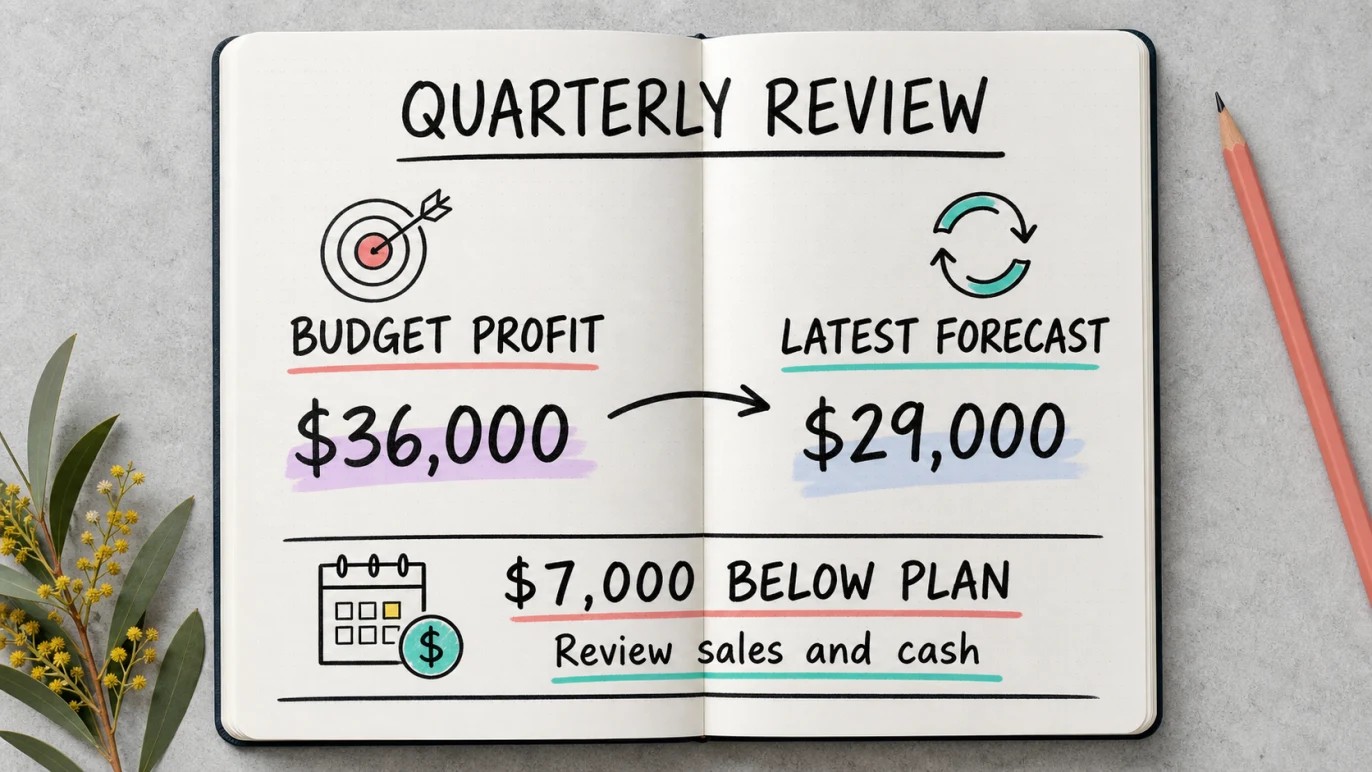
A small design studio sets a quarterly budget of $90,000 in sales, $30,000 in direct costs and $24,000 in operating expenses. Its target net profit is $36,000.
After the first month, actual sales are below plan and several proposals have moved later. The owner updates the expected result for the full quarter without changing the original budget.
| Quarterly Profit And Loss Line | Budget | Latest Forecast | Difference |
|---|---|---|---|
| Sales | $90,000 | $82,000 | -$8,000 |
| Direct costs | $30,000 | $29,000 | -$1,000 |
| Operating expenses | $24,000 | $24,000 | $0 |
| Net profit | $36,000 | $29,000 | -$7,000 |
The latest forecast is $7,000 below the budgeted profit. That is not a reason to erase the target or cut every expense. The owner first separates delayed work from lost work, checks whether direct costs will fall with sales and updates the cash forecast for slower customer receipts.
The decision may be to follow up proposals, protect gross margin, delay a non-essential equipment purchase and review the outlook again next month. The budget still shows the target; the forecast makes the present decision clearer.
What to do when the forecast moves away from budget
Treat a budget-to-forecast gap as a decision prompt. Work through it in this order:
- Check the actuals. Reconcile the bank and confirm invoices, bills, payroll and adjustments are complete.
- Name the driver. Separate price, sales volume, timing, customer mix, direct cost, overhead and bookkeeping causes.
- Decide whether it is temporary. A delayed project needs a different response from a permanently lost customer.
- Update the remaining periods. Change only the assumptions affected by the new evidence.
- Test cash. Move expected receipts and payments to realistic dates before committing to spending.
- Choose one action and owner. Record who will act, what will change and when the forecast will be reviewed again.
If uncertainty is high, prepare a base forecast plus a simple downside case. Scenarios are more useful than pretending one precise number is certain.
Common budgeting and forecasting mistakes
Avoid these habits:
- changing the original budget every time actual performance misses the target
- forecasting from incomplete or unreconciled bookkeeping
- confusing a profit forecast with cash available in the bank
- using different account categories, periods or GST treatment across the three views
- adding so much detail that the forecast cannot be updated on time
- changing numbers without recording the assumption or decision behind them
- relying on one optimistic sales case when a downside scenario would change a hiring or purchase decision
A forecast is an estimate, not a promise. Its usefulness comes from consistent inputs, visible assumptions and timely updates.
How Gimbla fits the workflow
Gimbla helps keep the actual side of the process current. Invoices support recorded sales, bills and expenses support costs, payroll records support employee expenses, and bank reconciliation confirms what moved through the bank.
Keep the budget and forecast in a spreadsheet, adviser model or planning tool that suits the business. Map its lines to the same chart of accounts used in Gimbla, then run the Profit and Loss for the same period and accounting basis. That makes it easier to trace a change back to the underlying invoices, bills, pay runs or account entries.
When cash timing matters, use a 12-week cash budget alongside the profit forecast. The nearer-term view can show whether a sound quarterly plan still creates a tight week.
A monthly budgeting and forecasting routine
- Reconcile bank and credit card accounts.
- Complete the accounting close for the month.
- Run the Profit and Loss for the month and year to date.
- Compare actual results with the original budget and explain material variances.
- Update the forecast for the remaining months using current evidence.
- Refresh expected cash receipts and payments.
- Record the action, owner and next review date.
- Keep the budget, latest forecast and actual result clearly labelled.
Monthly review is practical for many small businesses. Review sooner when sales are volatile, cash is tight or a large customer, supplier, tax payment, staffing change or asset purchase could alter the result.
Frequently asked questions
What is the difference between a budget and a forecast?
A budget sets the financial target for a period. A forecast updates what is now likely to happen using actual results, current trends and new information.
Should a small business use a budget or a forecast?
Use both. The budget sets targets and spending priorities, while the forecast helps you respond when sales, costs, timing or cash expectations change.
How often should a small business update its forecast?
Monthly is practical for many small businesses. Update it sooner when a major sale, cost, customer payment, tax amount or staffing decision changes the outlook.
What do budget, actual and forecast mean?
Budget is the original plan, actual is what the accounts recorded, and forecast is the latest estimate of where the business will finish.
In short
Budgeting and forecasting work best as a pair. Use the budget to set direction, use actuals to understand performance and use the forecast to make the next decision with current information.
Start with a model you can maintain: one annual budget, one regularly updated forecast and a separate short-term cash view when timing matters.