- Overview
- Quick answer
- Key points
- Budget, actual, variance and forecast compared
- How to calculate a budget variance
- Read the Profit and Loss from top to bottom
- Simple example
- Turn each material variance into an explanation
- Check the actuals before blaming the budget
- Do not rewrite the budget to hide a miss
- A monthly budget-vs-actual workflow
- How Gimbla fits the workflow
- Frequently asked questions
- In short
Budget vs Actual: Why Your Profit and Loss Moved
Published August 1st, 2026 | Team Gimbla
Budget vs actual analysis compares what a business planned to earn and spend with what its Profit and Loss recorded for the same period. The useful part is not the variance by itself. It is working out whether sales, direct costs, margin, overheads, timing or bookkeeping changed, then deciding what to do next.
For a small business, this can be a short monthly habit. Close the books, compare like-for-like figures, investigate the few gaps that matter and write down the action each one suggests.
A variance is a question, not a verdict. Explain the gap before cutting costs, changing prices or rewriting the plan.
Quick answer
A budget is the original financial plan. Actuals are the income and expenses recorded for the period. A variance is the difference between the two.
The Australian Government’s budget guidance recommends comparing real income and costs with estimated figures and notes that a Profit and Loss statement provides the actual results for that review.
Use one consistent calculation, such as actual minus budget, and label the business meaning. More revenue than planned is usually favourable. More expense than planned is usually unfavourable. Some reports display cost variances with the opposite sign, so the words and context matter more than whether a number is green or red.
Key points
- Compare the same period, accounting basis, GST treatment and account categories.
- Reconcile and close the books before treating actual figures as final.
- Read revenue, direct costs, gross profit, overheads and net profit in that order.
- Separate timing differences from lasting changes in price, volume or cost.
- Keep the original budget visible and update a separate forecast when expectations change.
Budget, actual, variance and forecast compared
These four terms belong in the same review, but they do different jobs.
| Term | What It Shows | Question It Answers |
|---|---|---|
| Budget | The income, costs and profit the business planned for the period. | What did we intend to achieve? |
| Actual | The result recorded in the accounts for the same period. | What happened? |
| Variance | The difference between actual and budget. | Where did the result move away from plan? |
| Forecast | An updated estimate based on current results and newer information. | What is now likely to happen? |
A Budget should remain a stable reference point. A Cash Flow Forecast or revised profit forecast can change as customer demand, prices, staffing, supplier costs and payment timing become clearer.
How to calculate a budget variance
A simple formula is:
Budget variance = actual amount - budget amount
The arithmetic is easy. The interpretation changes with the line being reviewed.
| P&L Line | Positive Actual-Minus-Budget Result | Negative Actual-Minus-Budget Result |
|---|---|---|
| Revenue | Actual revenue is above budget; generally favourable. | Actual revenue is below budget; generally unfavourable. |
| Direct or operating costs | Actual cost is above budget; generally unfavourable. | Actual cost is below budget; generally favourable. |
| Gross or net profit | Actual profit is above budget; generally favourable. | Actual profit is below budget; generally unfavourable. |
Do not rely on signs alone. A lower expense is not automatically good if maintenance was skipped, a supplier bill is missing or the business delivered fewer sales. Higher revenue can also create pressure if it came with weak margin or slow customer payments.
Read the Profit and Loss from top to bottom
Start at the top of the report so one variance explains the next.
Revenue
Ask whether the business sold fewer units, charged a different price, completed work later than planned or changed its mix of products and services. A revenue gap can be about volume, price, timing or customer mix.
Direct costs and gross profit
Compare sales with Cost of Goods Sold or other direct delivery costs. Supplier prices, freight, contractor time, waste, discounts and job mix can all move gross profit margin.
If sales are close to budget but gross profit is not, the first place to look is usually pricing, direct-cost coding or how efficiently the work was delivered.
Operating expenses
Review wages, rent, software, insurance, marketing, professional fees and other overheads. Separate recurring changes from one-off costs and timing differences. An annual insurance bill may make one month look high even when the full-year budget is still reasonable.
Net profit
Net profit brings the preceding movements together. A result below budget might come from lower sales, thinner gross margin, higher overheads or a combination. Find the drivers before deciding whether the answer is more sales, different pricing, tighter delivery costs or an updated forecast.
Simple example
A small design studio compares its July Profit and Loss with the monthly budget. The budget and actual report use the same account categories and the same GST basis.
| Profit And Loss Line | Budget | Actual | Difference |
|---|---|---|---|
| Sales income | $50,000 | $46,000 | -$4,000 |
| Cost of goods sold | $20,000 | $21,000 | +$1,000 |
| Gross profit | $30,000 | $25,000 | -$5,000 |
| Operating expenses | $18,000 | $17,000 | -$1,000 |
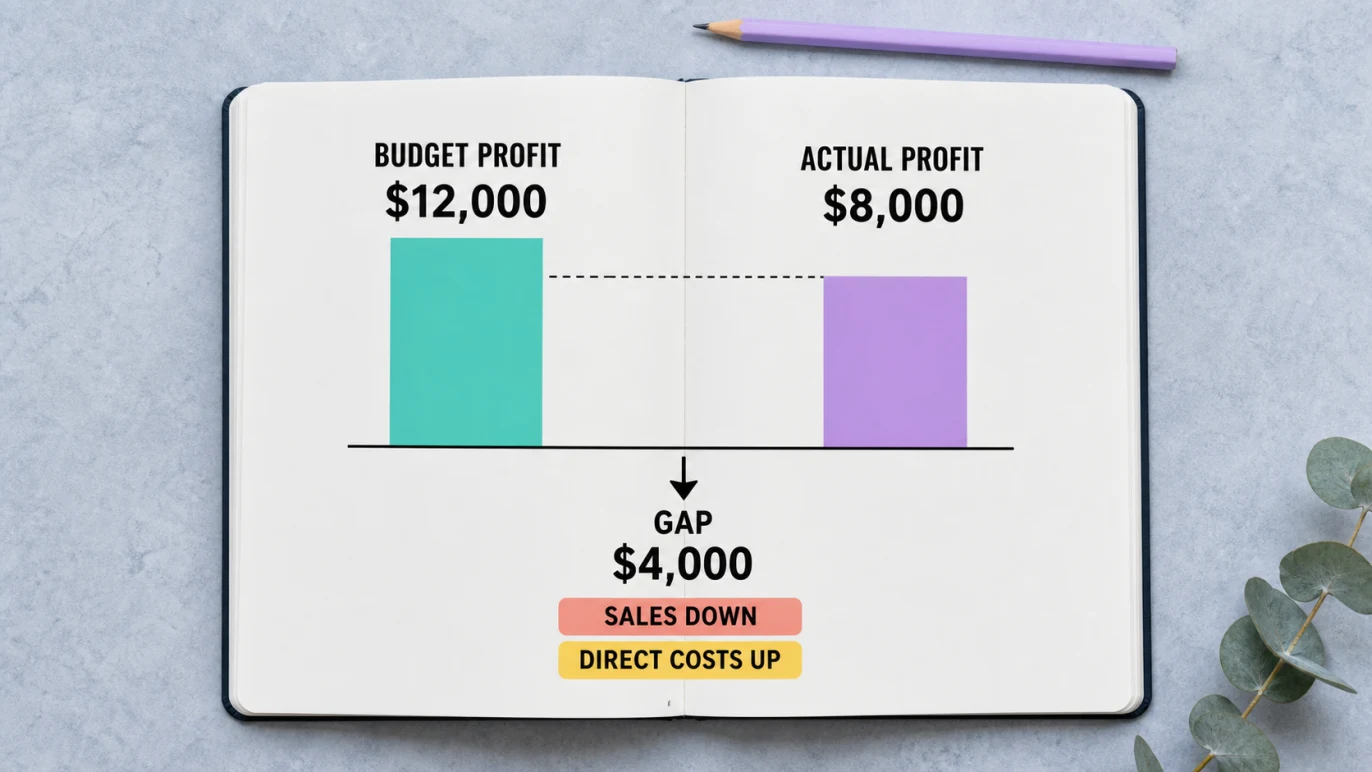
| Net profit | $12,000 | $8,000 | -$4,000 |
Actual profit is $4,000 below budget. The studio earned $4,000 less revenue and spent $1,000 more on direct delivery, reducing gross profit by $5,000. Operating expenses were $1,000 under budget, which partly offset the shortfall.
The owner then checks job records and finds that one project moved into August while contractor time on another job exceeded the estimate. The response is specific: update the August forecast for the delayed project, review how contractor hours are quoted and keep the original July budget as the comparison point.
Turn each material variance into an explanation
Do not spend the same amount of time on every line. Set a review rule that fits the size and risk of the business. A variance may deserve attention because it is large in dollars, large as a percentage, repeated across several months or important to a decision.
For each material gap, capture four things:
- Result: what moved and by how much?
- Cause: was it price, volume, timing, mix, efficiency, a one-off item or a bookkeeping issue?
- Action: what should change, continue or be watched?
- Owner and timing: who will act, and when will the result be reviewed again?
A useful note might read: “July gross profit was $5,000 below budget because one project moved into August and contractor hours exceeded the quote. Update the forecast now and review job estimates before the next proposal is sent.”
That sentence is more useful than a spreadsheet cell marked red because it connects the report to a decision.
Check the actuals before blaming the budget
A variance can come from incomplete bookkeeping rather than business performance. Finish an accounting close before treating the comparison as settled.
Check that:
- bank and credit card accounts are reconciled
- customer invoices, supplier bills and payroll entries are complete for the period
- transactions are dated in the right month
- accruals, prepayments, depreciation and stock adjustments have been handled where relevant
- the budget and actual report use the same cash or accrual basis
- both sets of figures use the same GST-inclusive or GST-exclusive treatment
- budget categories still map to the current chart of accounts
- one-off costs and income are labelled rather than hidden in ordinary categories
The Australian Government’s Profit and Loss guidance recommends clearly identifying whether figures are GST inclusive or exclusive and labelling estimated figures. Those details are essential when the report is used as a comparison.
Do not rewrite the budget to hide a miss
When conditions change, update the forecast rather than silently changing the original budget. The broader Budget vs Forecast guide explains how small businesses can use both planning views together. Keeping both views answers two different questions:
- Budget vs actual: how did performance compare with the plan?
- Forecast vs actual: how accurate is the latest expectation?
The original plan may become unrealistic after a major customer win, supplier increase, staffing change or disruption. That does not make it useless. It still shows where assumptions changed. The forecast then provides the more current path for cash, profit and operational decisions.
A monthly budget-vs-actual workflow
Use a short, repeatable process:
- Complete bank reconciliation and the month-end close.
- Run the Profit and Loss for the month and year to date.
- Align actual accounts with the budget categories.
- Calculate dollar and percentage variances.
- Investigate the few gaps that pass the business’s review threshold.
- Record cause, action, owner and review date.
- Update the forecast without overwriting the original budget.
- Review cash timing separately before committing to spending or drawings.
Monthly review suits many small businesses. A fast-growing, seasonal or cash-constrained business may need a weekly sales, cost or cash view as well.
How Gimbla fits the workflow
Gimbla helps keep the actual side of the comparison current. Invoices support recorded revenue, bills and expenses support costs, payroll captures employee pay, and bank reconciliation confirms what moved through the bank.
Whether the planning budget lives in a spreadsheet, adviser model or another budgeting tool, map its categories to the Gimbla chart of accounts. Then run the Profit and Loss for the same period and basis. A clean mapping makes it easier to move from a variance to the invoices, bills, pay runs or account entries behind it.
Read the result with cash flow as well as profit. A favourable profit variance does not guarantee that customers have paid, and an unfavourable month may be a timing issue rather than a permanent decline. The 12-week cash budget can show whether the next payments still fit.
Frequently asked questions
What does budget vs actual mean?
Budget vs actual means comparing the income and costs a business planned for a period with the results it actually recorded for the same period. The differences are called variances.
How do you calculate a budget variance?
A simple calculation is actual minus budget. For revenue and profit, a positive result is generally favourable. For costs, a positive result usually means the business spent more than planned. Check the sign convention used by your report.
Is a budget the same as a forecast?
No. A budget records the original plan or target. A forecast updates the expected outcome using actual results, current trends and newer information. Keep both so you can measure performance against the plan without losing the latest outlook.
How often should a small business compare budget with actual results?
Monthly review is useful for many small businesses, after bank reconciliation and the accounting close have made the actual figures reliable. Review more often when sales, costs or cash are changing quickly.
In short
Budget vs actual analysis turns a Profit and Loss into a decision tool. Compare like with like, explain the material gaps, protect the original budget and update the forecast separately. The goal is not to make every variance disappear. It is to understand what changed early enough to respond well.