- Overview
- Quick answer
- Key points
- September employer reconciliation: prepare the payroll file now
- Which records to review
- Use the right SARS date
- Do not blur sole trader and company records
- VAT and employer records need their own trail
- Simple example
- Questions to ask before relying on the file
- How Gimbla fits the workflow
- A practical preparation workflow
- Frequently asked questions
- In short
South Africa Tax Records To Check Before SARS Filing Season 2026
Published July 8th, 2026 | Updated September 10th, 2026 | Team Gimbla
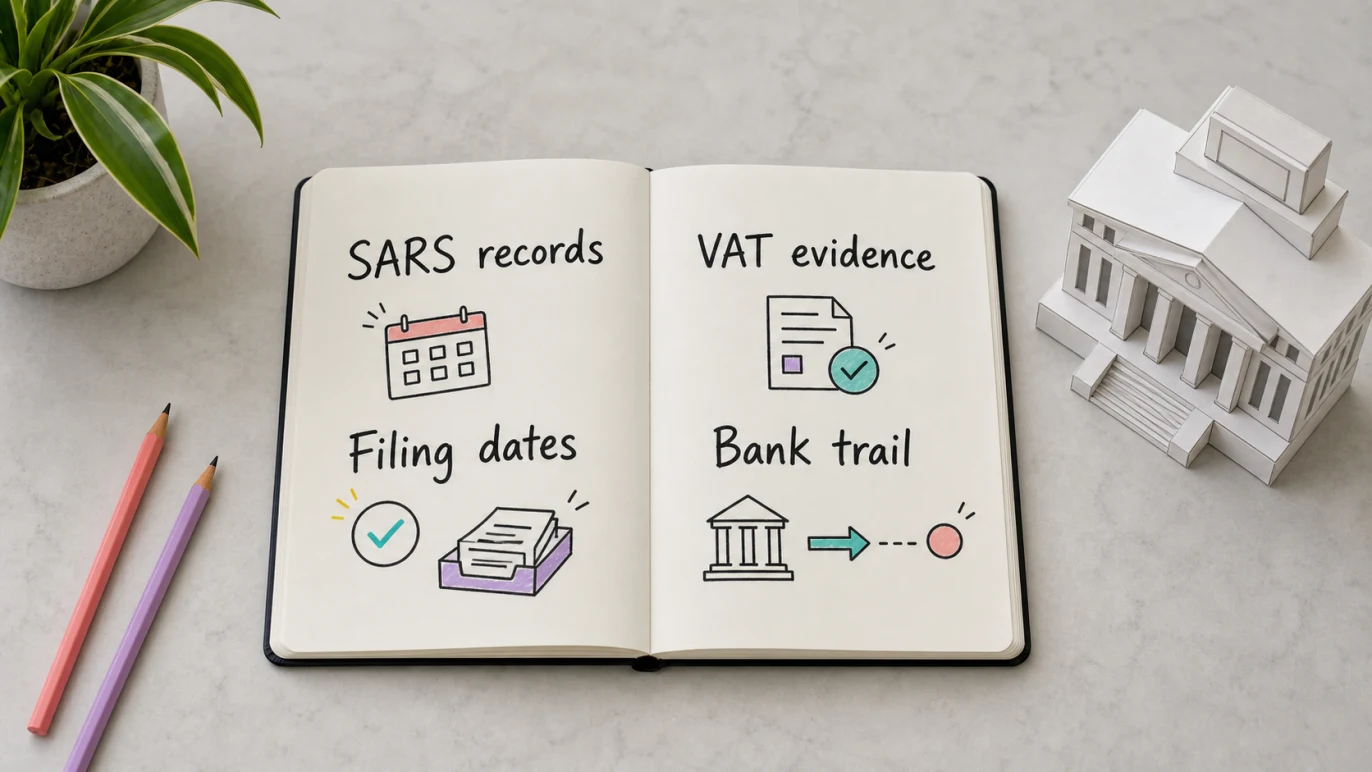
South African sole traders, freelancers and provisional taxpayers should use SARS Filing Season 2026 as a record-quality checkpoint, not only a lodgement date. SARS lists the 2026 season dates for auto assessments, non-provisional taxpayers, provisional taxpayers and trusts, which means the useful work starts before a return is submitted.
Small companies should treat those personal income tax dates separately from company tax, but the same record discipline still matters. Invoices, VAT records, payroll amounts, bank reconciliation and CIPC evidence should be easy for an accountant or tax practitioner to review.
Filing season is easier when the records already explain the story: what you earned, what you spent, what tax you collected, what you paid and what still needs adviser review.
Quick answer
SARS’s Filing Season 2026 changes list auto-assessment notices from 1 July to 12 July 2026 and non-provisional taxpayer filing from 13 July to 23 October 2026. Provisional filing starts on 13 July and trust filing on 19 September, with both closing on 22 January 2027.
Trustees and bookkeepers can use the South Africa trust filing records guide to separate IT3(t) and ITR12T preparation and reconcile beneficiary decisions, payments and unpaid balances.
One change matters especially for business owners: certain provisional taxpayers may also be auto-assessed in 2026. Review an assessment rather than assuming the normal annual filing path applies. If it is correct, SARS says no further ITR12 action is required. If it is wrong, amend and submit the annual return by the applicable filing deadline. Keep any separate provisional estimate-and-payment cycle in view. If no auto-assessment notice arrives by 12 July, prepare to file from 13 July.
For a South African small business, the practical next step is to gather records before the relevant filing window: sales invoices, receipts, supplier bills, VAT evidence if registered, payroll records if you employ people, bank statements, loan or owner-drawings notes and company-maintenance documents where applicable.
Key points
- Sole traders and freelancers with business income should check whether they are provisional taxpayers.
- Companies should not treat personal income tax filing dates as their full compliance calendar.
- VAT, PAYE, UIF, Skills Development Levy and company records need their own supporting evidence.
- A clean bank reconciliation helps the accountant test whether income, expenses and tax balances make sense.
- Gimbla can organise the bookkeeping trail, but it does not replace SARS guidance or local tax advice.
September employer reconciliation: prepare the payroll file now
South African employers have a separate, immediate record deadline. SARS says the 2026 interim employer reconciliation window runs from 21 September to 31 October 2026. It covers the first six months of the reconciliation year, from 1 March to 31 August, and requires an EMP501 submission through eFiling or e@syFile™ Employer.
Before the window opens, reconcile PAYE, UIF and Skills Development Levy against the EMP201 returns already submitted. Check that payroll records, employee tax reference numbers and interim IRP5/IT3(a) certificates agree with the figures in the payroll system. SARS notes that missing or invalid income tax numbers can delay processing or cause an EMP501 submission to be rejected.
SARS also plans an updated e@syFile™ Employer release in mid-September. Payroll administrators should download the formal release when it becomes available, review the updated payroll-import and validation requirements, and avoid leaving the reconciliation until the final week. The full SARS EMP501 interim-declaration notice sets out the submission channels and current requirements.
For a small employer, the practical preparation pack is simple: save the six months of EMP201 confirmations and payment evidence, reconcile each employee’s gross pay and deductions, verify tax numbers, generate a draft IRP5/IT3(a) file, and investigate any difference before it reaches the EMP501.
Which records to review
Start with the records that usually cause rework during tax preparation.
| Record area | What to check | Why it matters |
|---|---|---|
| Sales and receipts | Invoices, receipts, credit notes, cash sales and customer deposits | Helps income agree with bank deposits and VAT records |
| Supplier bills | Tax invoices, recurring costs, stock, equipment and unpaid supplier balances | Supports expense claims and keeps accounts payable visible |
| VAT records | VAT201 support, tax codes, output VAT, input VAT and adjustments where registered | Separates tax collected from ordinary sales income |
| Payroll and employer costs | PAYE, UIF, Skills Development Levy, payslips, staff payments and liabilities | Keeps wage costs, deductions and remittances traceable |
| Bank reconciliation | Bank feeds, statements, unmatched payments, deposits, transfers and loan movements | Shows whether the accounting file agrees with real cash movement |
| Company compliance | Annual returns, beneficial ownership filings, securities or beneficial-interest registers, shareholding and director registers, and financial accountability evidence | Keeps company-maintenance and inspection records ready beside tax evidence |
For the document basics, start with invoice, VAT - Value Added Tax and bank reconciliation. If you are comparing bookkeeping tools by country, the free accounting software by country guide keeps the South Africa page in context.
Use the right SARS date
The filing date that matters depends on the taxpayer and return type. Do not use the first date you see as a universal deadline.
| Taxpayer or return position | SARS Filing Season 2026 timing | Practical record task |
|---|---|---|
Auto-assessed individual, including certain provisional taxpayers | 1 July to 12 July 2026 | Check income, deductions and third-party data before accepting or correcting the assessment |
| Non-provisional taxpayer | 13 July to 23 October 2026 | Gather salary, investment, deduction and expense evidence early |
| Provisional taxpayer | 13 July 2026 to 22 January 2027 | Prepare business-income, expense, VAT, bank and adviser-review records |
| Trust submission | 19 September 2026 to 22 January 2027 | Keep trust records separate from ordinary business records and get advice |
| Company tax and company maintenance | Separate company workflow | Do not rely on personal income tax dates; check company tax, VAT, PAYE and CIPC obligations separately |
If business income is earned in your own name, ask your accountant whether the provisional taxpayer window applies. If the business trades through a company, ask what company tax return, VAT, PAYE and CIPC documents are needed for the same review pack.
Keep the annual ITR12 and an IRP6 separate
The Filing Season dates above concern the annual income-tax return (ITR12). They do not turn a provisional taxpayer’s estimate-and-payment cycle into the same task. For a year of assessment that starts on 1 March 2026, SARS’s provisional tax guidance says the first 2027/01 IRP6 return and related payment are due on 31 August 2026 and are based on estimated full-year taxable income. A correct auto-assessment can remove the need for further annual ITR12 action, but it does not by itself answer whether an IRP6 obligation applies.
Keep the supporting records together, but label the two reviews differently: the ITR12 uses the completed tax-year facts, while the IRP6 estimate needs current income, expense, deduction and tax-credit information for the year in progress. Confirm the taxpayer’s period and position with SARS or a qualified adviser before submitting either return.
For the completed year ended 28 February 2026, there is also a separate voluntary provisional tax top-up review before 30 September. Use that guide to reconcile earlier payments and discuss any remaining shortfall with your tax practitioner.
Review an auto-assessment before accepting it
An auto-assessment is still a record check. Compare the SARS information with business income, deductions, bank evidence and other third-party data. A provisional taxpayer who agrees with the annual assessment does not need to submit another ITR12. That does not decide any separate provisional return or payment obligation. If the assessment is incomplete or wrong, correct the information and submit the annual return within the applicable filing deadline.
Do not blur sole trader and company records
A sole trader’s business income can flow into the owner’s personal tax return. A company is a separate legal taxpayer with its own accounting records, tax accounts and company-maintenance obligations. The day-to-day bookkeeping may feel similar, but the compliance trail is not the same.
South African companies should also keep CIPC evidence close to their finance records. CIPC’s Notice 36 of 2026 says it conducts routine on-site and virtual beneficial ownership inspections. If an entity is selected, its directors or members must personally attend; a filer, consultant or company secretarial professional cannot take their place.
The records CIPC may inspect include the beneficial ownership information filed with the Commission, securities or beneficial-interest registers, shareholding structures, the director register and documents identifying ultimate beneficial owners. The notice also restates the 5% ownership or control threshold and says beneficial ownership information must be submitted or updated each year within 30 business days after the entity’s anniversary. Keep those records with annual returns, financial statements or accountability evidence and the tax review pack rather than in disconnected files.
That does not mean every small company needs a complicated system. It means the file should make sense when an accountant asks:
- which entity earned the income
- which bank account received the money
- which expenses belong to the business
- which owner, director or loan movements need separate treatment
- which tax balances are still payable or refundable
- which company-maintenance documents support the year
VAT and employer records need their own trail
VAT is not ordinary income. It is tax collected or paid through the business workflow and needs support from invoices, bills, tax codes, VAT periods and reconciled balances.
SARS’s September 2026 VAT Connect bulletin distinguishes the proposed threshold legislation from how it processes applications: SARS is applying the R2.3 million compulsory registration threshold to new registration and deregistration requests from 1 April 2026, ahead of promulgation of the retrospective amendments. Existing VAT registrations are not cancelled automatically because turnover falls below the higher threshold.
If your business is already registered, keep its registration status, VAT returns and supporting records under review with your tax practitioner. Preserve the turnover calculation, any cancellation request and SARS correspondence together, and confirm the effective cancellation date before changing invoice tax settings. A threshold announcement alone is not evidence that the business has left the VAT system.
Schools registered as VAT vendors have a separate 2026 workflow. The South African school VAT deregistration guide covers the SARS cancellation application, invoice corrections, input-tax reversals and exit-VAT records.
Payroll has the same control issue. If the business employs people, wages, PAYE, UIF and Skills Development Levy should be visible as separate records rather than a single bank payment. Net pay alone does not explain the full payroll cost or the amounts withheld for remittance.
For a small business owner, the useful habit is to review these records before the accountant starts the return. Waiting until lodgement time usually turns a simple question into a bank-statement reconstruction job.
Simple example
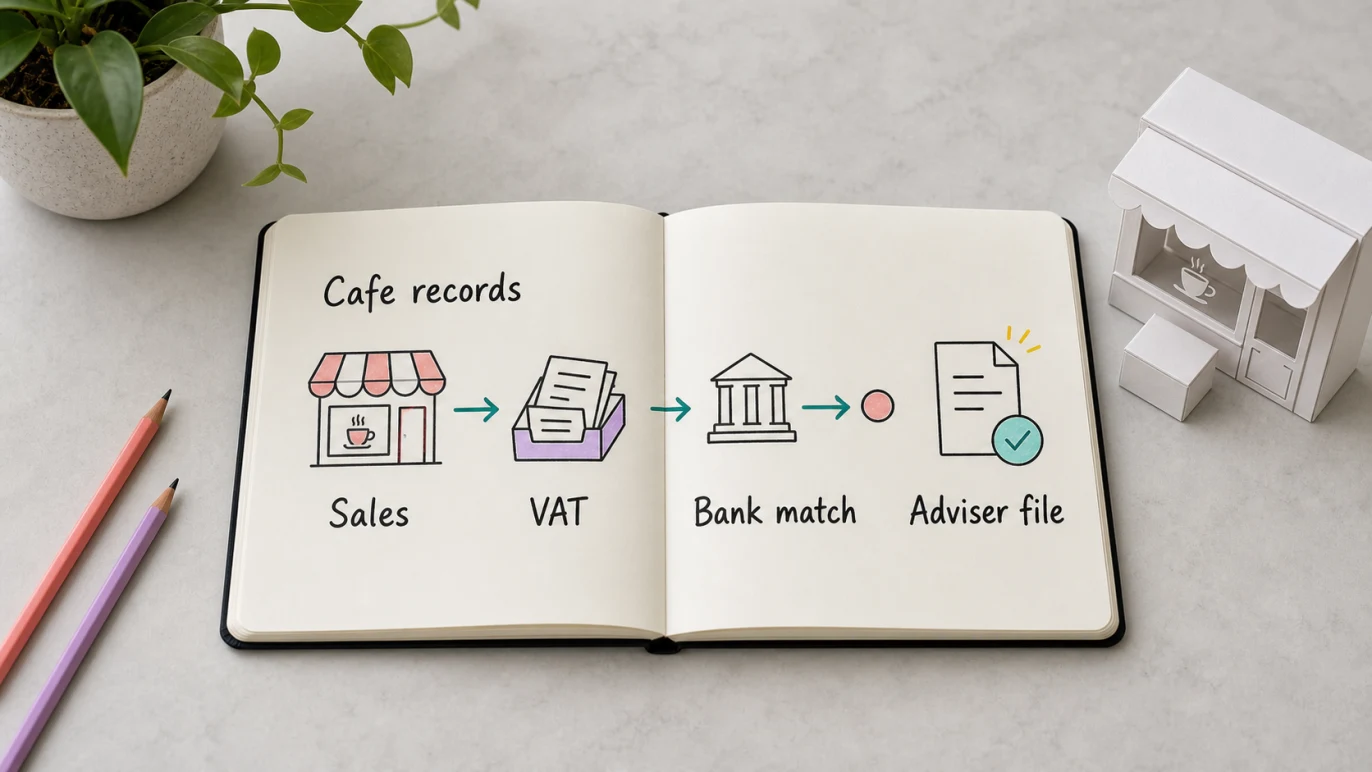
Imagine a Johannesburg cafe owner who sells coffee, caters small office events and pays two staff. Before sending records to an adviser, the owner checks five things.
First, daily sales, catering invoices and customer payments are matched to bank deposits. Second, supplier bills for ingredients, packaging and equipment are saved against the right contacts. Third, VAT records are separated from ordinary sales and expenses because the cafe is VAT registered. Fourth, payroll records show gross pay, deductions, employer costs and bank payments. Fifth, any owner drawings, loan movements or unusual transactions are noted before the adviser review.
The tax calculation still belongs with SARS guidance and the adviser. The bookkeeping file simply makes the facts easier to test.
Questions to ask before relying on the file
Ask these before treating the records as ready:
- Does each bank account agree with the accounting file?
- Are cash sales, card settlements and transfers separated clearly?
- Are invoices, credit notes and supplier bills saved with enough detail?
- Are VAT amounts, VAT periods and VAT201 support easy to follow?
- Are payroll liabilities separate from ordinary wage expenses?
- Are owner drawings, director loans or shareholder movements classified correctly?
- Are CIPC annual-return, beneficial-ownership, securities or beneficial-interest, shareholding and director records current where the business is a company or close corporation?
- Are any unusual transactions flagged for accountant review?
If one answer is unclear, fix the record before the filing window becomes urgent.
How Gimbla fits the workflow
Gimbla’s South Africa accounting software page is written for South African small businesses that need invoices, bills, expenses, rand reporting and VAT-friendly records in one place.
In a filing-season review, accounting software should help you:
- create invoices and credit notes consistently
- record supplier bills and recurring costs
- keep VAT-related amounts visible for review
- reconcile bank activity before relying on reports
- separate owner, loan, payroll and tax balances
- share cleaner records with an accountant or tax practitioner
The goal is not to turn software into tax advice. It is to give the adviser a better starting point.
A practical preparation workflow
Use this as a record-readiness pass before SARS filing or accountant handover.
- Confirm whether the taxpayer is an individual, provisional taxpayer, trust or company.
- Check the relevant SARS date and write down the handover date for the adviser.
- Reconcile all business bank accounts up to the review period.
- Match sales invoices, receipts and deposits.
- Match supplier bills, card payments and bank withdrawals.
- Review VAT records if the business is registered.
- Review payroll records if the business employs people.
- Add notes for loans, owner drawings, director movements and unusual transactions.
- Gather CIPC annual-return, beneficial-ownership and company-register records if the business trades through a company or close corporation.
- Send the accountant one organised pack rather than several disconnected exports.
For the reconciliation habit, see the bank reconciliation guide. For short-term payment planning around tax and payroll dates, a cash budget can help show whether the business has enough cash ready.
Frequently asked questions
Is SARS Filing Season 2026 the company tax deadline?
No. SARS Filing Season 2026 is a personal income tax filing-season page. Sole traders and provisional taxpayers should check it, while companies need separate company tax and CIPC workflows.
Can a provisional taxpayer be auto-assessed in 2026?
Yes. SARS says certain provisional taxpayers may receive an auto-assessment. If it is correct, no further annual ITR12 action is required. This does not replace a separate provisional tax IRP6 return and payment where that obligation applies; check the relevant period and deadline with SARS or an adviser.
What should a South African small business check first?
Start with invoices, supplier bills, VAT records where registered, payroll records if you employ people, bank reconciliation and adviser notes for unusual transactions.
Can Gimbla replace South African tax advice?
No. Gimbla can help organise bookkeeping records, but SARS filing, VAT, payroll and company compliance should be checked with official guidance and a qualified adviser.
In short
SARS Filing Season 2026 is a useful trigger to clean up records before tax work becomes rushed. Check the right filing window, separate sole trader and company records, keep VAT and payroll evidence visible, reconcile the bank and give your adviser a file that explains the business clearly.