- Overview
- Quick answer
- Key points
- What changed for school VAT records
- Records to review before applying
- How to apply for VAT cancellation
- What exit VAT means for retained assets
- Simple example
- How to keep the accounting trail clear
- Common mistakes to avoid
- Frequently asked questions
- Next steps for affected schools
South African Schools Must Apply for VAT Deregistration
Published August 8th, 2026 | Team Gimbla
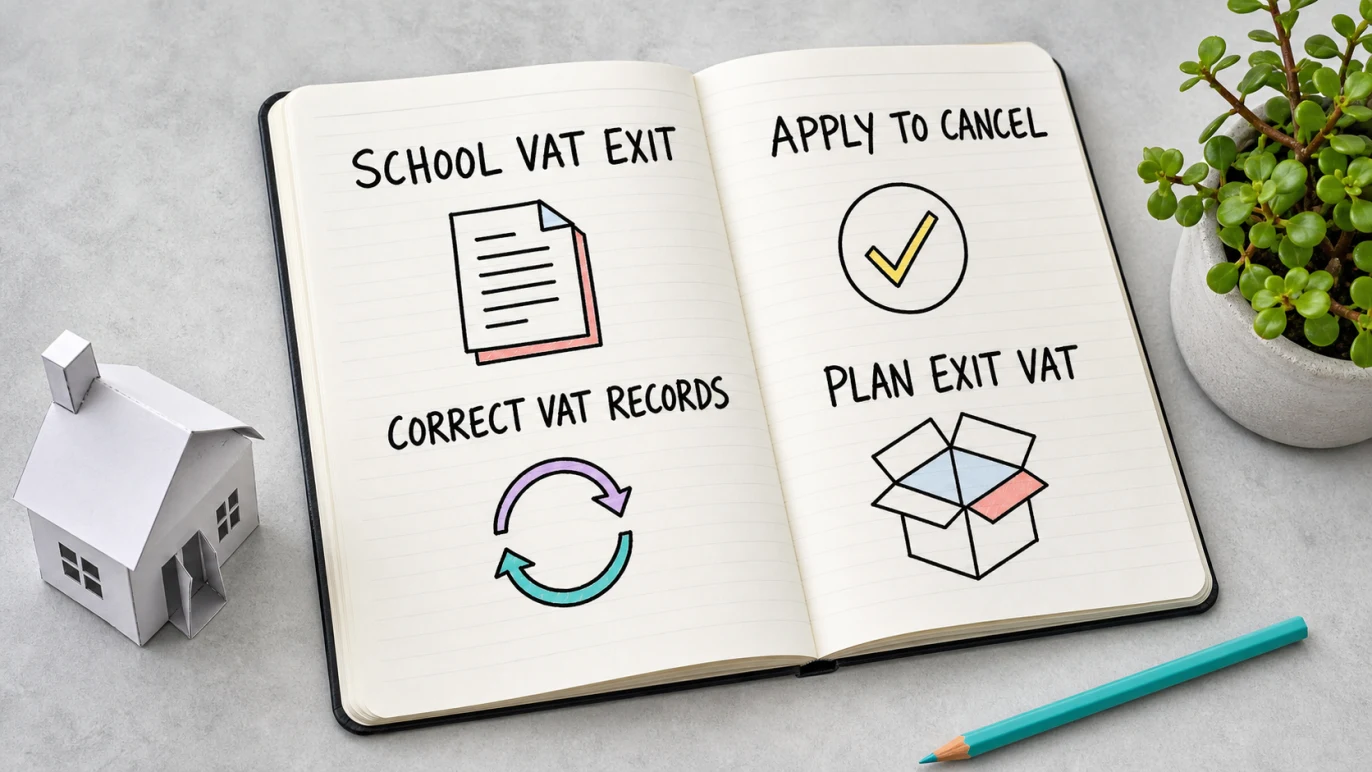
South African schools registered as VAT vendors must apply to cancel their VAT registration. SARS’s 7 August 2026 notice says the cancellation is not automatic after school supplies became exempt from VAT on 1 January 2026. Affected schools need to stop charging or deducting VAT, correct post-change records where necessary, prepare an exit-VAT schedule and submit the VAT123e application.
This is a tax and bookkeeping handover, not just a form. Keep invoices, credit notes, refunds, VAT201 returns, asset records and adviser calculations together so the application can be tested before it reaches SARS.
A school should preserve the audit trail: correct affected invoices and input-tax claims, document retained assets, keep required VAT returns current and apply for cancellation using SARS’s published process.
Quick answer
The SARS notice published on 7 August instructs schools registered under the South African Schools Act that are VAT vendors to complete form VAT123e. It says to use the cancellation reason “All enterprise activities have ceased on 31 December 2025” and the email subject “VAT deregistration – Schools”, or make a virtual appointment using the VAT and PAYE registration/deregistration option.
Schools should not treat the application as permission to erase old transactions. SARS expects corrections to preserve what was originally charged or claimed, followed by the appropriate credit note, refund or Request for Correction.
Key points
- Supplies made by affected schools are exempt from VAT from the change date, except to the extent that qualifying welfare activities are confirmed by a ruling.
- Cancellation is not automatic; the school must apply using VAT123e.
- VAT charged after the change may require a credit note and customer refund before the school can deduct the correction.
- Input tax claimed on post-change purchases may need to be reversed through a Request for Correction.
- Certain goods and rights held at 31 December 2025 may create deemed exit VAT, so asset and historic input-tax records need professional review.
What changed for school VAT records
The legislative change means an affected school is no longer carrying on a VAT enterprise from the start of 2026. The exception is limited to a school that is a welfare organisation conducting qualifying welfare activities and has written confirmation from the SARS Commissioner through a VAT ruling.
The SARS school VAT FAQ separates four record tasks:
- Correct VAT charged on school supplies after the change.
- Reverse input tax claimed on purchases made after the change where required.
- Calculate deemed exit VAT on relevant goods and rights retained at 31 December 2025.
- Keep submitting the required VAT returns until deregistration is complete.
Do not switch tax settings across the whole file without first separating school supplies, any qualifying welfare activity and transactions that belong to an earlier VAT period.
Records to review before applying
| Record area | What to check | Evidence to keep |
|---|---|---|
| Customer invoices | VAT charged on school supplies after the change date | Original invoices, credit notes and refund evidence |
| Supplier bills | Input tax deducted on post-change purchases | Bills, VAT201 periods and correction records |
| Retained assets | Goods and rights held at 31 December 2025 on which input tax was previously claimed | Asset register, acquisition cost, valuation support and historic tax evidence |
| Unpaid suppliers | Input tax previously deducted where the supplier remained unpaid at year end | Accounts payable ageing, payment history and earlier VAT adjustments |
| VAT returns | Returns already submitted and nil returns still due while cancellation is pending | VAT201 copies, RFC confirmations and SARS correspondence |
| Welfare activities | Whether a separate activity may qualify to remain registered | Ruling application and written SARS confirmation |
Use a fixed asset register and accounts payable report as starting points, but let a South African tax practitioner decide which items belong in the exit-VAT calculation.
How to apply for VAT cancellation
SARS’s current process is practical but exact:
- Complete the VAT123e application for cancellation of registration.
- Use the reason published for schools in the 7 August notice.
- Send the form using the SARS email address and subject line stated in that notice, or book the specified virtual appointment.
- Include a payment-arrangement request with the form if the school needs one for exit VAT.
- Keep filing required VAT returns and retain proof of every correction while the application is processed.
The application should agree with the accounting file. If the VAT201 history, customer refunds, input-tax reversals and asset schedule tell different stories, resolve the difference before submitting.
What exit VAT means for retained assets
Exit VAT is the common name for VAT that may arise on certain goods and rights retained when the school ceases its VAT enterprise. SARS says the amount is based on the lower of cost or open market value for the relevant item. Goods on which input tax was denied, such as certain motor cars or entertainment expenses, and assets acquired for no consideration may be excluded.
The official SARS reference guide for schools exiting the VAT system provides the detailed framework. The calculation can depend on acquisition history, improvements, connected-person transactions, unpaid suppliers and the evidence available, so it should not be estimated from the current balance sheet alone.
SARS’s FAQ says schools are liable to pay this amount from 1 January 2027 and may use 12 equal monthly instalments. A longer period needs agreement with SARS. The newer media notice adds that a payment-arrangement request can accompany VAT123e. Confirm how the school’s final cancellation date will work with the agreed payment plan.
Simple example
A VAT-registered school reviews its records and finds that it issued several invoices with VAT after the school-supply exemption had started. It also claimed input tax on computers bought during that period and still owns older equipment on which input tax was claimed before the change.
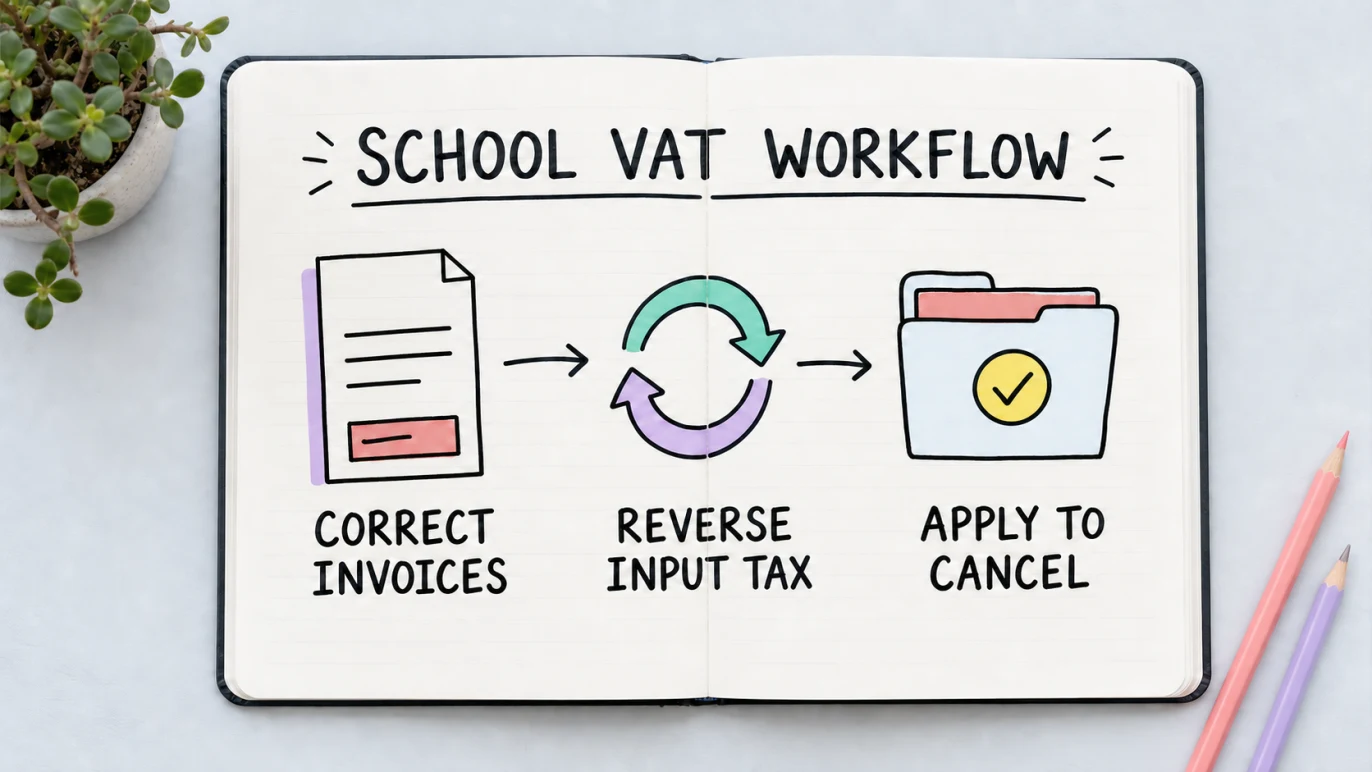
The school does not delete the invoices or rewrite the bank history. It lists the affected customer invoices, reports VAT already charged, issues credit notes and records refunds where required. It then prepares the relevant Requests for Correction for post-change input-tax claims, builds an asset schedule as at 31 December 2025 and keeps nil VAT returns current while its adviser reviews VAT123e and the exit-VAT calculation.
How to keep the accounting trail clear
Use the bookkeeping file to show each correction rather than hiding it:
- keep the original invoice and link the later credit note
- match any refund to the bank transaction
- preserve the supplier bill behind an input-tax reversal
- record the SARS tax-period correction separately from ordinary expenses
- keep retained-asset evidence with the fixed asset register
- reconcile the VAT balance after each correction
- store VAT123e, payment-plan correspondence and ruling documents with the review pack
Gimbla can help connect invoices, credit notes, refunds, bills and bank reconciliation. The credit note guide shows how to preserve the original invoice trail, while the GST, VAT and sales tax guide explains the accounting relationship between tax transactions, reports and the liability account.
Software does not determine whether an activity qualifies for the welfare exception or calculate the school’s legal exit-VAT liability. Use the South Africa accounting software page for the record workflow, then have the tax treatment checked against current SARS guidance.
Common mistakes to avoid
- Waiting for automatic cancellation when SARS requires an application.
- Continuing to charge VAT on affected school supplies.
- Deleting invoices instead of using credit notes and refunds to preserve the audit trail.
- Reversing all historic input tax without separating post-change purchases from retained assets.
- Stopping VAT201 submissions before SARS has completed the deregistration process.
- Assuming every school activity has the same treatment as an approved welfare activity.
- Calculating exit VAT from today’s asset values without checking the statutory valuation and cost rules.
Frequently asked questions
Must a South African school apply to cancel its VAT registration?
Yes, if it is registered under the South African Schools Act and is a VAT vendor. SARS says the cancellation is not automatic. A qualifying welfare activity may require separate ruling treatment.
Can a school keep charging VAT until SARS cancels the registration?
No. The exemption applies from the legislative change date, not from the eventual cancellation date. Affected invoices and returns may need correction.
Must a school keep submitting VAT returns while cancellation is pending?
Yes. SARS says schools must continue submitting nil returns where appropriate, while also reporting corrections such as credit notes for VAT charged after the change.
When is school exit VAT payable?
SARS’s FAQ says payment starts from 1 January 2027 and may be made in 12 equal monthly instalments, or another period agreed with SARS. Confirm the current arrangement for the school.
Next steps for affected schools
Start with the records, not the form. Identify every invoice and input-tax claim affected by the change, prepare the retained-asset schedule, reconcile the VAT balance and ask a South African tax practitioner to review the corrections and exit-VAT calculation.
Once that file agrees, follow the VAT123e process in SARS’s 7 August notice and keep the returns, refunds and correspondence current until deregistration is complete.