- Overview
- Quick Answer
- Key Points
- Why Quotes Stall
- Fix the Quote Before You Send It
- Include the Details Customers Need to Say Yes
- Show the Total Price Clearly
- Make Optional Choices Easier
- Put Terms Where They Cannot Be Missed
- Give the Customer One Clear Approval Step
- Follow Up Without Making It Awkward
- Turn Accepted Quotes Into Clean Invoices
- Common Quote Mistakes That Slow Approval
- Frequently Asked Questions
- Final Thought
How to Get Quotes Approved Faster
Published May 19th, 2026 | Updated May 23rd, 2026 | Team Gimbla
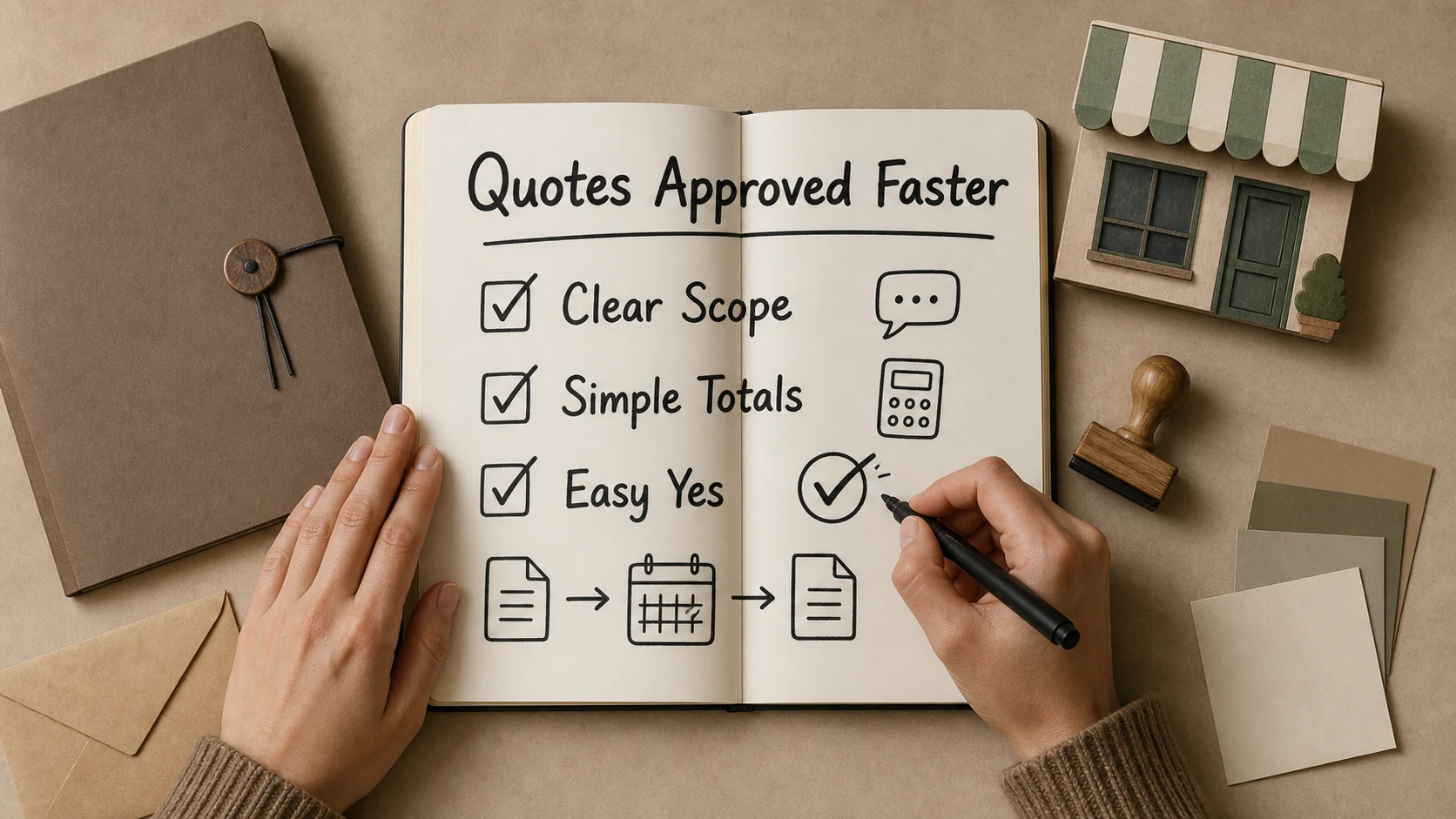
To get quotes approved faster, make the decision easy. Confirm what the customer wants before you quote, write the scope in plain language, show itemised and total costs, spell out timing and payment terms, and give the customer one obvious way to say yes.
A fast quote is not a vague shortcut. Business.gov.au says a good quote is clear, specific and complete, and that an accepted quote becomes a legally binding contract. That means speed comes from clarity: fewer assumptions, fewer hidden costs, and fewer follow-up questions before the customer can approve.
The best quote approval process removes doubt. The customer should know what is included, what is not included, what it costs, when it can happen, and exactly how to accept.
Quick Answer
The fastest way to get a quote approved is to reduce the customer’s decision work. A quote should answer five questions without a phone call: what will be delivered, what is excluded, what the total price is, when the work can start and finish, and how the customer accepts.
For Australian small businesses, this also protects the business. The Business.gov.au quote guidance recommends written quotes that include customer details, a clear description of the work, itemised and total costs, GST where applicable, payment terms, preferred payment method, dates, expiry and space for acceptance.
Key Points
- Get the scope clear before quoting, especially if the customer has only described the problem loosely.
- Show a simple total price and separate optional extras so the customer is not doing maths.
- Include payment terms, expiry date, start date, finish date and acceptance instructions.
- Follow up with a helpful question, not a pressure script.
- Convert accepted quotes to invoices promptly so accounts receivable stays clean from the first job record.
Why Quotes Stall
Quotes usually stall because the customer is unsure, not because they enjoy waiting. Common blockers include:
- unclear scope
- no visible total price
- too many optional choices
- missing timing
- payment terms that appear late in the process
- no clear approval step
- no reminder before the quote expires
If a quote forces the customer to ask “is this included?”, “when can you do it?”, or “what happens if I say yes?”, approval slows down.
That is why a quote should be written like a decision document, not just a price list.
Fix the Quote Before You Send It
Before writing the quote, ask enough questions to remove guesswork:
- What outcome does the customer want?
- What deadline or event is driving the job?
- What information, photos, measurements, access or approvals do you still need?
- Are there budget limits or preferred options?
- Who will approve the quote?
The last question matters. A quote sent to the person who requested it may still need approval from a business owner, property manager, finance team, committee or client. If you know who decides, you can write the quote for that decision.
For larger jobs, summarise the agreed scope before sending the price. A short confirmation such as “This quote covers the supply and installation of X at Y location, excluding Z” can prevent days of back-and-forth later.
Include the Details Customers Need to Say Yes
A quote that gets approved quickly is usually easy to scan. Include:
- your business name, ABN and contact details
- the customer’s name and contact details
- a short description of the work, goods or services
- itemised costs and the total price
- GST treatment, if applicable
- optional extras separated from the base quote
- what is excluded
- start date, finish date or estimated timeline
- quote expiry date
- payment terms and preferred payment method
- a simple acceptance instruction
If the customer is a business, also include any details their accounts team may need later, such as a purchase order reference, site address, project name or billing contact. That small step can save time when the accepted quote becomes an invoice.
Show the Total Price Clearly
Customers approve faster when they can see the real price without reconstructing it from line items.
For consumer-facing prices, the ACCC price display guidance says businesses must communicate clear and accurate prices and display a total price that includes taxes, duties and unavoidable or pre-selected fees. Even where your quote is business-to-business, the same practical habit helps: show the subtotal, GST if relevant, optional extras, and final payable amount clearly.
Use this structure:
| Quote Element | Why It Helps Approval | Example Wording |
|---|---|---|
| Scope summary | Confirms the customer is approving the right work | ”Includes setup, testing and handover.” |
| Exclusions | Prevents surprise disputes | ”Excludes after-hours work and third-party licence fees.” |
| Itemised pricing | Shows what drives the total | ”Materials, labour and setup listed separately.” |
| Total price | Removes mental maths | ”Total payable: $2,420 including GST.” |
| Acceptance step | Tells the customer how to approve | ”Reply ‘Approved’ before 31 May 2026.” |
Avoid burying compulsory charges in notes. If travel, call-out fees, weekend rates, delivery, payment surcharges or setup costs are unavoidable, put them where the customer can see them before approving.
Make Optional Choices Easier
Options can help customers choose, but too many choices can slow approval. If you need to offer options, use a simple good-better-best structure:
- Option A: minimum scope that solves the immediate problem
- Option B: recommended scope with the best fit for the customer’s goal
- Option C: premium or future-proof scope
Label the recommended option honestly. Do not make every option sound essential. If one option is clearly better because it reduces rework, improves durability or saves future administration, explain that in one short sentence.
For example:
“Recommended: includes the initial setup plus two handover sessions, so your team can use the system without booking extra support later.”
That kind of explanation helps the customer understand value without feeling pushed.
Put Terms Where They Cannot Be Missed
Payment terms should be part of the approval decision, not a surprise on the first invoice.
Include:
- deposit amount, if any
- milestone payments, if any
- invoice due date or payment period
- accepted payment methods
- late payment conditions, if used
- cancellation or rescheduling rules
- how variations will be priced and approved
Business.gov.au’s contract guidance explains that payment instructions should make clear whether an invoice is needed, when payment is due and how payment should be made. It also notes that progress payments should state when payments are due, what milestone triggers payment and how much is payable at each stage.
For service businesses, a short variation clause can be especially useful. It can say that changes to scope, timing or cost need written approval before extra work starts. That keeps the accepted quote from becoming a messy memory test.
Give the Customer One Clear Approval Step
If the quote needs approval, say exactly what approval looks like.
Use one of these:
- “Reply to this email with ‘Approved’ and your preferred start date.”
- “Sign and return this quote by the expiry date.”
- “Click approve in the quote email.”
- “Email your purchase order number so we can schedule the work.”
Do not make the customer choose between multiple channels unless you need to. One clear path is faster than a paragraph of options.
If the customer is a company, ask whether they need a purchase order before work starts. If they do, make that part of the acceptance step. This prevents the awkward situation where the customer has approved the work informally but the accounts team cannot process the invoice later.
Follow Up Without Making It Awkward
Good follow-up is part of quoting. The goal is to remove friction, not nag.
A simple rhythm works well:
| Timing | Follow-Up Purpose | Example |
|---|---|---|
| Same day | Confirm they received it | ”Just checking the quote came through cleanly.” |
| 1-2 business days later | Invite questions | ”Happy to clarify scope, timing or options.” |
| Before expiry | Create a natural decision point | ”This quote expires on Friday; would you like me to hold the start window?” |
| After no response | Close the loop politely | ”I’ll leave this open until Friday, then archive it unless you would like changes.” |
For high-value work, follow up by phone or video if the customer expects discussion. For simple repeat work, a short email may be enough.
Turn Accepted Quotes Into Clean Invoices
Once a quote is approved, move quickly. Confirm the acceptance, schedule the work, and keep the financial trail tidy.
In Gimbla, quotes sit alongside invoicing in the same accounting workflow. You can create and send quotes, then convert an accepted quote to an invoice instead of retyping the job details. That helps keep the quote, customer, invoice and payment connected.
Useful Gimbla workflows include:
- setting up customer records before quoting with the create a customer guide
- making quote and invoice documents look consistent with the document template guide
- preparing a simple one-off customer invoice with the free invoice generator
- reviewing what needs to be on invoices with the GST invoice checklist
- monitoring unpaid customer balances with the accounts receivable ageing guide
This matters because quote approval is only the first step. The real cash flow benefit comes when approved work turns into an accurate invoice and a tracked payment.
Common Quote Mistakes That Slow Approval
Quoting Before the Scope Is Clear
If the quote is based on too many assumptions, the customer may hesitate or ask for revisions. Ask the missing questions before pricing.
Hiding the Acceptance Method
If the customer has to work out whether to sign, reply, click, call or pay a deposit, approval slows down. Put the approval step near the price and expiry date.
Overloading the Quote With Choices
Optional extras are useful only when they help the customer decide. If every line is optional, the customer may park the quote until they have time to decode it.
Leaving Out Exclusions
Exclusions protect both sides. They also make the included work look more definite. If travel, design revisions, after-hours labour, stock, delivery, permits or third-party fees are not included, say so.
Sending a Quote With No Expiry Date
An expiry date creates a fair decision point and protects your pricing when supplier costs or availability change. Keep it reasonable for the type of work and the customer’s decision process.
Frequently Asked Questions
What is the fastest way to get a quote approved?
Make the quote easy to decide on. Confirm the customer’s needs first, write a clear scope, show the total price, include timing and payment terms, and give one obvious approval step.
Should a small business itemise quotes?
Usually, yes. Itemised quotes help customers understand what they are paying for and reduce the chance of questions about scope, GST, optional extras or exclusions.
How soon should I follow up after sending a quote?
A same-day “did this come through?” message is useful, especially for larger jobs. After that, follow up within one or two business days with a practical question about scope, timing or approval. If the quote has an expiry date, send a polite reminder before it lapses.
Is an accepted quote legally binding in Australia?
Business.gov.au says that if a customer accepts your quote, it becomes a legally binding contract. This is why your quote should clearly state the work, price, timing, payment terms and acceptance method. For legal advice about a specific dispute or contract, speak with a qualified adviser.
Final Thought
Fast quote approval is a clarity problem before it is a sales problem. The easier your quote is to read, compare, accept and turn into an invoice, the less time the customer needs to make a confident decision.
Start with one improvement: add a clear scope summary, total price, expiry date and acceptance instruction to every quote. Then review the next few quotes that stalled. The pattern will usually show you where customers are getting stuck.