South Africa Provisional Tax Top-Up: Prepare for 30 September 2026
Published September 5th, 2026 | Team Gimbla
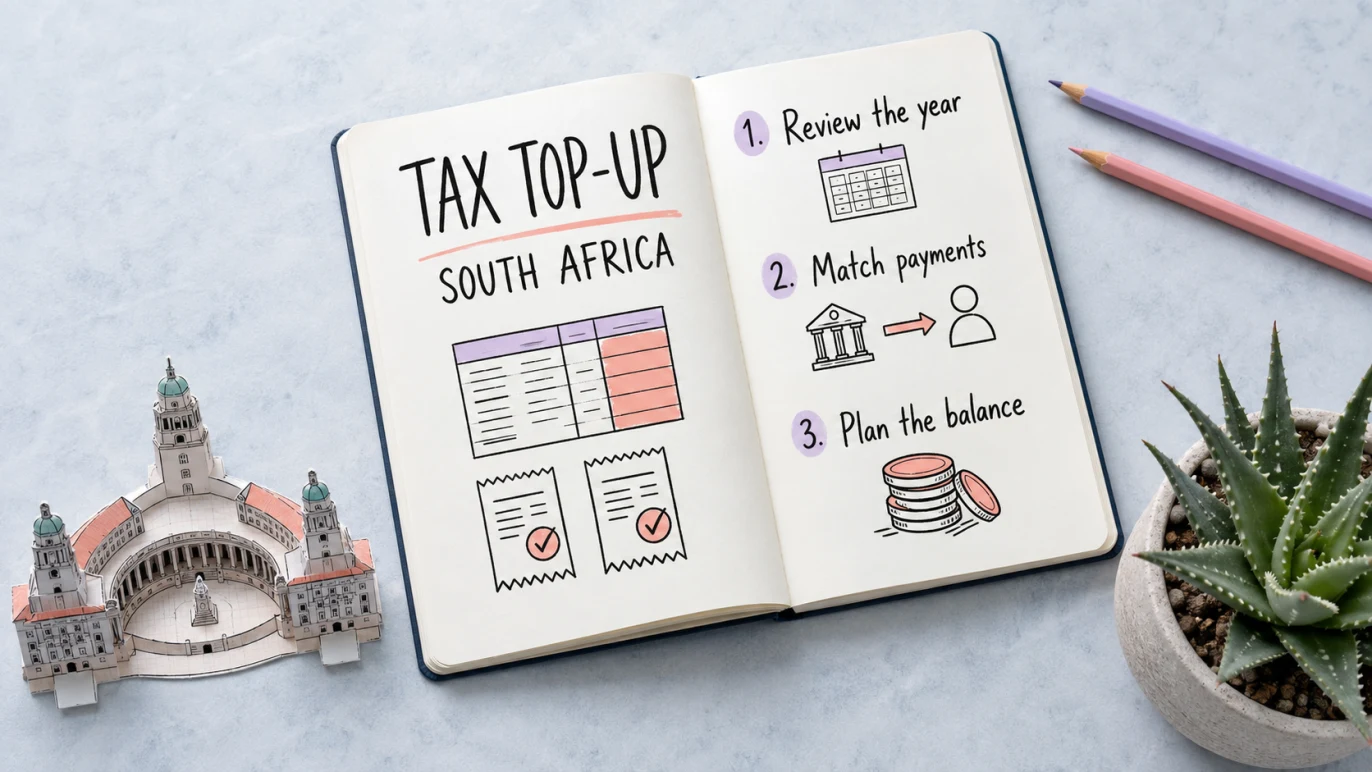
South African provisional taxpayers with a year ended 28 February 2026 should review any remaining income tax shortfall before 30 September 2026. SARS identifies that September date for the voluntary third, or top-up, payment. Start by asking your tax practitioner to compare the completed year’s tax calculation with payments already credited to that year.
The useful bookkeeping task is to produce a clear record of the balance: which taxpayer owes it, which year it belongs to, how it was calculated and which payments have already reduced it.
Review the completed tax year, match the payments already made, then plan any remaining amount with your tax practitioner.
Quick answer
A provisional tax top-up is an optional additional payment towards normal income tax. SARS’s provisional tax overview places it after the tax year ends and before the assessment is issued. Its purpose is to help address a shortfall after the earlier provisional payments.
For February year-ends, the SARS payment-date FAQ gives the September timing. Other approved financial year-ends generally use six months after year-end, and a date falling on a weekend or public holiday moves to the preceding business day. Confirm your own taxpayer position before using the calendar.
Key points
- Review the completed February 2026 year, keeping it separate from estimates for the year now in progress.
- Use a tax calculation reviewed by your practitioner; the profit in your bookkeeping report is only a starting point.
- Match existing payments to the correct taxpayer and period before calculating a balance.
- Keep money for an agreed top-up visible in your cash forecast alongside supplier and payroll commitments.
Keep the two tax years separate
September can be confusing because a business owner may have just dealt with an August provisional payment. For a taxpayer on the usual March-to-February cycle, that August 2026 payment concerns the 2027 year of assessment. The top-up discussed here concerns the 2026 year, which has already ended.
Create separate folders or schedules for the two reviews. Label each with the taxpayer name, tax number and year-end. If you operate a company and also have personal business or investment income, keep those taxpayers separate too.
| Review | Period being examined | Useful starting records |
|---|---|---|
| September 2026 top-up review | Completed year ended 28 February 2026 | Year-end accounts, tax calculation and earlier payment evidence |
| Current-year provisional estimate | Year beginning 1 March 2026 | Current results and expectations for the rest of the year |
Our broader South Africa tax-records guide covers filing-season preparation and the current-year IRP6 workflow. Use this article for the narrower question of a completed-year shortfall.
Build a shortfall schedule your adviser can review
Start with the profit and loss report and balance sheet for the completed year. Give your practitioner the supporting details behind unusual balances: an asset disposal, a large adjustment, an owner transfer or an invoice posted after the accounts were first prepared.
Then build a separate payment schedule. A useful working file has these columns:
- Payment date and amount: copy these from the bank evidence.
- Taxpayer and period: identify whose liability the payment relates to.
- SARS reference: retain the reference supplied for that payment.
- SARS account position: record whether the amount appears against the intended account and period.
- Unresolved difference: explain anything that still needs investigation.
This gives the adviser two things to review: the calculation and the evidence that earlier payments have been counted correctly. A bank debit alone does not explain which tax period a payment belongs to.
Simple example
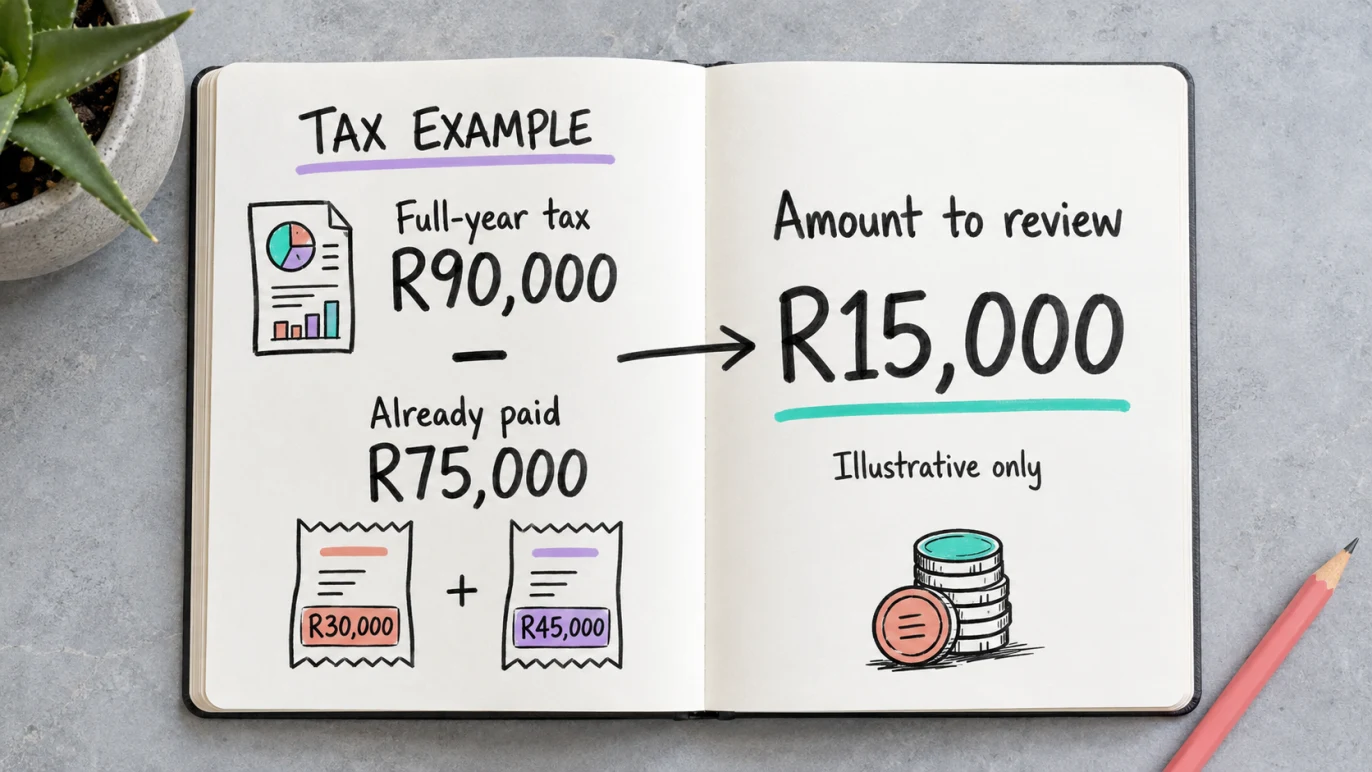
Assume a small South African company has a 28 February 2026 year-end and has not yet received its assessment. Its tax practitioner has reviewed the accounts and calculated R90,000 of income tax for the completed year. This is an illustrative tax amount, not a tax rate applied to accounting profit.
The company’s records show R30,000 paid for the first provisional period and R45,000 for the second. Assume both payments are correctly credited, and there are no other credits, payments, interest or penalties in this example.
| Illustrative tax reconciliation | Amount |
|---|---|
| Reviewed full-year income tax | R90,000 |
| Less first provisional payment | (R30,000) |
| Less second provisional payment | (R45,000) |
| Remaining amount to review for a top-up | R15,000 |
The company can now discuss the R15,000 shortfall and payment timing with its practitioner. In its cash budget, it should show the proposed outflow in the week it expects to pay. That makes the effect on available cash visible before the bank instruction is released.
What a top-up does not fix automatically
SARS’s Guide to Provisional Tax distinguishes interest on a shortfall from penalties involving earlier estimates or payments. A September payment can reduce potential interest exposure, but it does not rewrite the second provisional estimate or automatically remove an earlier penalty. Ask your practitioner to review those issues separately.
An assessment also changes the next step. Once SARS has issued it, follow the payment instructions and due date on that notice. Do not use the voluntary top-up date as permission to postpone an assessed debt.
Check the payment before releasing it
SARS’s eFiling provisional tax guide describes an additional-payment route under Payments, Pay Now and Create Additional Payment. It includes Provisional Tax (PROV) and a provisional-tax period payment option. Have the practitioner confirm the correct period for your situation rather than choosing the month in which you happen to be paying.
Use the SARS-generated payment details. Its payment rules explain the 19-digit payment reference number and tax-specific allocation requirements. Check the taxpayer, tax type, period and amount; do not copy an unrelated VAT or assessed-income-tax reference. Allow for your bank’s processing and authorisation requirements.
Save the payment instruction and bank confirmation together. Afterwards, reconcile the bank debit and check the SARS account allocation. If the money left the bank but the expected account entry is missing, leave the item open for investigation.
Prepare the bookkeeping file in Gimbla
Gimbla’s South Africa bookkeeping software can help keep invoices, expenses and the transaction trail organised for this review. A practical handover is:
- Complete the bank reconciliation for the year being reviewed, using the bank-reconciliation guide if needed.
- Review outstanding invoices, supplier bills and unexplained balances with the person preparing the accounts.
- Give the tax practitioner the reports, payment schedule and supporting documents together.
- Record any agreed payment using the account treatment confirmed for that taxpayer, retaining its year and reference in the transaction description.
- Match the payment when it appears in the bank records and retain the allocation evidence with the audit trail.
The tax calculation and SARS payment remain separate from preparing the bookkeeping file. Agree who will calculate, authorise, pay and verify the amount so each step has a clear owner.
Frequently asked questions
Is the third provisional tax payment compulsory?
No. SARS describes the third payment as voluntary. It can reduce potential interest on a tax shortfall, but it does not replace the first two provisional payments or the annual income tax return.
Does 30 September 2026 apply to every company?
No. This date applies to the February year-end situation discussed here. Companies with a different financial year-end generally use a date six months after year-end, subject to the business-day rule. Confirm the applicable date with SARS or your tax practitioner.
Will a September top-up cancel an underestimation penalty?
Not automatically. Underestimation penalties consider the second provisional estimate and the relevant payments by year-end. A later top-up addresses a remaining tax shortfall, so earlier penalties need separate review.
What if SARS has already issued my assessment?
Follow the assessment’s payment instructions and due date. Do not assume that the voluntary top-up date lets you delay an assessed amount until 30 September.