NFP Self-Review Return: 2026 Checklist for Australian Not-For-Profits
Published May 25th, 2026 | Team Gimbla
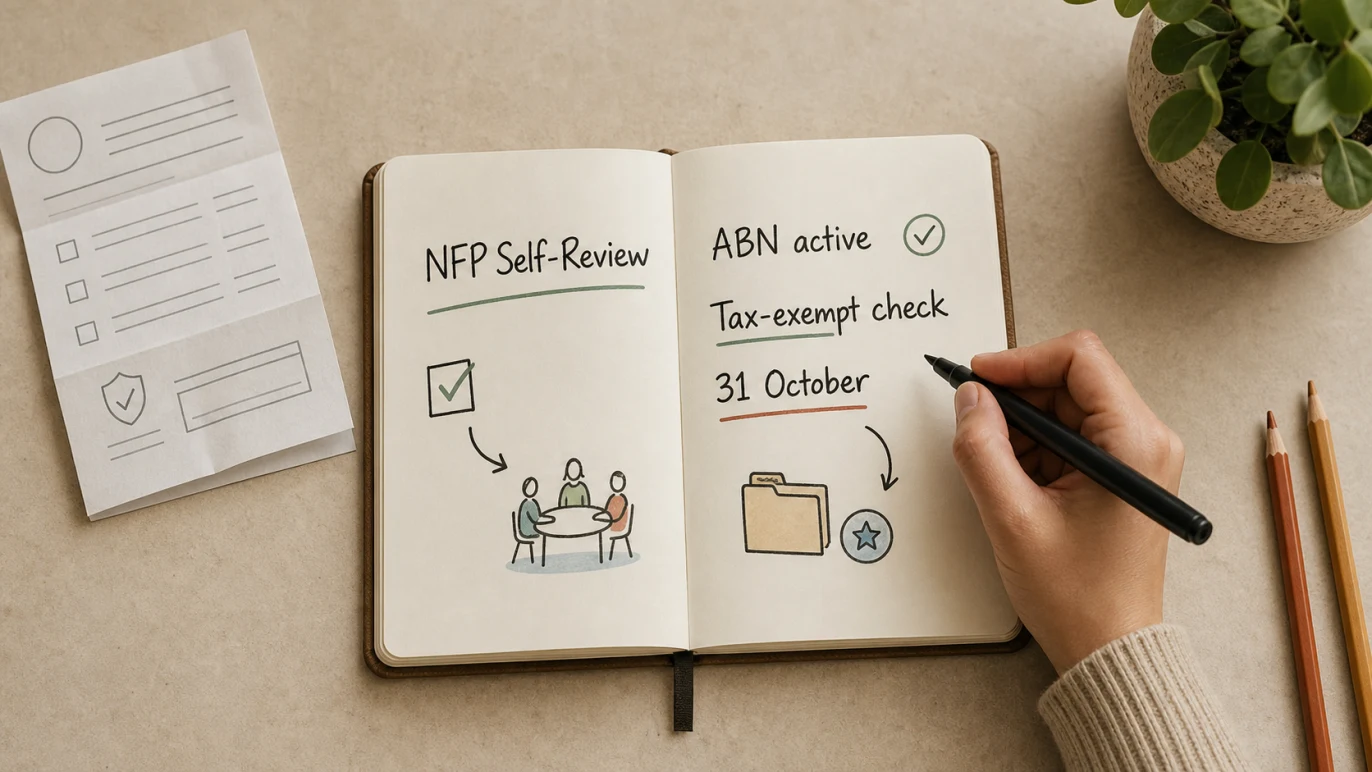
The NFP self-review return is an Australian Taxation Office annual lodgment for many non-charitable not-for-profits with an active ABN. It asks the organisation to notify the ATO that it has reviewed whether it is eligible to self-assess as income tax exempt.
For a small club, association or community group, the practical job is not just ticking a form. Before 31 October, check the organisation’s ABN details, governing rules, purpose, income category, bank records, committee approval and evidence that supports the tax position.
The self-review return is an annual tax-exemption checkpoint. Treat it as a bookkeeping and governance review, not a last-minute form.
Quick Answer
The ATO says non-charitable not-for-profits with an active ABN need to lodge an annual NFP self-review return to notify eligibility to income tax exemption. The return is about the organisation’s income tax position. It does not replace other records, GST, PAYG withholding, payroll, super, fundraising, grant or governance obligations.
For organisations that use the standard Australian income year from 1 July to 30 June, the return is generally a 31 October lodgment rhythm. That makes the 2025-26 NFP self-review return a 31 October 2026 planning item.
Registered charities are usually in a different reporting pathway through the ACNC. If your organisation is a charity, start with the charity accounting software guide and confirm whether the ATO self-review return applies before lodging.
Key Points
- The NFP self-review return is for many non-charitable not-for-profits with active ABNs.
- It confirms the organisation has reviewed whether it can self-assess as income tax exempt.
- The return depends on the organisation’s purpose, rules, activities and income category.
- Bookkeeping records should support the answer, especially income, spending, bank activity and committee decisions.
- If the organisation is actually a registered charity, taxable NFP or government entity, check the correct reporting pathway before lodging.
Who The Return Is For
The NFP self-review return is aimed at not-for-profit organisations that are not registered charities and that self-assess as income tax exempt. Common examples may include community service groups, sports clubs, cultural organisations, industry bodies, resource development organisations and similar member or community organisations.
The important word is “may”. The category depends on the organisation’s governing documents, activities and tax law position. A club name or friendly community purpose is not enough by itself.
Before lodging, confirm:
- the organisation has an active ABN
- it is not registered as a charity with the ACNC
- its governing rules show not-for-profit clauses
- its actual activities match the claimed purpose
- it fits a recognised income tax exempt category
- responsible people have reviewed the answer and kept evidence
If the organisation is unsure, get advice from a registered tax agent or adviser who understands not-for-profit tax.
What To Check Before 31 October
Use the return as a short annual close. The ATO’s NFP self-review return question guide shows the type of information the return asks for, including organisation details and questions about income tax exemption.
| Area to check | What to review | Why it matters |
|---|---|---|
| ABN details | Name, ABN, contact details and authorised people | The return connects to the organisation’s ATO record |
| Governing rules | Constitution, rules, purpose and not-for-profit clauses | The tax position should match the legal setup |
| Activities | What the organisation actually did during the year | Activities should support the claimed exempt category |
| Income and spending | Membership fees, grants, events, donations, interest and expenses | Records should explain the organisation’s purpose and scale |
| Committee approval | Treasurer notes, meeting minutes or board review | Responsible people should understand the answer being lodged |
Do not leave the review to one volunteer’s memory. A short set of notes, reconciled records and committee approval makes the next year’s return much easier.
NFP Self-Review Return Vs Charity Reporting
Not-for-profit does not automatically mean charity. In Australia, a charity is generally registered with the Australian Charities and Not-for-profits Commission and has its own reporting obligations. A non-charitable NFP may instead need to self-review its income tax exemption and notify the ATO through the NFP self-review return.
| Organisation type | Typical reporting pathway | Practical check |
|---|---|---|
| Registered charity | ACNC reporting and charity tax settings | Check ACNC registration before lodging an ATO NFP self-review return |
| Non-charitable NFP with active ABN | ATO NFP self-review return where it self-assesses as income tax exempt | Confirm category, purpose, rules and evidence each year |
| Taxable not-for-profit | Income tax return or other tax reporting pathway | Do not assume exemption if the organisation does not fit a category |
This distinction matters because the wrong pathway can create late cleanup. If the organisation has changed activities, merged, started paying staff, registered as a charity, lost charity registration or changed its governing rules, review the position before lodging.
Simple example
A local community sporting club has an active ABN and is not registered as a charity. For the 2025-26 income year, it has $82,000 in membership fees, canteen income and small grants. The treasurer reconciles the bank account, checks the constitution, confirms the club’s main purpose is still sporting, and takes the review to the committee before lodging.
The supporting income records might look like this:
| Financial record | Amount |
|---|---|
| Membership fees | $48,000 |
| Canteen and event income | $18,000 |
| Small community grant | $16,000 |
| Total income reviewed | $82,000 |
The club does not treat the return as a full tax return calculation. It treats it as evidence that the club reviewed its status, kept the records that support the answer, and lodged before the 31 October 2026 deadline.

Records To Gather Before Lodging
A tidy bookkeeping file makes the self-review much less stressful. Gather the records that explain both the numbers and the organisation’s purpose.
Useful records include:
- current constitution, rules or governing documents
- ABN, authorised contact and ATO access details
- bank statements and completed bank reconciliations
- income records for fees, events, grants, donations, sponsorships and interest
- supplier bills, receipts, reimbursements and approvals
- payroll, PAYG withholding and super records if the organisation has employees
- GST or BAS records if the organisation is registered for GST
- committee minutes showing major financial or purpose-related decisions
- prior-year self-review notes and any adviser advice
If the organisation also receives grants, use project or activity tracking so the committee can see whether grant income and spending match the approved purpose. Gimbla’s project tracking can help keep those records easier to review.
How Gimbla Helps With The Review
The self-review return is easier when the books are current. In Gimbla, a not-for-profit can keep everyday records close to the review questions:
- Record income such as membership fees, grants, events and reimbursements.
- Enter supplier bills and attach or store supporting evidence.
- Reconcile the bank account so the ledger agrees with cash.
- Use projects for grants, programs or activities that need separate reporting.
- Review the Profit and Loss, balance sheet and cash records before the committee approves the return.
If the organisation is choosing software, compare this article with the charity accounting software guide, which covers donations, grants, GST, reporting and bookkeeping workflows.
Common Mistakes To Avoid
Assuming Not-For-Profit Means Tax Exempt
Not-for-profit status and income tax exemption are related, but they are not the same shortcut. The organisation still needs to fit an exempt category and keep evidence.
Lodging Without Committee Understanding
The treasurer may prepare the records, but responsible people should understand the basis for the answer. A short committee minute can help show the review was deliberate.
Ignoring Changes In Activities
A club or association can drift. New commercial activity, changed membership, new grants, paid staff or a new constitution can affect the review. Check the current year, not only last year’s answer.
Mixing Grants, Donations And Trading Income Together
If every receipt lands in one generic income account, the organisation may struggle to explain its purpose and activity. Use clear income categories and project tracking where the distinction matters.
NFP Self-Review Checklist
Before lodging, work through this sequence:
- Confirm the ABN is active and contact details are current.
- Check whether the organisation is registered as a charity.
- Review the constitution, rules and not-for-profit clauses.
- Confirm the main purpose and activities for the year.
- Reconcile bank accounts and review unusual transactions.
- Separate grant, member, event, donation and interest income where practical.
- Check GST, BAS, payroll and super records if they apply.
- Save evidence and adviser notes beside the accounting records.
- Take the review to the committee, board or responsible people.
- Lodge before the 31 October deadline if the return applies.
The checklist is intentionally practical. The self-review is not just about knowing the rule; it is about having records that make the answer credible.
Frequently Asked Questions
Who needs to lodge the NFP self-review return?
The ATO says non-charitable not-for-profits with an active ABN generally need to lodge an annual NFP self-review return to notify eligibility to income tax exemption. Check the ATO position for your organisation if it is registered as a charity, taxable, inactive or no longer fits an exempt category.
When is the NFP self-review return due?
For organisations using the standard Australian income year from 1 July to 30 June, the return is generally due by 31 October after the income year ends. That makes the 2025-26 return a 31 October 2026 planning item for standard-year organisations.
Do registered charities lodge an NFP self-review return?
Registered charities usually report through the ACNC pathway rather than the ATO NFP self-review return. Check the organisation’s ACNC registration and tax status before lodging.
What if the organisation is not income tax exempt?
Do not force the self-review answer. If the organisation does not fit an income tax exempt category, it may need a different tax reporting pathway. Get advice before lodging late, lodging incorrectly or assuming exemption.
In Short
The NFP self-review return is an annual checkpoint for many Australian non-charitable not-for-profits with active ABNs. It asks the organisation to confirm that it has reviewed whether it can self-assess as income tax exempt.
Start early. Reconcile the bank, review the rules, check the organisation’s purpose, separate the records that matter, get committee approval and lodge by 31 October if the return applies.