- Overview
- Quick answer
- Key points
- What changed from 1 April 2026?
- KiwiSaver deductions, employer contributions and ESCT are different
- Simple example
- Records New Zealand employers should keep
- Accounting software workflow
- Checklist before the next pay run
- Common mistakes to avoid
- Frequently asked questions
- In short
New Zealand KiwiSaver Payroll Changes: What Employers Should Check in 2026
Published May 23rd, 2026 | Team Gimbla
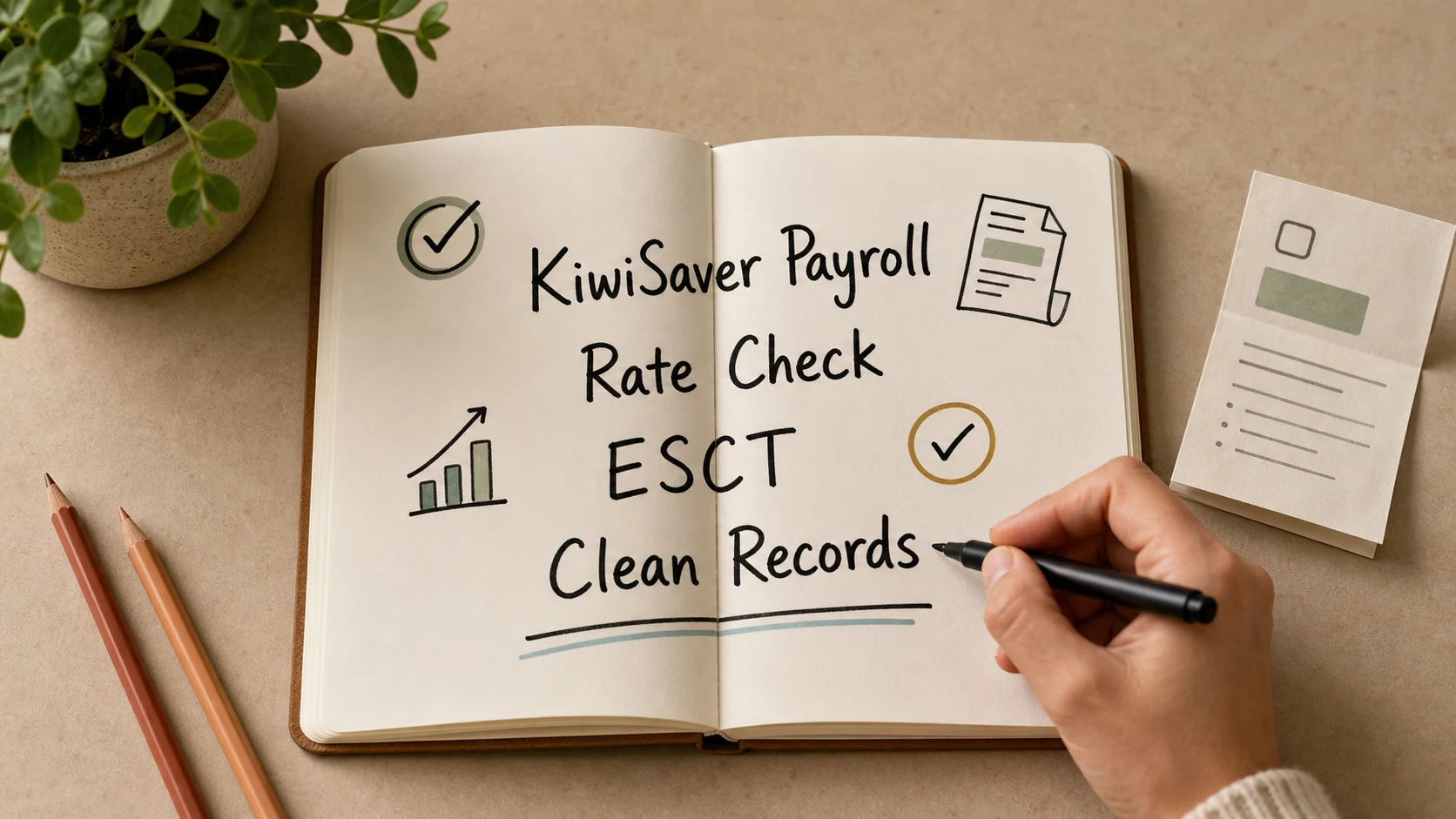
New Zealand employers should treat the 2026 KiwiSaver rate changes as a payroll-settings and record-keeping job, not just a percentage update. From 1 April 2026, the minimum employee and matching employer KiwiSaver contribution rates moved to 3.5%, with further movement planned later. That means payroll settings, employee notices, employer contributions, ESCT, bank payments and accounting records all need a clean review.
For small businesses, the practical next step is simple: check each employee’s KiwiSaver status and contribution rate before the next pay run, then make sure the employer contribution, ESCT and bookkeeping entries still agree with the payroll report.
KiwiSaver changes are easiest to handle when payroll and bookkeeping tell the same story: gross wages, employee deductions, employer contributions, ESCT and bank payments should reconcile.
Quick answer
The IRD’s KiwiSaver changes guidance says the default minimum contribution rate for both employees and employers increased to 3.5% from the first pay date on or after 1 April 2026. Employees may contribute 3.5%, 4%, 6%, 8% or 10%, while some employees can apply for a temporary rate reduction.
For employers, the bookkeeping question is not only “what rate should payroll use?” It is also “does the payroll report match the accounting records?” Employer contributions, employee deductions and ESCT can affect wage cost, liabilities, payments and month-end review.
Key points
- This is a New Zealand payroll change. Do not apply Australian STP, super or PAYG rules to it.
- KiwiSaver deductions and employer contributions should be checked employee by employee.
- ESCT applies to employer superannuation contributions unless a different PAYE treatment has been agreed.
- Payroll records, bank payments and accounting entries should reconcile after each pay run.
- Gimbla can help keep New Zealand business records, invoices, expenses, GST and reports tidy, but employers still need compliant payroll settings for KiwiSaver and PAYE.
What changed from 1 April 2026?
The rate shift means many New Zealand employers need to review both sides of the KiwiSaver workflow:
| Payroll area | What to check | Why it matters |
|---|---|---|
| Employee contribution rate | Whether the employee is on 3.5%, 4%, 6%, 8%, 10% or a valid temporary reduction | The deduction comes out of employee pay |
| Employer contribution | Whether the employer contribution is at least the required rate for eligible employees | It is an employer cost and may be subject to ESCT |
| Temporary rate reduction | Whether the employee has supplied or IRD has issued a valid notice | The payroll setting may be different from the default |
| ESCT | Whether the right ESCT method and rate are used | The net amount paid to KiwiSaver may differ from the gross employer contribution |
| Accounting records | Whether wage expense, deductions, liabilities and payments reconcile | Month-end reports and cash flow depend on clean payroll posting |
The IRD’s employer contribution guidance says employers generally make compulsory employer contributions each time they pay salary or wages to eligible KiwiSaver employees. It also explains that ESCT applies to employer contributions unless the employer and employee have agreed to treat the contribution as salary or wages under PAYE rules.
KiwiSaver deductions, employer contributions and ESCT are different
It is easy to blur these three items because they appear around the same pay run.
Employee KiwiSaver deductions are amounts withheld from the employee’s gross pay and paid through the payroll process.
Employer KiwiSaver contributions are amounts the employer contributes for eligible employees. They are usually an employer cost, not a deduction from net pay.
ESCT is tax on employer superannuation contributions. It reduces the employer contribution amount that reaches the employee’s KiwiSaver or complying fund unless the contribution is treated under PAYE rules.
This distinction matters in the books. A payroll report might show gross wages, employee deductions, employer contributions, ESCT and net pay separately. If those amounts are posted into accounting software too broadly, the Profit and Loss statement, liabilities and bank reconciliation become harder to trust.
Simple example
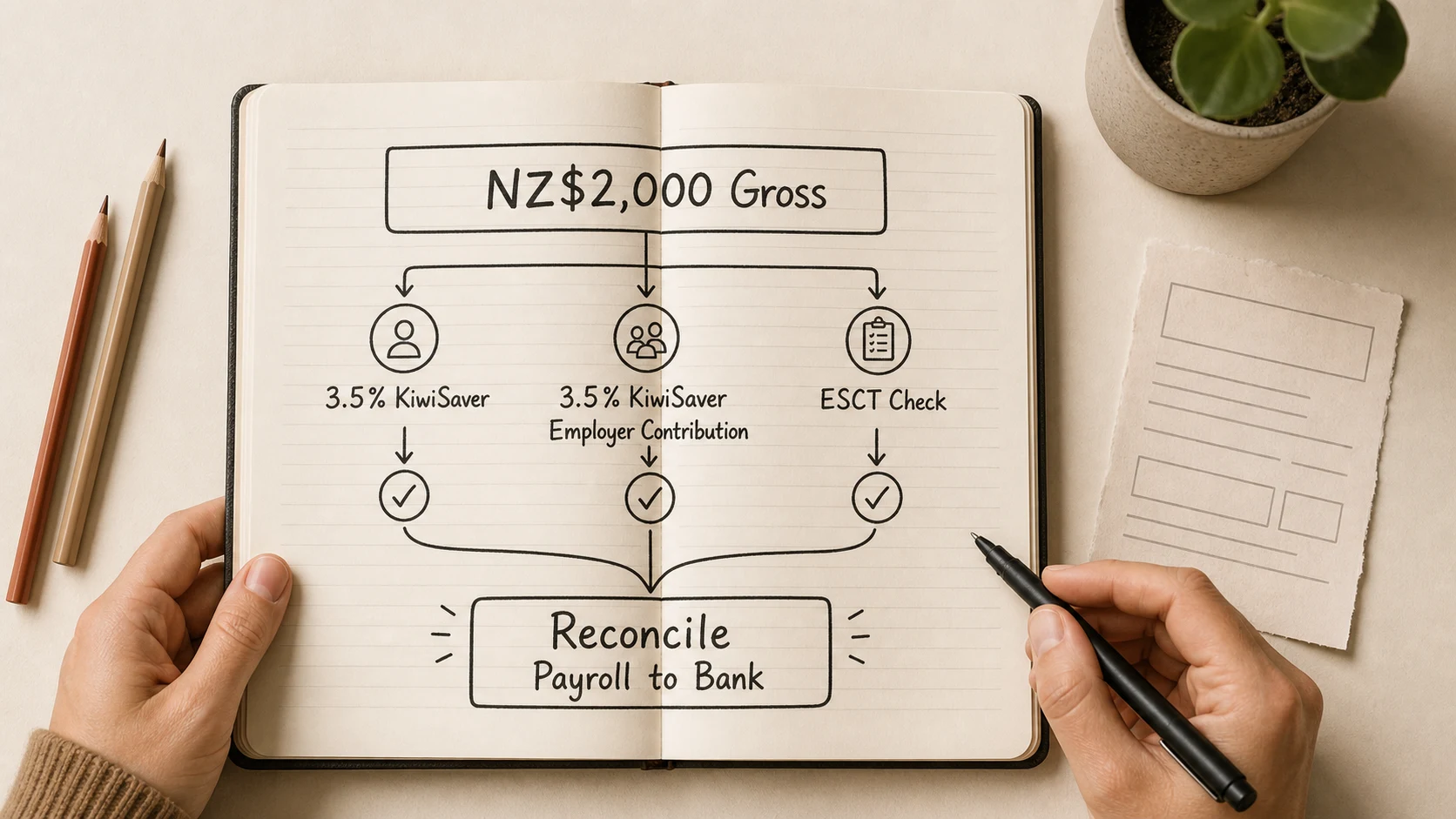
Imagine a Wellington design studio pays an employee NZ$2,000 gross for a fortnightly pay run. The employee is in KiwiSaver and uses the 3.5% employee contribution rate.
The payroll review should separate:
- gross wages
- employee KiwiSaver deduction
- PAYE and other employee deductions
- employer KiwiSaver contribution
- ESCT on the employer contribution
- net pay to the employee
- total amount payable through the payroll filing and payment process
The owner should not only approve the bank payment. They should check that the payroll report, bank transactions and accounting entries agree. That habit makes it easier to spot a wrong rate, a missed temporary reduction, a duplicated liability or an ESCT coding problem before month end.
Records New Zealand employers should keep
Employment New Zealand’s record-keeping guidance says employers must keep complete and accurate wage, time, holiday and leave records. It also notes that if payroll software calculates records, employers still need to check the system accurately records changes to employees’ hours and pay.
For KiwiSaver and ESCT, a useful file trail includes:
- the employee’s KiwiSaver deduction rate or change notice
- any temporary rate reduction certificate or IRD notice
- pay-run reports showing employee deductions and employer contributions
- ESCT calculation details or payroll settings
- bank payment records
- accounting entries for wages, payroll liabilities and employer contribution costs
- notes from your payroll adviser, accountant or tax agent where a treatment is not obvious
Good records reduce the pain when an employee asks a question, IRD details do not match expectations, or the accountant reviews payroll costs at year end.
Accounting software workflow
KiwiSaver is a payroll compliance workflow, but it also leaves a bookkeeping trail. After each pay run, the business should be able to answer:
- What was the gross wage cost?
- What was deducted from employee pay?
- What employer contribution was recorded?
- What ESCT was deducted or payable?
- What cash left the bank?
- What liability remains unpaid?
- Do payroll, bank and accounting reports agree?
Gimbla’s New Zealand accounting software page is focused on everyday bookkeeping: invoices, expenses, GST-friendly records, cash flow and reports. If you use separate payroll software for KiwiSaver and PAYE, the job is to post payroll totals into the accounts cleanly, reconcile the bank payment, and keep payroll liabilities separate from ordinary expenses.
For wider country setup, Gimbla’s free accounting software by country guide explains why GST, VAT, sales tax and payroll rules need local treatment. For tax setup inside the books, the GST, VAT and sales tax guide is useful background.
Checklist before the next pay run
Use this as a practical review:
- Confirm which employees are in KiwiSaver or a complying fund.
- Check each employee’s current contribution rate.
- Record any valid temporary rate reduction.
- Confirm employer contribution settings for eligible employees.
- Review ESCT settings and rate logic.
- Run a draft payroll report before paying staff.
- Compare payroll totals with expected bank payments.
- Post payroll totals into the accounting records clearly.
- Reconcile the bank payment after it clears.
- Keep employee notices and payroll reports with the period’s records.
Common mistakes to avoid
Updating the default rate but not employee exceptions
Some employees may use a higher rate, a valid temporary reduction or a different situation. Do not treat one default setting as the whole payroll review.
Treating employer contributions as employee deductions
Employee deductions and employer contributions are different. Mixing them can distort wage cost, liabilities and employee records.
Forgetting ESCT
ESCT changes the net employer contribution that reaches the scheme. If ESCT is coded or calculated incorrectly, payroll and accounting reports can both look plausible while still being wrong.
Reconciliations that stop at net pay
Net pay is only one part of payroll. Reconcile deductions, employer contributions, ESCT, tax payments and bank movements as well.
Frequently asked questions
What changed for KiwiSaver payroll in 2026?
From the first pay date on or after 1 April 2026, the minimum employee and employer KiwiSaver contribution rates moved to 3.5%. Employees may use other allowed rates or, in some cases, a temporary rate reduction.
What is ESCT?
ESCT is employer superannuation contribution tax. It is deducted from employer contributions to KiwiSaver or complying funds unless the employer contribution is treated as salary or wages under PAYE rules.
Do KiwiSaver changes affect accounting records?
Yes. Employer contributions, employee deductions, ESCT, payroll liabilities and bank payments all need to be recorded clearly so payroll reports, accounting reports and bank reconciliation agree.
Can Gimbla run New Zealand KiwiSaver payroll?
This article is about the bookkeeping and record trail around KiwiSaver payroll. Use compliant New Zealand payroll software, IRD guidance or a payroll adviser for KiwiSaver and PAYE calculations. Gimbla can help keep the wider business records, GST, bank reconciliation and reports organised.
In short
The 2026 KiwiSaver change is a useful prompt to clean up payroll records. Check employee rates, employer contributions, ESCT and bank payments before the next pay run, then make sure the accounting records agree with the payroll report.