- Overview
- Quick answer
- Key points
- The three figures in a GST calculation
- Add GST and remove GST are different jobs
- Mixed taxable and GST-free invoice lines
- Discounts and rounding
- Simple example
- What to check before relying on the result
- From the worksheet to an invoice and BAS
- Practical calculation checklist
- Frequently asked questions
- Conclusion
How to Add or Remove GST in Australia
Published August 3rd, 2026 | Team Gimbla
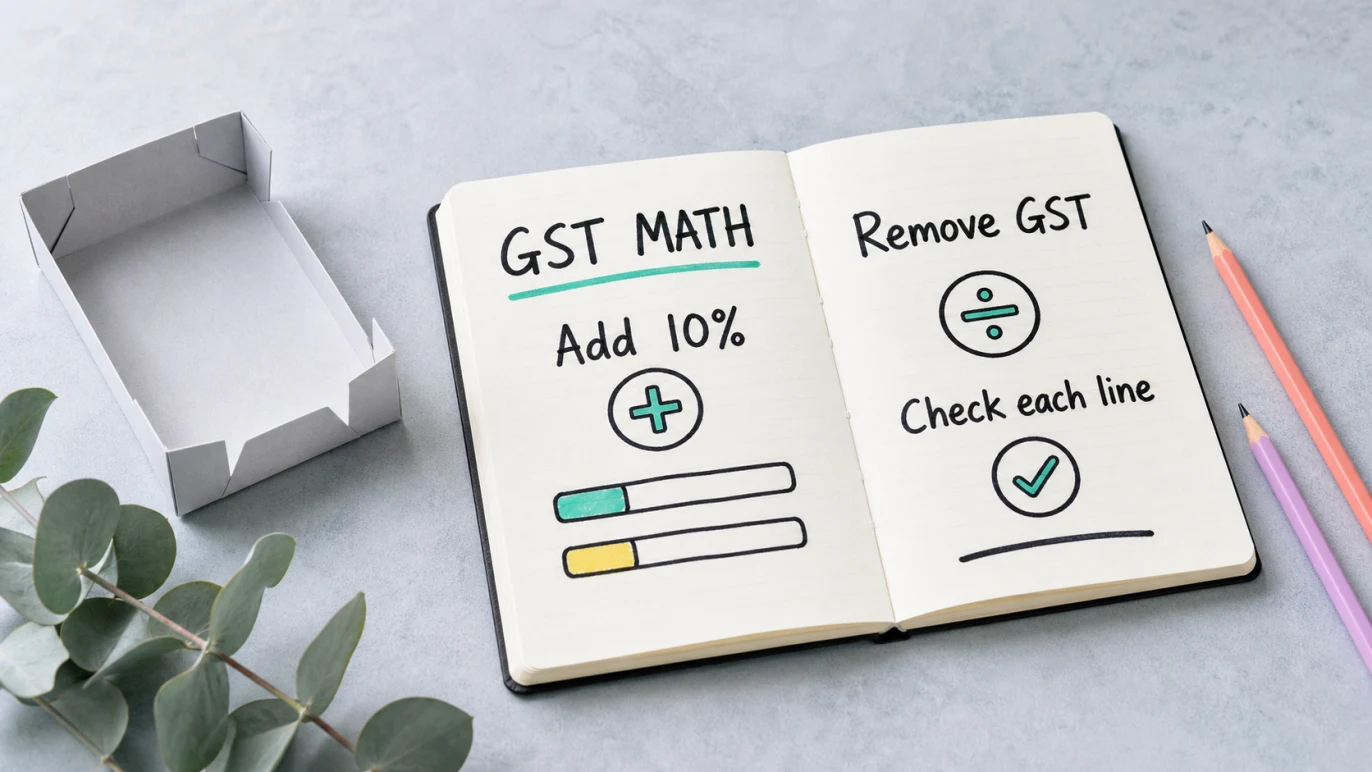
To add GST to a fully taxable Australian price, multiply the GST-exclusive amount by 1.10. To remove GST from a GST-inclusive amount, divide by 1.10. To find only the GST inside a fully taxable inclusive price, divide the inclusive amount by 11.
That quick formula is useful for one amount. A real invoice needs one more step: apply the formula only to taxable lines, after relevant discounts, then check that the displayed GST and total agree to the cent. GST-free, input-taxed and out-of-scope sales must not be swept into a blanket 10% calculation.
The formula is simple; the important accounting decision is which lines are actually taxable.
Quick answer
Australian GST is 10% on most taxable sales. Use these three calculations for a fully taxable amount:
- GST-exclusive to GST-inclusive: exclusive price ×
1.10 - GST-inclusive to GST-exclusive: inclusive price ÷
1.10 - GST inside an inclusive price: inclusive price ÷
11
For mixed invoices, calculate each taxable line separately and leave GST-free lines out of the GST subtotal. The ATO’s GST definitions distinguish taxable, GST-free and input-taxed sales. If classification is uncertain, confirm it before issuing the invoice rather than using the calculator result as tax advice.
This article was checked on 3 August 2026. The general GST registration threshold remains $75,000 for a business or enterprise and $150,000 for a non-profit organisation, with special rules for some activities. The ATO’s GST registration guidance explains current and projected turnover tests and when registration is compulsory.
Key points
- Add 10% to a GST-exclusive taxable price; do not add another 10% to a price that already includes GST.
- One-eleventh of a fully taxable GST-inclusive price is the GST component.
- Apply discounts before calculating GST on the reduced taxable price.
- Separate taxable and GST-free lines before calculating the invoice total.
- Keep the source invoice, tax treatment and GST amount connected to your BAS records.
The three figures in a GST calculation
| Figure | What it means | Quick formula for a fully taxable sale |
|---|---|---|
| GST-exclusive | The price before GST | Inclusive price ÷ 1.10 |
| GST | The tax on the taxable part of the sale | Exclusive price × 10%, or inclusive price ÷ 11 |
| GST-inclusive | The customer-facing total after GST | Exclusive price × 1.10 |
For example, a $500 GST-exclusive taxable service has $50 GST and a $550 GST-inclusive price. Starting from $550, dividing by 11 gives $50 GST, while dividing by 1.10 gives the original $500 price.
The shortcut works only when the entire amount is taxable at 10%. If an inclusive total contains GST-free items, dividing the whole total by 11 overstates GST.
Add GST and remove GST are different jobs
| Starting amount | Job | Correct operation |
|---|---|---|
| GST-exclusive taxable price | Add GST | Multiply by 1.10 |
| GST-inclusive taxable price | Find the pre-GST price | Divide by 1.10 |
| GST-inclusive taxable price | Find only the GST component | Divide by 11 |
A common mistake is to remove GST by subtracting 10% from the inclusive price. Ten per cent of $110 is $11, which would leave $99; the correct exclusive price is $100. The tax is one-eleventh of the inclusive amount because the $110 total represents 110% of the pre-GST price.
Mixed taxable and GST-free invoice lines
Start with the tax treatment, not the grand total. For each line:
- Multiply quantity by unit price.
- Apply any line discount.
- Decide whether the discounted line is taxable, GST-free, input taxed or outside the GST system.
- Calculate GST only on taxable lines.
- Add the exclusive lines, GST and inclusive totals.
The GST glossary explains the core terms, while the GST invoice checklist covers the details a tax invoice should show. A calculation cannot determine whether a particular food, health, education, export, property or financial supply qualifies for special treatment; those rules depend on the facts.
Discounts and rounding
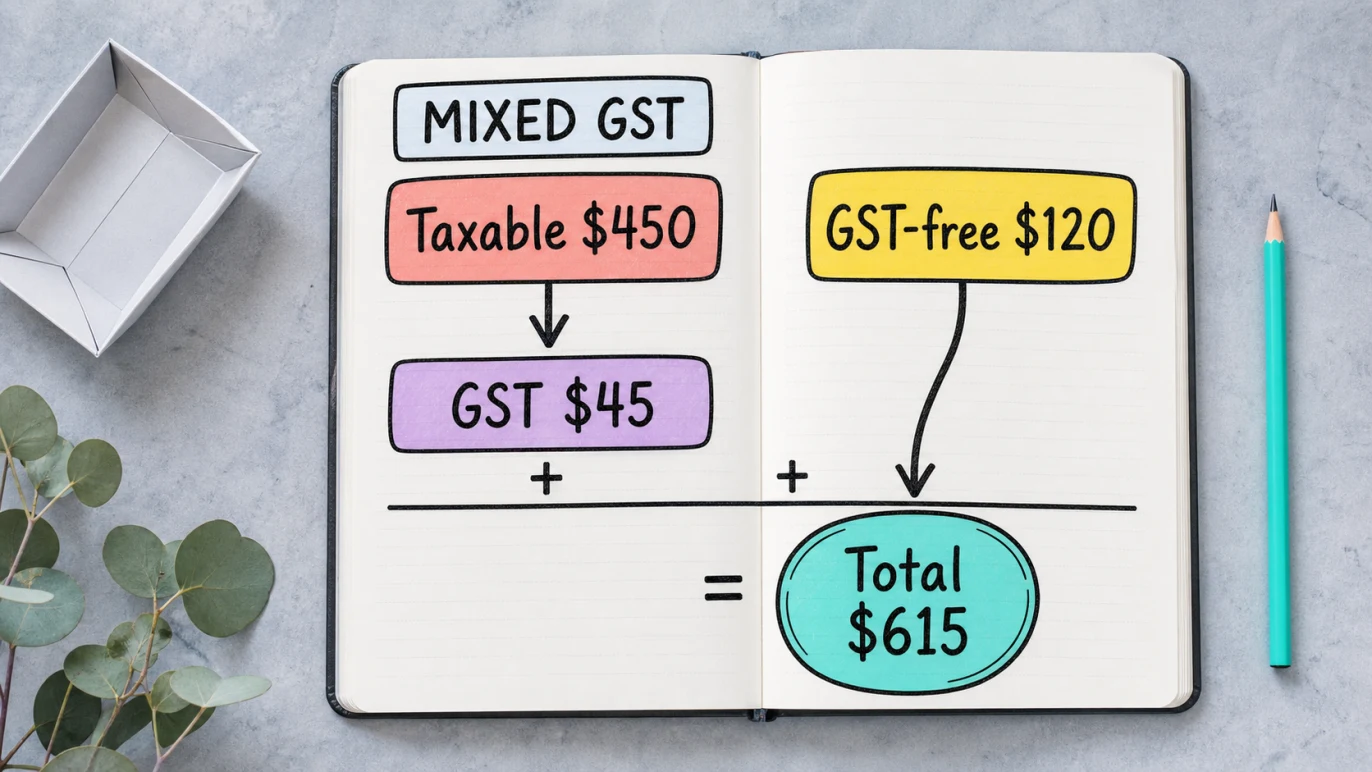
If a taxable line is discounted, GST is calculated from the reduced price. A 10% discount on a $500 taxable line reduces the exclusive value to $450, so the GST is $45, not $50.
Work to full precision, then round the GST shown to the nearest cent. Where a GST amount lands exactly on half a cent, Australian tax-invoice rounding uses half-up treatment. Small differences can still arise when one system calculates GST for each displayed line and another works from a taxable invoice subtotal. Use one consistent method, keep any rounding adjustment visible and make sure the invoice total agrees with the accounting record.
Simple example
A small business prepares an invoice with one discounted taxable service and one line already confirmed as GST-free. It calculates the two lines separately rather than dividing the final mixed total by 11.
| Invoice line | Calculation | Exclusive | GST |
|---|---|---|---|
| Taxable service | 2 × $250, less 10% discount | $450.00 | $45.00 |
| GST-free item | 3 × $40 | $120.00 | $0.00 |
| GST-exclusive subtotal | $450 + $120 | $570.00 | $45.00 |
| GST-inclusive total | $615.00 | ||
The GST is $45, not one-eleventh of the $615 total. Dividing the mixed total by 11 would incorrectly treat the GST-free $120 line as taxable.
What to check before relying on the result
- Confirm the business is registered, or required to be registered, before charging GST.
- Check the tax treatment of every unusual line instead of guessing from its description.
- Confirm whether entered prices are GST-exclusive or GST-inclusive.
- Apply discounts before calculating the taxable amount.
- Compare the worksheet with the final tax invoice and accounting entry.
- Ask a registered tax agent or BAS agent about mixed, input-taxed, margin-scheme, cross-border or other specialised supplies.
From the worksheet to an invoice and BAS
The calculation is only the start of the bookkeeping trail. In Gimbla, the practical flow is:
- Create the customer and invoice lines.
- Apply the correct tax treatment to each line.
- Review the subtotal, GST and amount due before sending.
- Match the customer payment during bank reconciliation.
- Review sales tax and purchase tax in the tax report before lodging the BAS.
- Record the BAS payment against the GST liability account rather than a normal expense.
The invoice total guide explains how GST, discounts, credits and payments reach the amount due. The GST, VAT and Sales Tax user guide shows the reporting and liability-clearing workflow in Gimbla. You can also create a simple invoice before setting up the wider books.
When the calculation is ready to become a live accounting record, create the invoice in Gimbla.
Practical calculation checklist
- Mark every amount as GST-exclusive or GST-inclusive.
- Separate taxable, GST-free and other tax treatments.
- Calculate quantity and discounts before GST.
- Round displayed GST to cents and check the grand total.
- Put the tax treatment and GST amount on the invoice clearly.
- Keep the invoice and supporting classification evidence for BAS review.
Frequently asked questions
How do I add 10% GST to a price?
Multiply the GST-exclusive price by 1.10. The difference between that result and the original price is the GST amount.
How do I remove GST from a GST-inclusive price?
For a fully taxable sale, divide the GST-inclusive price by 1.10 to find the GST-exclusive price, or divide it by 11 to find the GST component.
Do I charge GST on every invoice line?
No. Apply GST only to taxable sales. GST-free, input-taxed and out-of-scope items need their own correct treatment.
Should a discount be applied before GST?
Calculate GST from the discounted taxable price. Keep the discount and tax treatment visible so the invoice total can be checked.
Conclusion
Adding or removing GST is straightforward when the whole amount is taxable. Mixed invoices require better bookkeeping: classify each line, apply discounts first, calculate GST only where it belongs and make the final invoice agree with the records that support your BAS.