- Overview
- Quick answer
- Key points
- What changes for accounting and bookkeeping practices?
- Who may be covered?
- AML/CTF compared with normal bookkeeping checks
- Simple example
- What to prepare before relying on a starter kit
- How accounting software can help
- Practical checklist before 1 July 2026
- Frequently asked questions
- Conclusion
AML/CTF Reforms for Accountants and Bookkeepers: What to Prepare Before 1 July 2026
Published May 23rd, 2026 | Team Gimbla
Australia’s AML/CTF reforms bring certain professional services into AUSTRAC’s regime from 1 July 2026. For accounting practices, bookkeepers and small-business advisers, the first job is not to panic or buy a generic policy pack. It is to check whether the services you provide are covered, enrol if required, then build a risk-based process that staff can actually follow.
This matters even for small practices because AML/CTF work is not only a legal file. It touches client onboarding, identity checks, record keeping, staff training, document retention, access controls and the way unusual client behaviour is escalated.
Treat AML/CTF preparation as an operating process, not a one-off compliance document. The practice needs clear client checks, clear responsibility and records that can be found later.
Quick answer
From 1 July 2026, AUSTRAC says AML/CTF law will extend to certain services typically provided by accountants, lawyers, conveyancers, real estate professionals, dealers in precious metals and stones, and trust and company service providers. Accountants are not covered merely because they prepare accounts or tax work; coverage depends on whether the practice provides a designated service and has the required Australian connection.
Start with AUSTRAC’s check if you may be regulated tool. If your practice is likely to be regulated, review AUSTRAC’s accounting program starter kit, choose who owns the work, and map the client records your team will need before 1 July 2026.
Key points
- The reforms are service-based, so check what your practice actually does for clients.
- AUSTRAC opened enrolment for new professions on 31 March 2026.
- Covered practices need an AML/CTF program before providing designated services from 1 July 2026.
- Customer due diligence, suspicious matter reporting and record keeping become operational workflows, not just adviser notes.
- Accounting software can support the record trail, but it does not replace AML/CTF judgement or legal compliance.
What changes for accounting and bookkeeping practices?
The reforms pull some professional-service work into Australia’s AML/CTF regime. AUSTRAC says businesses including accountants can enrol online from 31 March 2026, and from 1 July 2026 covered businesses must comply with obligations such as AML/CTF programs, customer due diligence, suspicious matter reporting and record keeping.
For a small accounting or bookkeeping practice, that means the compliance question becomes operational:
| Area | What changes | Practical preparation |
|---|---|---|
| Scope | Not every service is automatically covered | List services and test them against AUSTRAC’s guidance |
| Enrolment | Covered practices need to enrol with AUSTRAC | Decide who owns enrolment and profile updates |
| Client onboarding | Identity, beneficial ownership and risk checks may be needed | Build checklists before accepting covered work |
| Suspicious matters | Staff need to know when to escalate unusual behaviour | Create a simple internal escalation path |
| Records | Evidence must be kept and retrievable | Keep client files, checks, notes and decisions organised |
The important distinction is between ordinary bookkeeping hygiene and regulated AML/CTF obligations. Good records help, but they are not the whole program.
Who may be covered?
AUSTRAC frames the expansion around designated services. That means an accounting practice, bookkeeper or adviser should check the specific services it provides rather than assuming the business is either always inside or always outside the regime.
Common areas to review include services connected with company, trust or legal arrangement work, high-risk transactions, complex structures, property-related activity and client money movement. If your practice only performs routine bookkeeping, payroll admin or tax-record preparation, do not assume the same answer applies. The safest step is to run the AUSTRAC check and get legal advice if the result is unclear.
AML/CTF compared with normal bookkeeping checks
Bookkeepers already collect records, question odd transactions and keep client files tidy. AML/CTF goes further because it is focused on money laundering, terrorism financing and proliferation financing risk.
| Normal bookkeeping check | AML/CTF-style check |
|---|---|
| Is the invoice or bill complete? | Does the client, structure or transaction create ML/TF risk? |
| Is the transaction coded correctly? | Do we understand the client and beneficial owners? |
| Does the bank reconciliation balance? | Is there unusual behaviour that needs escalation? |
| Are records ready for BAS or tax time? | Are AML/CTF decisions, checks and reports documented? |
The two workflows can support each other. A clean audit trail, clear client records and controlled access make compliance work easier, but AML/CTF still needs its own risk-based program.
Simple example
Imagine a two-partner accounting practice that mainly helps local small businesses with tax, BAS, bookkeeping cleanup and company setup work. The partners use AUSTRAC’s tool and identify that some company and trust services may be designated services.
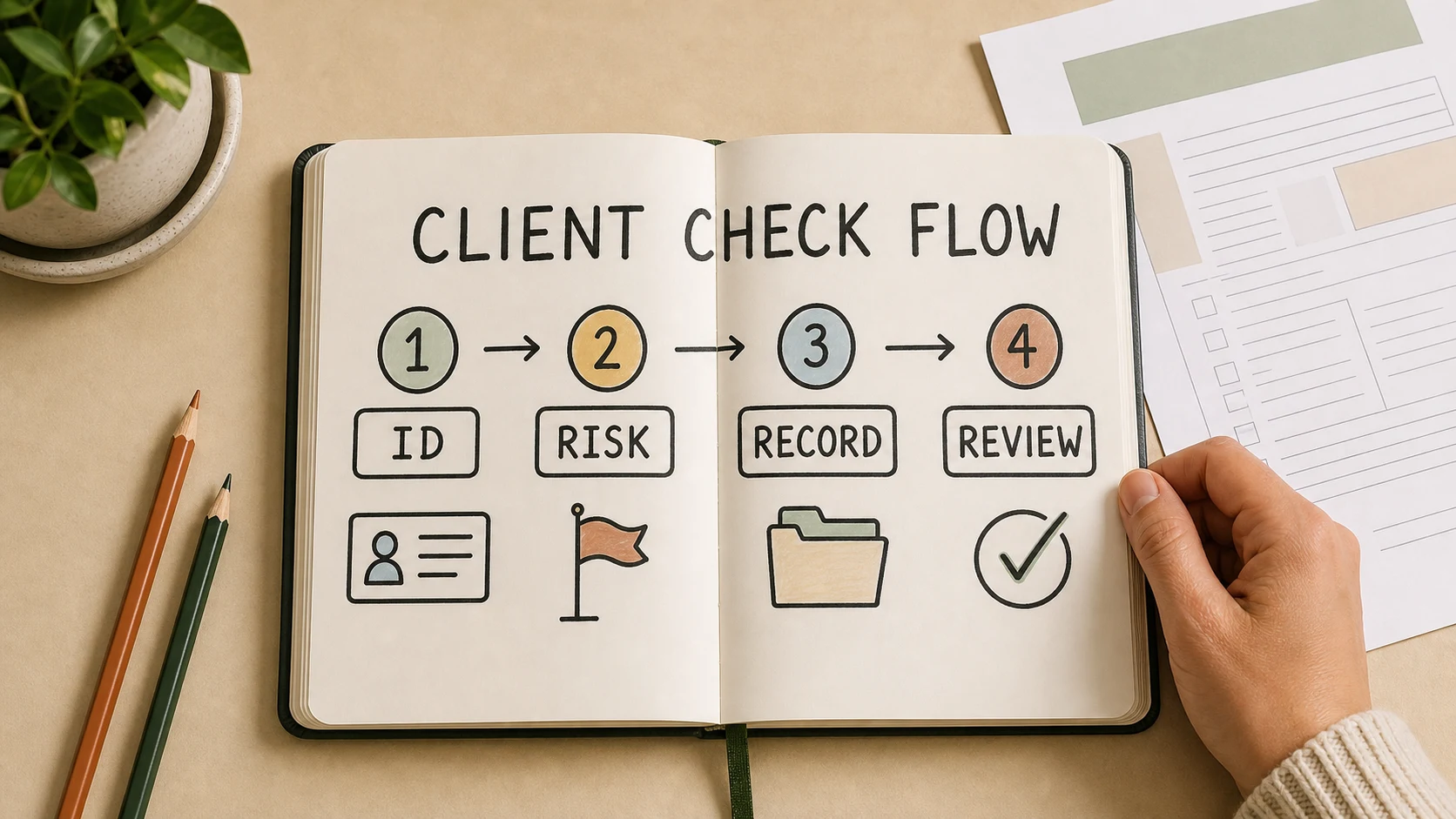
The practice does not need a complicated enterprise system on day one. It needs a repeatable workflow:
- Confirm which services are covered.
- Enrol with AUSTRAC if required.
- Customise the AML/CTF program for the practice’s size and risk profile.
- Add client identity, beneficial ownership and risk notes to onboarding.
- Train staff to escalate unusual client behaviour.
- Keep records so later review does not rely on memory.
What to prepare before relying on a starter kit
AUSTRAC’s accounting starter kit is designed to help small practices customise, use and maintain an AML/CTF program. AUSTRAC also says practices that do not meet the starter kit’s suitability characteristics need to assess whether the kit is appropriate and identify changes.
Before relying on any template, gather:
- a list of services the practice provides
- client types, including individuals, companies, trusts and overseas clients
- how client identity and authority are currently checked
- who can approve new clients and higher-risk work
- where client records, notes and supporting documents are stored
- how staff escalate concerns
- how often policies and procedures will be reviewed
This is where a small practice can get into trouble with a beautiful document and weak habits. The program should describe how the team actually works.
How accounting software can help
Accounting software is not an AML/CTF program, but it can support the evidence trail around clients and transactions.
In Gimbla, the useful supporting habits are ordinary but powerful:
- use role-based access through the invite a user guide so staff, advisers and reviewers do not share logins
- keep bank activity tidy with bank reconciliation
- maintain a clear chart of accounts and general ledger
- keep invoice, bill and payment records close to the client file
- use the small business bookkeeping checklist as a routine for keeping evidence current
- review exceptions during accounting close rather than leaving them to year end
Those steps do not decide whether a suspicious matter report is required. They make the facts easier to find when the compliance officer, partner or adviser needs to make that call.
Practical checklist before 1 July 2026
- List every service your practice provides.
- Use AUSTRAC’s check tool to identify possible designated services.
- Decide who owns AML/CTF preparation internally.
- Enrol with AUSTRAC if your practice is required to enrol.
- Customise an AML/CTF program to your practice’s size, services and client risks.
- Update client onboarding to capture identity, ownership and risk information.
- Train staff on escalation and record keeping.
- Review software access, document storage and audit trails.
- Set a review date after the first few months of operating under the program.
AUSTRAC’s transitional rules guidance also notes timing details for newly regulated businesses, including when an AML/CTF compliance officer must be notified. Check the current AUSTRAC guidance before setting internal deadlines.
Frequently asked questions
Do all accountants and bookkeepers need to enrol with AUSTRAC?
Not automatically. Coverage depends on the services provided and the required Australian connection. Use AUSTRAC’s tool and get legal advice if the answer is unclear.
When do the AML/CTF reforms start for accountants?
For newly regulated professional services, the main start date is 1 July 2026. AUSTRAC opened enrolment for new professions on 31 March 2026.
What should a small accounting practice prepare first?
Start with scope. List your services, identify which may be designated services, decide who owns compliance, then customise a program and onboarding workflow before accepting covered work after 1 July 2026.
Can accounting software replace an AML/CTF program?
No. Accounting software can support clean records, access controls and audit trails. It cannot replace legal review, customer due diligence judgement, suspicious matter escalation or a compliant AML/CTF program.
Conclusion
The AML/CTF reforms are not just another policy file. They ask accounting and bookkeeping practices to know which services create risk, check clients consistently, keep evidence and escalate unusual matters before they become bigger problems.
For Gimbla users, the practical starting point is strong record discipline: clear users, clean bank reconciliation, tidy client records, and audit trails that make later review easier. Pair that with AUSTRAC’s official guidance and professional legal or compliance advice where the practice’s obligations are not obvious.