- Overview
- Quick answer
- Key points
- ACNC reporting requirements by charity size
- What is the Annual Information Statement?
- What must an annual financial report contain?
- Review versus audit for charities
- When are the AIS and financial report due?
- Records every charity should keep
- Simple example
- How Gimbla makes charity reporting easier
- Year-end ACNC reporting checklist
- Frequently asked questions
- The bottom line
ACNC Financial Reporting Requirements for Australian Charities
Published August 23rd, 2026 | Team Gimbla
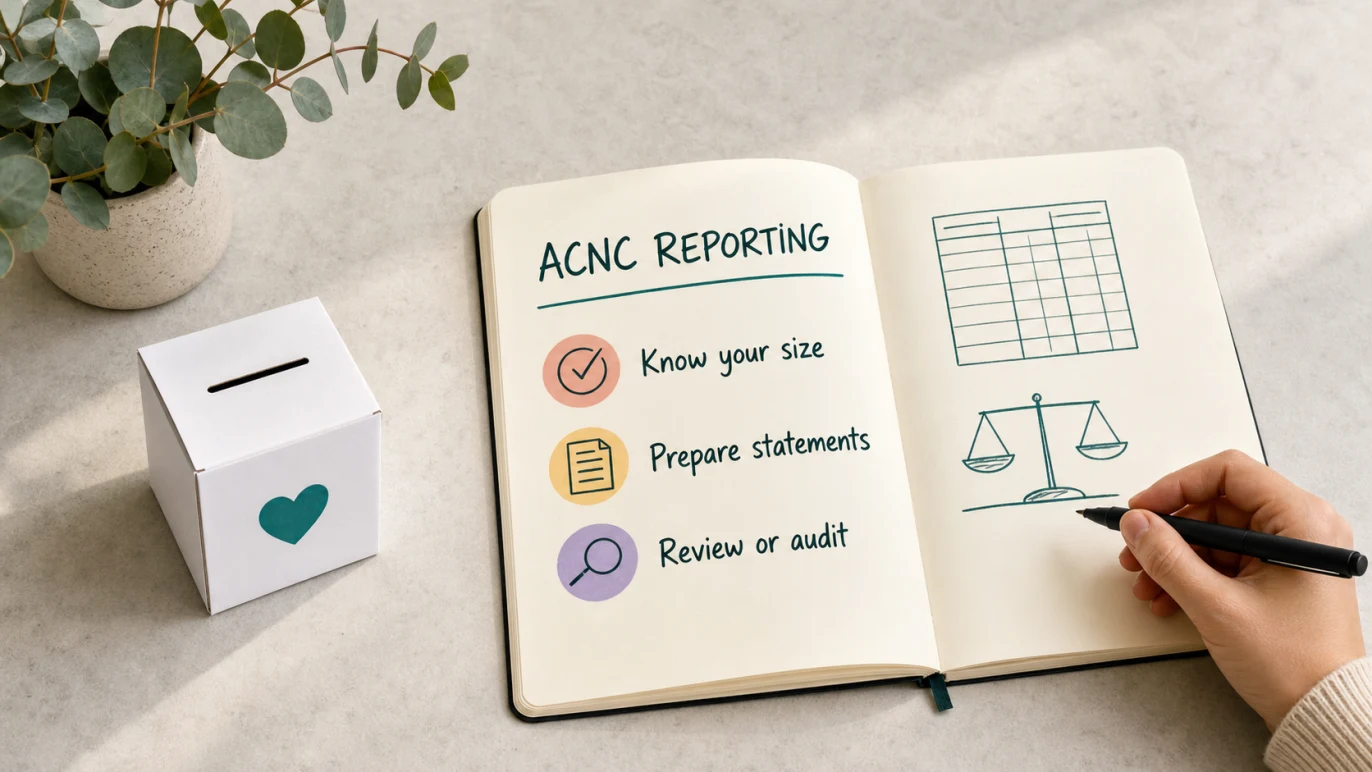
Most Australian registered charities must submit an Annual Information Statement to the ACNC every year. Whether the charity must also submit an annual financial report—and whether that report needs a review or audit—depends mainly on annual revenue. Small charities are generally not required by the ACNC to submit a financial report, medium charities must submit a reviewed or audited report, and large charities must submit an audited report.
The ACNC’s financial and other reporting guidance is the official starting point. A charity should also check its governing document, grants and obligations to other regulators because those rules can require more than the ACNC minimum.
ACNC reporting becomes much easier when the charity closes and reconciles its books throughout the year, instead of rebuilding the evidence after the reporting period ends.
Quick answer
ACNC reporting requirements follow the charity’s size for the reporting period:
- Small charity: annual revenue under $500,000. The Annual Information Statement is generally required, but an annual financial report is optional under ACNC rules.
- Medium charity: annual revenue of $500,000 or more but under $3 million. An Annual Information Statement and annual financial report are generally required, and the financial report must be reviewed or audited.
- Large charity: annual revenue of $3 million or more. An Annual Information Statement and audited annual financial report are generally required.
Medium and large charities must generally use accrual accounting for ACNC reporting. A small charity may use cash or accrual accounting. Basic Religious Charities and charities covered by certain special or transitional arrangements can have different requirements, so confirm the charity’s status before relying on the standard table.
Key points
- Charity size is based on annual revenue, not total income, assets, donations or profit.
- The Annual Information Statement and any required financial report are generally due within six months after the reporting period ends.
- An ACNC financial report is a formal package of statements, notes, declarations and assurance material—not just one report exported from accounting software.
- Small charities still need appropriate financial and operational records, even when submitting a financial report is optional.
- Gimbla can help keep the ledger, reconciliations, grant records and financial reports organised, but it does not replace the Charity Portal, a qualified reviewer, an auditor or professional advice.
ACNC reporting requirements by charity size
The current size thresholds have applied since the 2022 Annual Information Statement. Revenue is only one component of total income, so do not use donations received, cash in the bank or total assets as a shortcut for classifying the charity.
| Charity size | Annual revenue | Annual Information Statement | Annual financial report | Review or audit | Accounting basis |
|---|---|---|---|---|---|
| Small | Under $500,000 | Generally required | Optional under ACNC rules | No ACNC requirement | Cash or accrual |
| Medium | $500,000 to under $3 million | Generally required | Generally required | Review or audit | Accrual |
| Large | $3 million or more | Generally required | Generally required | Audit | Accrual |
This is the standard ACNC position. The ACNC charity-size guide notes exceptions for Basic Religious Charities and some reporting arrangements. A small charity’s constitution, governing document or grant agreement may also require statements, a review or an audit even though the ACNC does not.
What is the Annual Information Statement?
The Annual Information Statement, often shortened to AIS, is the annual online return submitted through the ACNC Charity Portal. It asks about the charity, its activities and its finances.
The AIS and annual financial report are connected but not interchangeable. The AIS contains questions and financial fields. Medium and large charities generally attach their separate annual financial report as part of the same annual reporting process.
Most registered charities must lodge an AIS, but exceptions apply. For example, the ACNC says charities registered with the Office of the Registrar of Indigenous Corporations do not submit an AIS to the ACNC. Check the charity’s record on the Charity Register rather than assuming every not-for-profit follows the same pathway.
What must an annual financial report contain?
For medium and large charities, the ACNC says the minimum annual financial report package generally includes:
- A statement of profit or loss and other comprehensive income.
- A statement of financial position, commonly called a balance sheet.
- A statement of changes in equity, where required.
- A statement of cash flows.
- Notes to the financial statements.
- A signed and dated Responsible People’s declaration covering the statements and notes.
- A signed reviewer’s or auditor’s report for a medium charity, or a signed auditor’s report for a large charity.
The statements must be either General Purpose Financial Statements or Special Purpose Financial Statements, depending on the charity’s circumstances and reporting-entity assessment. The report must also meet applicable Australian Accounting Standards and present a true and fair view.
This is where professional input matters. A clean Profit and Loss statement, balance sheet, cash flow statement and trial balance are strong foundations, but they do not automatically create the full compliant package. The notes, reporting framework, disclosures and Responsible People’s declaration still need to be prepared and checked.
Review versus audit for charities
A review and an audit are both independent assurance engagements, but they provide different levels of assurance.
| Assurance work | Who generally needs it | What it provides | Who can perform it |
|---|---|---|---|
| Review | A medium charity may choose a review instead of an audit | Limited assurance based on less extensive work than an audit | An eligible reviewer under the ACNC rules |
| Audit | A medium charity may choose one; a large charity generally must have one | Reasonable assurance and a direct opinion on the financial report | A registered company auditor, audit firm or authorised audit company |
The ACNC review and audit guidance also requires the reviewer or auditor to provide a signed written independence declaration. Book the engagement early: poor records or a late appointment can put the reporting timetable under pressure.
When are the AIS and financial report due?
The AIS and any required annual financial report are generally due within six months after the charity’s reporting period ends. The standard ACNC reporting period is 1 July to 30 June, but a charity may have an approved substituted accounting period.
That usually means:
- a 30 June period end leads to a 31 December due date
- a 31 December period end leads to a 30 June due date.
Extensions and special dates can change the practical deadline. For example, the ACNC extended the 2025 AIS deadline for standard 30 June balancers. Always check the charity’s actual date on the Charity Register and the current ACNC due-date guidance.
Records every charity should keep
Submitting a financial report may be optional for a small charity, but record keeping is not. The ACNC says charities must keep appropriate written financial and operational records for seven years. Financial records must explain transactions, financial position and performance, and allow true and fair statements to be prepared and reviewed or audited when required.
Keep a reporting file that brings together:
- bank statements and completed bank reconciliations
- donation, fundraising and membership income records
- grant agreements, project codes and grant acquittal evidence
- invoices, supplier bills, receipts, reimbursements and approvals
- payroll, PAYG withholding and super records where relevant
- GST and BAS records where relevant
- asset, loan and liability schedules
- board, committee or AGM minutes supporting financial decisions
- previous financial statements, accounting policies and assurance reports.
The charity may also have obligations to the ATO, a state or territory regulator, a grant provider or ASIC. ASIC’s registered-charity guidance explains that an organisation registered with both agencies still reports different matters to each one.
Simple example
Imagine a community charity with $850,000 of annual revenue. Under the current ACNC thresholds, it is a medium charity. It generally needs to submit an AIS and annual financial report, use accrual accounting, and have the financial report reviewed or audited.
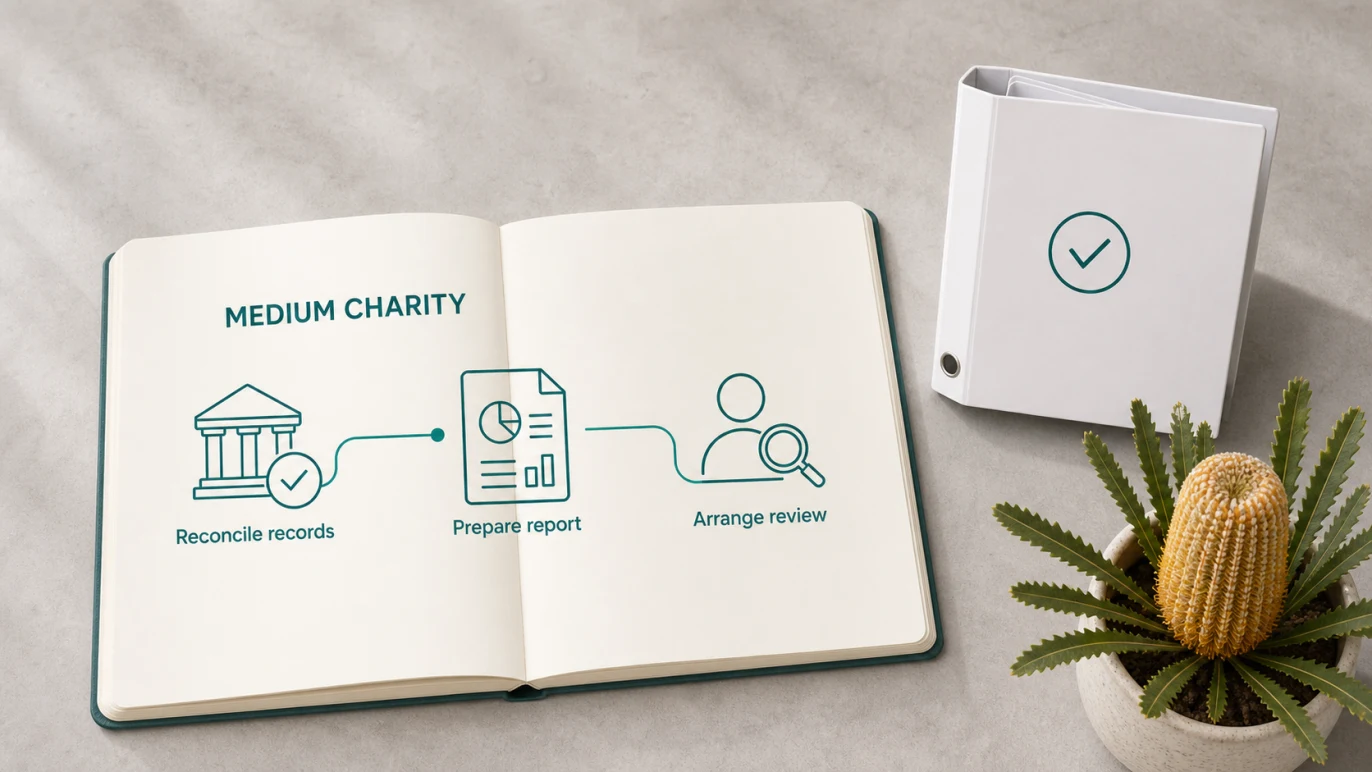
Throughout the year, the treasurer records donations and grant income, enters supplier bills, reconciles every bank account and runs project reports for restricted funding. After period end, the charity closes the ledger, resolves old balances, prepares the statements and notes with its accountant, obtains the Responsible People’s declaration and sends the complete package to its independent reviewer.
That workflow is far easier than asking a reviewer to start with unreconciled bank statements, missing bills and grant spreadsheets that do not agree with the ledger.
How Gimbla makes charity reporting easier
Gimbla helps with the accounting records underneath ACNC reporting. A charity can keep everyday invoices, bills, receipts, payments and journals in the same ledger, then use bank reconciliation to confirm that recorded cash agrees with the bank.
For grant-funded work, Gimbla’s grants and projects workflow can separate funding and related spending by project code. The treasurer can then review the Profit and Loss, balance sheet, cash flow and project information before the accountant or reviewer asks for it.
A practical Gimbla reporting rhythm is:
- Record donations, grants, invoices, bills and payments as they happen.
- Use consistent accounts and project codes for restricted or purpose-specific funds.
- Reconcile every bank and card account each month.
- Review the Profit and Loss, balance sheet, cash flow and unusual ledger balances.
- Give responsible people clear reports before they approve the annual accounts.
- Export or share the underlying reports and records with the accountant, reviewer or auditor.
Gimbla does not lodge the AIS or annual financial report directly to the ACNC. It also does not prepare every disclosure, sign the Responsible People’s declaration or provide an independent review or audit. Its value is making the bookkeeping and evidence easier to follow before those final compliance steps.
If your charity is comparing systems, review free accounting software for Australian organisations alongside the broader guide to charity accounting software.
Year-end ACNC reporting checklist
- Confirm the charity’s reporting period and actual AIS due date.
- Calculate annual revenue and confirm whether the charity is small, medium or large.
- Check for Basic Religious Charity status, ORIC reporting or another special arrangement.
- Read the governing document, grant agreements and other regulator requirements.
- Reconcile bank, receivable, payable, payroll, GST, grant, asset and loan accounts.
- Confirm whether the report needs a review or audit and appoint the right person early.
- Prepare the required statements, comparative figures, notes and disclosures.
- Obtain the signed Responsible People’s declaration and independence declaration.
- Attach the signed reviewer’s or auditor’s report where required.
- Submit through the ACNC Charity Portal and retain the underlying records.
Frequently asked questions
What reporting does the ACNC require?
Most registered charities must submit an Annual Information Statement each year. Medium and large charities must generally also submit an annual financial report, subject to exemptions and special arrangements.
Does a small charity need to submit a financial report to the ACNC?
For a small charity with annual revenue under $500,000, submitting an annual financial report is generally optional under ACNC rules. Its governing document, grant agreement or another regulator may still require financial statements, a review or an audit.
Does a medium charity need an audit?
Not necessarily. A medium charity with annual revenue from $500,000 to under $3 million must generally submit an annual financial report that is either reviewed or audited. The charity’s own governing document or funding terms may still require an audit.
When is an ACNC Annual Information Statement due?
The AIS and required financial report are generally due within six months after the reporting period ends. Check the ACNC Charity Register for the charity’s actual due date because extensions or an approved substituted accounting period may change it.
The bottom line
The core ACNC financial reporting obligation is size-based: small charities generally lodge the AIS without a mandatory financial report, medium charities add a reviewed or audited annual financial report, and large charities add an audited report. Every charity still needs records that explain its transactions, financial position and performance.
Gimbla makes the preparation easier by keeping the ledger, bank reconciliation, grants, projects and financial reports connected throughout the year. That gives the charity, accountant and independent reviewer or auditor a cleaner starting point when the formal ACNC reporting package is due.