South Africa Trust Filing 2026: Reconcile Beneficiary Records Before Submitting
Published September 9th, 2026 | Team Gimbla

South African trustees and bookkeepers preparing the 2026 trust filing should start with beneficiary records and reconciled accounts. SARS’s 7 September filing announcement gives 30 September 2026 for the IT3(t) third-party return and an ITR12T window from 19 September 2026 to 22 January 2027. Put both in the diary, then check that trustee decisions, beneficiary schedules and bank transactions tell the same story.
This is a record-preparation guide for people maintaining a trust’s books. A registered tax practitioner should confirm which amounts belong in each return and how they are taxed.
Keep the decision to vest an amount, the payment of that amount and the remaining balance visible as separate records.
Quick answer
The ITR12T is the trust’s annual income tax return. The IT3(t) reports third-party information about amounts vested in beneficiaries. Completing one does not complete the other. Your preparation pack should connect the trust’s financial reports to its beneficiary records, with an explanation for any difference.
The practical starting point is a beneficiary-by-beneficiary schedule: opening balance, amounts vested, payments made, other approved movements and closing balance. Have the adviser review its categories before using it for filing.
Key points
- Assign an owner to each submission and save its receipt separately.
- Match beneficiary names and identifiers across records before preparing the returns.
- Keep trustee decisions alongside transaction evidence; cash movements alone can miss amounts still unpaid.
- Separate trust assets and transactions from those of trustees, beneficiaries and related businesses.
Give Each Return Its Own Workstream
Use a small submission register rather than one task labelled “trust tax”. Record the taxpayer, assessment year, return, responsible person and submission status. Attach the confirmation when the task is finished.
SARS’s announcement applies the ITR12T closing date to both provisional and non-provisional trust taxpayers. It also identifies a simplified eFiling return for passive trusts. A quiet bank account is therefore a reason to review the correct return, not to assume that filing can be ignored.
If provisional tax is relevant, keep it in a separate workstream. The SARS trust FAQs confirm that an IRP6 submission does not replace the annual ITR12T. The broader South Africa tax records guide covers other filing and employer-record tasks.
Build a Pack That Someone Else Can Follow
SARS lists the trust deed or will, income and expenditure information, tax-credit evidence, financial statements or administration accounts, beneficial-ownership documents, trustee appointment resolutions and Letters of Authority among the records to have available.
Group the working file around the questions a reviewer needs to answer. The following organisation is a practical suggestion, not an additional SARS-prescribed form.
| Working file | What to put together | Review question |
|---|---|---|
| Authority and identity | Trust deed, amendments, appointment records and current participant details | Are the correct trust and authorised people identified? |
| Accounts | Trial balance, ledger detail, financial statements and bank reconciliations | Can each reported balance be traced to evidence? |
| Beneficiaries | Resolutions, individual movement schedules and payment references | Do decisions, payments and unpaid balances reconcile? |
| Filing | Reviewed return copies, submission receipts and unresolved queries | What was submitted, by whom, and what still needs attention? |
Give every file a clear period and version. A report labelled “final” is less useful than one showing the trust name, year-end, preparation date and reviewer. Keep a short list of unresolved items instead of hiding them in a long email chain.
Separate Vesting From Payment
SARS’s FAQs explain that vesting and cash distribution can happen at different times. In practical terms, a beneficiary may become entitled to an amount before the trust pays it. A bank statement shows the payment; it does not, by itself, establish the entitlement or its tax treatment.
Ask the adviser to reconcile the resolution and supporting legal documents with the beneficiary schedule. Do not simply classify every transfer to a beneficiary as an operating expense. It may concern a distribution, loan or another transaction that needs different treatment.
Preserve the actual dates and documents. If the evidence is incomplete, flag the gap for review rather than inventing a resolution or changing its date to make a schedule agree.
Simple example
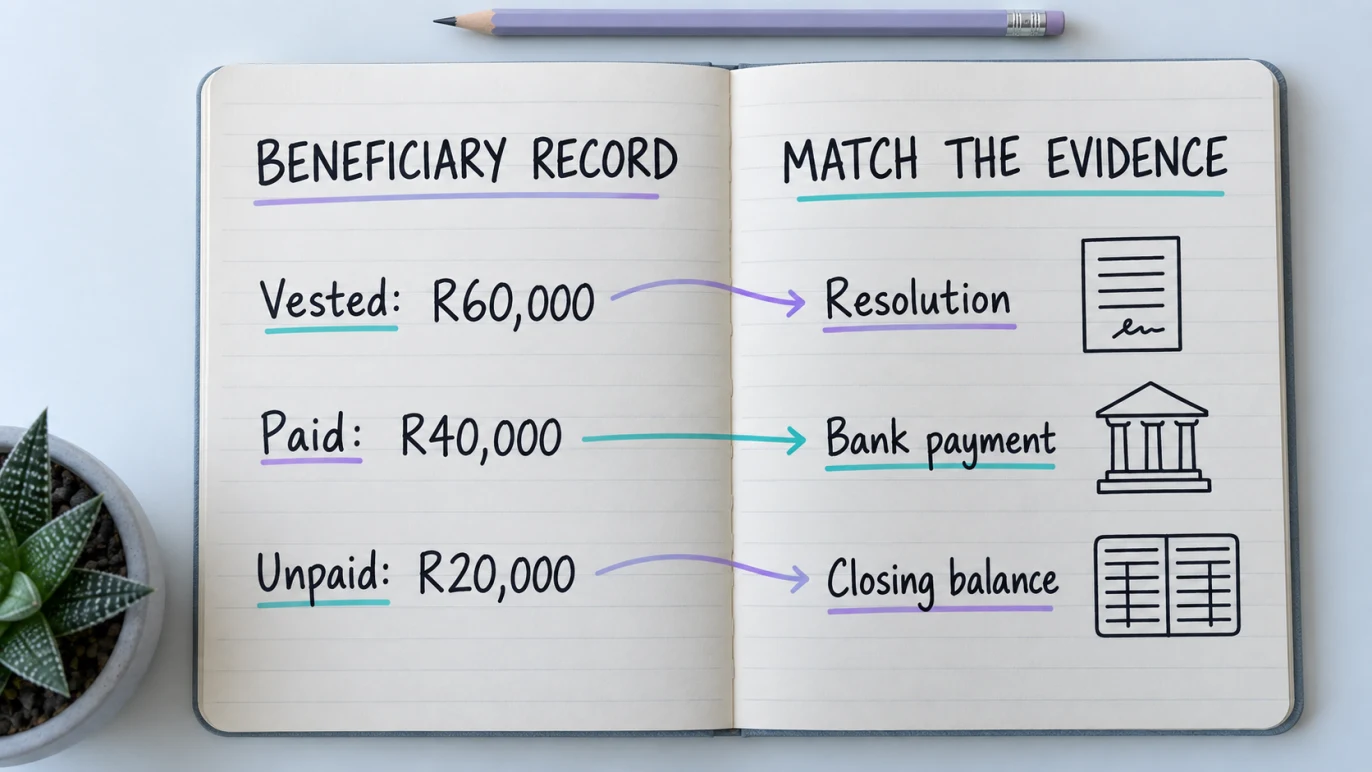
Assume a trustee resolution validly vests R60,000 in one beneficiary, as confirmed by the trust’s adviser. The opening amount payable is zero. The trust pays R40,000, and there are no other movements in this simplified example.
The reconciliation is R0 + R60,000 − R40,000 = R20,000 unpaid. Keep the resolution supporting R60,000, the bank reference supporting R40,000 and a closing schedule explaining R20,000 together.
A payment-only report would show R40,000 and miss the unpaid amount. The adviser still needs to determine the relevant income category, assessment year and return entries. These figures illustrate record matching, not a tax calculation or a rule for every trust.
Keep Ownership Information Consistent
The SARS ITR12T completion guide includes beneficial-ownership and participant information. Review the current form with the person preparing the return, especially where another entity sits between the trust and an individual.
Trust administration also involves the Master of the High Court. The South African Government’s trust registration page points trustees to a separate beneficial-ownership registration process. Do not assume that updating one authority automatically updates the other.
Use one controlled source of current names, identification details and authority documents for the review. Restrict access to sensitive personal information and share it through the secure channel agreed with the practitioner.
Use the Books to Support the Review
Start with bank reconciliation, then examine the trial balance and relevant general ledger accounts. Investigate unexplained transfers and balances before exporting the year-end reports.
For a bookkeeper using Gimbla, the useful handover is a consistent set of accounting reports with transaction references and supporting schedules. Keep the same cut-off date across exports and retain an audit trail for adjustments. Agree any beneficiary-account structure and journal treatment with the adviser before posting changes.
The handover should make each figure traceable. Specialist trust-return preparation and submission still need their own review and SARS process.
Before Handing Over the File
- Confirm the trust, assessment year, return obligations and submission owner.
- Reconcile bank accounts and list any outstanding reconciling items.
- Match beneficiary schedules to resolutions, payments and closing balances.
- Ask the practitioner to resolve classification, ownership or documentation gaps.
- Save the approved reports and each submission confirmation together.
Frequently Asked Questions
When are South African trust returns due in 2026?
SARS gives 30 September 2026 for the IT3(t) third-party return for the 2026 year of assessment. The ITR12T filing window runs from 19 September 2026 to 22 January 2027. Confirm the trust’s obligations with its registered tax practitioner.
Does filing an IRP6 replace the ITR12T?
No. SARS says submitting a provisional tax return does not remove the obligation to submit the trust’s annual ITR12T income tax return.
Can I use bank payments alone to prepare beneficiary records?
No. Compare bank payments with the trust deed, trustee resolutions and beneficiary schedules. An amount vested in a beneficiary can differ from the cash paid, so ask the adviser to confirm the reporting treatment.