- Overview
- Quick Answer
- Key Points
- What Changed in the 2026-27 Budget?
- Why Dynamic PAYG Matters for Cash Flow
- Current PAYG vs Dynamic Monthly PAYG
- What Business Owners Should Do Before 1 July 2027
- What Accountants and Bookkeepers Should Watch
- Australia-Specific Rule, Global Direction
- How Gimbla Helps With a Software-Ready PAYG Workflow
- Common Mistakes to Avoid
- Frequently Asked Questions
- Conclusion
Dynamic PAYG Instalments: What the 2026 Budget Means for Small Business Cash Flow
Published May 25th, 2026 | Team Gimbla
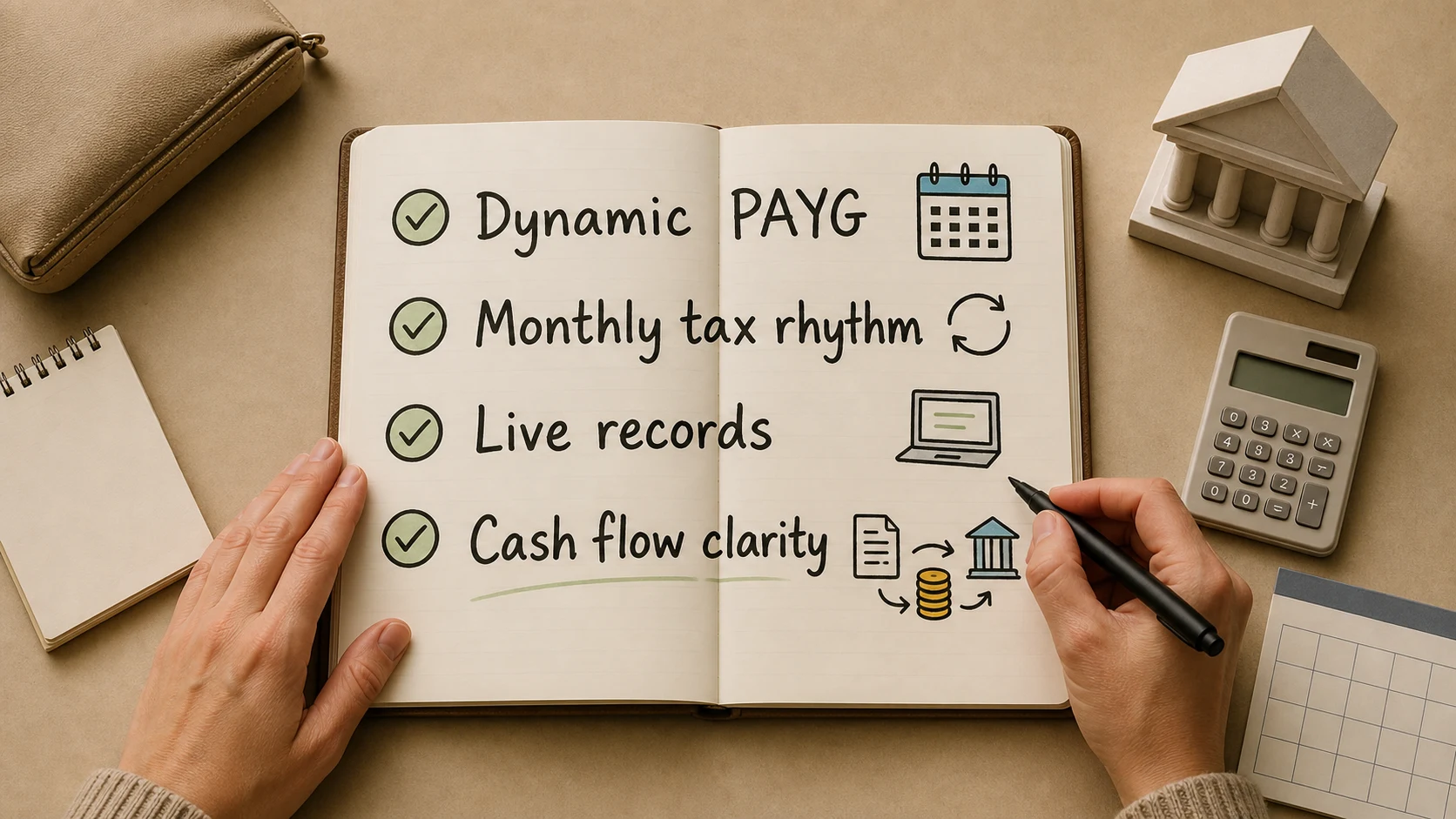
The 2026-27 Federal Budget included a small-business tax change that deserves more attention: from 1 July 2027, small and medium businesses are expected to be able to opt in to monthly PAYG instalments, with expanded access to dynamic calculations supported by business software.
In plain English, the tax office is moving towards PAYG instalments that can better reflect current business activity instead of relying so heavily on last year’s numbers. For small businesses with seasonal income, uneven project work or fast growth, that could make tax cash flow easier to plan.
Dynamic PAYG instalments are not a tax cut. They are a better-timed tax planning workflow, and they only work well if the bookkeeping behind them is current.
Quick Answer
Dynamic PAYG instalments are an Australian tax administration change announced in the 2026-27 Federal Budget. The Australian Government says businesses will be able to opt in to monthly PAYG instalments from 1 July 2027, and that the ATO’s dynamic instalments pilot will be expanded so business software can help calculate PAYG instalments more accurately.
This is an Australia-specific PAYG measure, not a global rule. The broader idea is global: tax systems are moving closer to live digital records, software-assisted calculations and more frequent reporting. For business owners, the practical message is simple. Keep invoices, bills, bank transactions and tax records up to date monthly, because stale bookkeeping makes dynamic tax calculations less useful.
Key Points
- Monthly PAYG instalments are expected to be opt-in for small and medium businesses from 1 July 2027.
- Dynamic instalments aim to align PAYG payments more closely with current business conditions.
- The change is most useful for businesses with variable, seasonal or fast-changing income.
- Good software records will matter more, because the calculation depends on timely business data.
- PAYG instalments remain prepayments of income tax, not an extra tax and not a discount.
What Changed in the 2026-27 Budget?
The Australian Government’s Budget 2026-27 business summary says businesses will be able to opt in to monthly PAYG instalments from 1 July 2027. It also says the ATO’s dynamic instalments pilot is being expanded, using business software to more accurately calculate PAYG instalments when conditions change.
That matters because the current PAYG instalment system can feel blunt. The Australian Government’s PAYG instalments guide explains that PAYG instalments are usually quarterly payments that help businesses avoid a large income tax bill after lodging their annual return. You may pay an amount calculated by the ATO, or calculate a payment using an instalment rate.
For a stable business, that can work well. For a business with lumpy revenue, one-off projects, seasonal sales or a sharp slowdown, the instalment can drift away from what is happening now.
Why Dynamic PAYG Matters for Cash Flow
PAYG instalments are meant to stop income tax becoming a once-a-year surprise. The problem is timing. If instalments are too high, cash is tied up before the business really has spare cash. If they are too low, the business may face a larger final tax bill after lodging the return.
Dynamic instalments are designed to make that timing problem smaller. Instead of waiting for tax time or manually varying a quarterly instalment, an approved software-based calculation could help the business adjust more regularly.
That could be valuable for:
- builders, consultants and agencies with project-based revenue
- retailers and hospitality businesses with seasonal peaks
- sole traders whose income changes quickly from quarter to quarter
- growing companies whose tax position moves faster than last year’s return
- accountants and BAS agents managing clients who regularly vary instalments
The point is not to pay less tax. The point is to make the tax rhythm match the business rhythm more closely.
Current PAYG vs Dynamic Monthly PAYG
| Area | Current PAYG instalment habit | Dynamic monthly PAYG direction |
|---|---|---|
| Timing | Usually quarterly for many small businesses | Monthly opt-in expected from 1 July 2027 |
| Calculation | Often based on ATO-calculated amounts or rates | Dynamic calculation supported by business software |
| Data quality needed | Quarterly records may be enough for basic review | Monthly records need to be clean and current |
| Best fit | Stable income and predictable margins | Seasonal, project-based or fast-changing income |
| Main risk | Overpaying or underpaying until the next review | Trusting software output without reviewing the records |
What Business Owners Should Do Before 1 July 2027
There is no need to rush into a new process today. There is, however, a clear opportunity to prepare the business records that would make monthly PAYG useful later.
Build a Monthly Close Habit
Dynamic PAYG depends on reliable numbers. If invoices are late, supplier bills are missing, bank transactions are unreconciled or GST coding is messy, the calculation may give a false sense of accuracy.
A simple monthly close for a small business might include:
- Send invoices and record customer payments.
- Enter supplier bills, subscriptions and payroll-related costs.
- Reconcile bank and credit card transactions.
- Check GST, VAT or sales tax codes before reporting periods close.
- Review profit, cash balance, unpaid invoices and unpaid bills.
- Flag unusual income or expenses for your accountant.
This is not just tax compliance. It is the foundation for better cash-flow decisions.
Keep PAYG Separate From Ordinary Expenses
A PAYG instalment is a prepayment towards expected income tax. It should not be treated like rent, software, wages or supplier purchases.
In bookkeeping terms, the payment often needs to be tracked separately so your accountant can match instalments paid during the year against the final tax position. Gimbla’s PAYG instalment posting guide walks through that accounting treatment for companies, trusts and sole traders.
Model Monthly Tax Cash Flow Early
Even before the 2027 start date, you can model what monthly PAYG would feel like.
Take your last four quarterly PAYG instalments, divide them into monthly amounts and compare that to your actual monthly cash balance. Then ask:
- Would smaller monthly tax payments reduce quarter-end pressure?
- Would monthly payments create too much admin for the business?
- Does revenue arrive evenly enough to support monthly instalments?
- Would a separate tax bank account make the cash flow clearer?
- Which month usually creates the biggest tax squeeze?
The answer may be different for a cafe, a construction business, a consultant and an online retailer.
What Accountants and Bookkeepers Should Watch
For accountants and bookkeepers, this is not just a compliance date. It is a client segmentation exercise.
Some clients will be excellent candidates for monthly PAYG because their revenue changes quickly and their books are already current. Others may need bookkeeping cleanup first. Some stable clients may not benefit much from changing the rhythm at all.
A practical review list:
- Which clients often vary PAYG instalments manually?
- Which clients complain about quarterly cash-flow shocks?
- Which clients have seasonal income or project-based revenue?
- Which clients reconcile monthly without prompting?
- Which clients need better coding before software-led calculations are reliable?
The advisory opportunity is not simply “opt in or do not opt in”. It is helping clients understand whether their records are good enough for a more real-time tax workflow.
Australia-Specific Rule, Global Direction
Dynamic PAYG instalments are specific to Australian income tax administration. The dates, ATO systems, BAS interaction and PAYG terminology belong to Australia.
The underlying concept is broader. Around the world, tax authorities are using software, digital records, e-invoicing, bank data and more frequent reporting to reduce the gap between business activity and tax reporting. That does not mean every country has the same obligations. It does mean small businesses should expect accounting records to become more live, structured and connected over time.
For Australian businesses, the immediate lesson is practical: the better your monthly bookkeeping, the more useful these software-led tax settings become.
How Gimbla Helps With a Software-Ready PAYG Workflow
Dynamic PAYG will only be as good as the accounting records behind it. Gimbla helps small businesses keep those records visible throughout the month, not just at BAS time.
Useful workflows include:
- creating invoices promptly and tracking whether they have been paid
- recording bills and expenses before the month is stale
- using bank feeds or uploaded statements to keep transactions current
- reviewing activity statement amounts through BAS lodgment
- posting PAYG instalments separately from ordinary expenses
- checking profit, cash position, unpaid invoices and unpaid bills before making tax decisions
If your PAYG instalment appears on a BAS or IAS, the guide to BAS and IAS types can also help you identify what the ATO is asking you to report.
Common Mistakes to Avoid
Treating Dynamic PAYG as a Tax Saving
Dynamic PAYG changes timing, not the final income tax calculation. The annual tax return still reconciles the business’s actual tax position.
Waiting Until BAS Time to Fix the Books
If monthly instalments rely on live business data, monthly bookkeeping becomes the control point. A rushed quarterly cleanup will be too late to support a reliable monthly calculation.
Confusing PAYG Instalments With PAYG Withholding
PAYG instalments are prepayments towards your own expected income tax. PAYG withholding is tax you withhold from payments to employees or other payees. They may both appear around activity statements, but they are not the same obligation.
Varying Without Evidence
Even with better software, business owners should keep evidence for tax decisions. If revenue has dropped, costs have changed or margins have shifted, keep the reports and notes that explain why an instalment position was reasonable.
Frequently Asked Questions
Are dynamic PAYG instalments available now?
No. The 2026-27 Budget announced expanded access from 1 July 2027, subject to the final ATO design and implementation details. Use the lead time to improve monthly bookkeeping, reporting and cash-flow routines.
Will monthly PAYG instalments reduce the total tax a business pays?
No. PAYG instalments are prepayments towards expected income tax. Monthly or dynamic calculations may change timing and cash-flow visibility, but not the final tax worked out in the income tax return.
Should every small business opt in to monthly PAYG instalments?
Not necessarily. Monthly instalments may suit businesses with seasonal or fast-changing income, but every business should compare the admin, cash-flow effect and software readiness with its accountant or tax agent.
Conclusion
Dynamic PAYG instalments are part of a bigger shift towards software-led tax administration. For small businesses, the opportunity is not just a new payment schedule from 2027. It is a reason to make monthly bookkeeping more reliable now.
If your records are current, tax planning becomes less reactive. You can see profit, cash, unpaid invoices and expected tax earlier, which gives you more time to act before a BAS, instalment notice or tax bill arrives.