- Overview
- Quick answer
- Key points
- Quarterly BAS due dates for 2026–27
- Monthly BAS lodgement dates
- What about an annual BAS?
- Lodgement and payment share the due date
- Simple example
- A practical BAS calendar workflow
- Lodging a BAS with Gimbla
- If you may miss the due date
- Frequently asked questions
- Final thought
BAS Due Dates 2026–27: Monthly and Quarterly Lodgement Calendar
Published August 9th, 2026 | Team Gimbla

Australian BAS due dates depend on the reporting cycle shown on your activity statement. A monthly BAS is generally due on the 21st day of the following month. Standard quarterly dates follow the familiar 28 October, 28 February, 28 April and 28 July pattern. Eligible online lodgers and registered agents can receive later dates for some quarters, but not for quarter 2.
For the 2026–27 year, start with the calendar below, then confirm the date displayed in ATO online services or on the generated statement. That final check matters because concessions, weekends, public holidays and the mix of obligations on a statement can change the effective deadline.
Use the standard BAS calendar to plan your bookkeeping, but use the due date on the issued activity statement to decide when to lodge and pay.
Quick answer
First, identify whether the business reports GST monthly, quarterly or annually. Then check the due date attached to the issued statement. The Australian Taxation Office’s BAS due-date guidance says the displayed date applies to both lodgement and payment.
Do not add an online or agent extension to the standard date automatically. Eligible electronic concessions should appear after the statement generates, and the quarter 2 due date already includes extra time. If a date falls on a weekend or public holiday, the next-business-day rule applies.
Key points
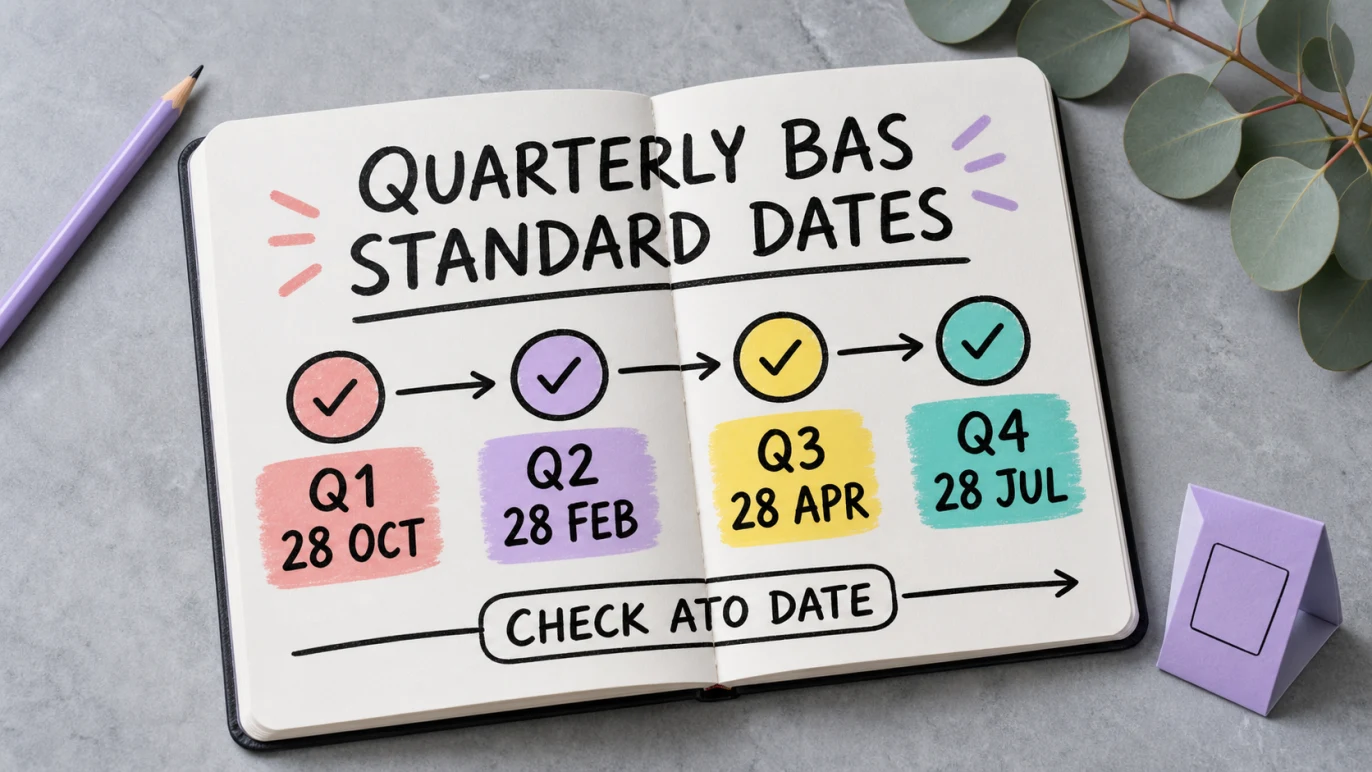
- Standard quarterly BAS dates fall on 28 October, 28 February, 28 April and 28 July.
- Eligible businesses that receive and lodge quarterly statements online can get two extra weeks for quarters 1, 3 and 4.
- Registered BAS or tax agents have a separate lodgement program for eligible clients; its dates are not the same as the self-lodger concession.
- Monthly BAS returns are generally due on the 21st of the following month and do not receive the standard quarterly concession.
- The date shown on the issued activity statement is the safest date to put in the business calendar.
Quarterly BAS due dates for 2026–27
The table separates the original due date from the two common electronic-lodgement paths. An online self-lodger and a client of a registered agent should not assume they share the same extension.
| Quarter and period | Original due date | Eligible online self-lodger | Eligible registered-agent client |
|---|---|---|---|
| Q1: July–September 2026 | 28 October 2026 | 11 November 2026 | 25 November 2026 |
| Q2: October–December 2026 | 28 February 2027* | No extra concession | No extra concession |
| Q3: January–March 2027 | 28 April 2027 | 12 May 2027 | 26 May 2027 |
| Q4: April–June 2027 | 28 July 2027 | 11 August 2027 | 25 August 2027** |
* The original quarter 2 date is a Sunday in 2027, so the ATO’s next-business-day rule applies. Check the displayed date and relevant public holidays rather than assuming a date from this calendar alone.
** The ATO’s current BAS agent lodgment program for 2026–27 lists the quarter 4 concession as 25 August 2027 and says it is to be confirmed when the 2027–28 program is developed.
The online self-lodger dates come from the ATO’s two-week concession terms. The concession applies only when the statement and business meet the conditions. If eligible, the updated date should appear online; no application is required.
Monthly BAS lodgement dates
The general monthly rule is simpler: lodge and pay by the 21st day of the month after the taxable period. The calendar dates for the 2026–27 financial year are below.
| Monthly BAS period | Standard calendar date | Weekend note |
|---|---|---|
| July 2026 | 21 August 2026 | Friday |
| August 2026 | 21 September 2026 | Monday |
| September 2026 | 21 October 2026 | Wednesday |
| October 2026 | 21 November 2026 | Saturday — next-business-day rule |
| November 2026 | 21 December 2026 | Monday |
| December 2026 | 21 January 2027 | Thursday |
| January 2027 | 21 February 2027 | Sunday — next-business-day rule |
| February 2027 | 21 March 2027 | Sunday — next-business-day rule |
| March 2027 | 21 April 2027 | Wednesday |
| April 2027 | 21 May 2027 | Friday |
| May 2027 | 21 June 2027 | Monday |
| June 2027 | 21 July 2027 | Wednesday |
Standard monthly statements do not receive the quarterly two-week concession. One narrow exception applies to an eligible December statement lodged electronically through a registered agent: the agent program can move that date to 21 February for a business client with turnover up to $10 million that reports GST monthly. Deferred-GST businesses are not eligible. Schools and associated bodies have a separate December rule, so they should check their generated statement rather than relying on the agent exception.
What about an annual BAS?
The ATO calls this an annual GST return. It is available only to eligible businesses that are voluntarily registered for GST and have turnover below the registration threshold—generally $75,000, or $150,000 for a not-for-profit body.
The ATO’s current guidance gives 31 October as the annual date. If the business is not required to lodge an income tax return, the annual GST return is due on 28 February after the annual tax period. Registered-agent dates can differ. Both calendar dates fall on weekends for the 2025–26 annual period, so the next-business-day rule and the date shown on the return matter.
Annual GST reporting does not automatically turn every other obligation into an annual one. A business with PAYG withholding or another activity-statement obligation may still receive monthly or quarterly statements for those amounts.
Lodgement and payment share the due date
For a normal BAS, the date is not merely a filing reminder. It is also the date by which any amount shown as payable is due. A payment arrangement may help with cash flow, but it does not silently replace the lodgement obligation.
This is why BAS planning belongs in both the bookkeeping calendar and the cash-flow forecast. Aim to finish the records early enough to review the statement and know whether the business needs to fund a payment.
Simple example
Mia’s design studio reports GST quarterly and lodges its own statements through ATO online services. For the July–September 2026 quarter, the original BAS date is 28 October. After the statement generates, the ATO account shows that the business is eligible for the online concession and displays 11 November.
Mia puts the displayed date in the calendar, then schedules bank reconciliation and GST-code review two weeks earlier. If the studio instead used a registered BAS agent and met the agent-program conditions, the relevant date could be 25 November. Mia does not add the agent concession to the online date or assume either concession before it appears.
A practical BAS calendar workflow
- Check the reporting cycle and statement type in ATO online services. A BAS and an IAS are not always the same, and the labels can affect the due date.
- Record the displayed lodgement and payment date, not merely the generic calendar date.
- Schedule transaction entry, bank reconciliation, payroll checks and GST review before the deadline.
- Compare the statement with the Business Activity Statement records and investigate unusual figures.
- Lodge through the authorised channel and arrange payment using the correct ATO payment reference number.
- Save the submission receipt and record the payment or refund against the correct tax accounts.
Lodging a BAS with Gimbla
Gimbla can keep the BAS preparation and lodgement path close to the records that produced the figures. Once invoices, bills, payroll and bank transactions are current, the BAS report can populate supported statement fields. Linked amounts can be reviewed against their transaction detail before submission through the supported SBR workflow.
For a visual walkthrough, watch How to Lodge Your BAS Online Directly to the ATO with Gimbla. The video shows the software-ID setup, outstanding activity statements, prefilled figures, review, submission and payment details. The Gimbla BAS lodgement page covers the product workflow, while the SBR-enabled BAS announcement explains how prefill and transaction drill-down fit together.
Gimbla provides software, not tax or BAS agent services. The business remains responsible for checking its records, confirming the issued statement and lodging and paying by the applicable date. Ask a registered tax agent or BAS agent when a reporting cycle, concession or tax treatment is unclear.
If you may miss the due date
Do not assume that a late statement receives an automatic extension. The ATO says to make contact as soon as possible, preferably before the deadline. Its guidance for businesses having difficulty lodging or paying says that lodging on time keeps the account information current, while unpaid amounts can attract general interest charge.
If payment is the problem, a payment plan may be available. Keep the two tasks separate: lodge the statement when possible, then address the amount due with the ATO or a registered adviser. Exceptional or unforeseen circumstances may support a deferral request, but approval and eligibility should be checked rather than assumed.
Frequently asked questions
What are the quarterly BAS due dates for 2026–27?
The standard dates are 28 October 2026 for quarter 1, 28 February 2027 for quarter 2, 28 April 2027 for quarter 3 and 28 July 2027 for quarter 4. Weekend and public-holiday rules can move the effective date.
Do registered BAS agents get different due dates?
Eligible electronic lodgements through a registered agent have 2026–27 concession dates of 25 November for quarter 1 and 26 May for quarter 3. Quarter 2 has no extra concession. The listed quarter 4 agent date is 25 August 2027, subject to confirmation in the next agent program.
When is a monthly BAS due?
A monthly BAS is generally due on the 21st day of the month after the taxable period. Standard monthly statements do not receive the quarterly online concession, although a limited December concession can apply to eligible registered-agent clients.
What happens if a BAS due date falls on a weekend or public holiday?
The ATO says you have until the next business day to lodge and pay when the due date falls on a weekend or public holiday. Check the date shown on the generated activity statement before relying on a calendar.
Final thought
A useful BAS calendar has two layers: the standard monthly or quarterly pattern, and the date attached to the actual statement. Plan the bookkeeping and cash flow from the standard dates, then replace the reminder with the ATO-displayed deadline as soon as the statement generates.
That habit prevents a common mistake—using a concession that belongs to a different lodgement channel—and gives the business time to review the records before both lodgement and payment fall due.
Disclaimer: This article provides general information and does not constitute tax or BAS agent advice. Due dates and concessions depend on the statement, reporting cycle, lodgement channel and eligibility. Check the current ATO record or speak with a registered tax agent or BAS agent.